The Vest in the Gravel
The biker yard was never quiet.
Engines roared like thunder trapped in metal.
Boots scraped over gravel.
Tools clanged near open garage doors.
Men laughed too loudly over coffee, old grudges, and stories that had grown larger every time they were told.
The Iron Saints clubhouse sat at the edge of a dusty road outside Millstone, behind a chain-link fence and a rusted sign that read:
Respect the Road. Respect the Lost.
Most people in town crossed the street when they saw the Saints roll in.
They saw leather, scars, tattoos, motorcycles, and old men who looked like they had survived too many storms to care what anyone thought of them.
They did not see the toy drives.
The hospital rides.
The veteran funerals.
The late-night roadside rescues.
The way those men showed up when someone had no one left.
At the center of the yard stood Harlan Boone.
Everyone called him Grave.
Not because he was cruel.
Because he remembered the dead.
Every lost brother.
Every roadside cross.
Every name stitched into the memorial wall inside the clubhouse.
No one interrupted Grave when he was speaking.
No one walked straight into his yard without being noticed.
Until the little girl did.
She appeared at the open gate like she had been running for miles.
Small.
Barefoot.
Breathless.
Her faded green dress was dirty at the hem. Her hair stuck to her face. Both arms were wrapped around something far too large for her tiny body to carry.
A leather vest.
Old.
Heavy.
Covered in dust.
At first, no one took her seriously.
Why would they?
A child had wandered into a biker yard clutching leather like a blanket.
One man near the repair bay chuckled.
“Look at that. Little thing brought us laundry.”
Another laughed.
The girl flinched.
Not from fear.
From anger.
The vest slipped from her arms and fell onto the gravel.
A few men laughed harder.
But she didn’t.
She dropped to her knees, grabbed it quickly, and brushed the dirt off with both hands as if it were the most precious thing in the world.
That made Grave look up.
He had been standing near his black motorcycle, wiping oil from his hands with a rag. He watched the girl cross the yard toward him, every step uneven, every breath short.
The laughter faded a little.
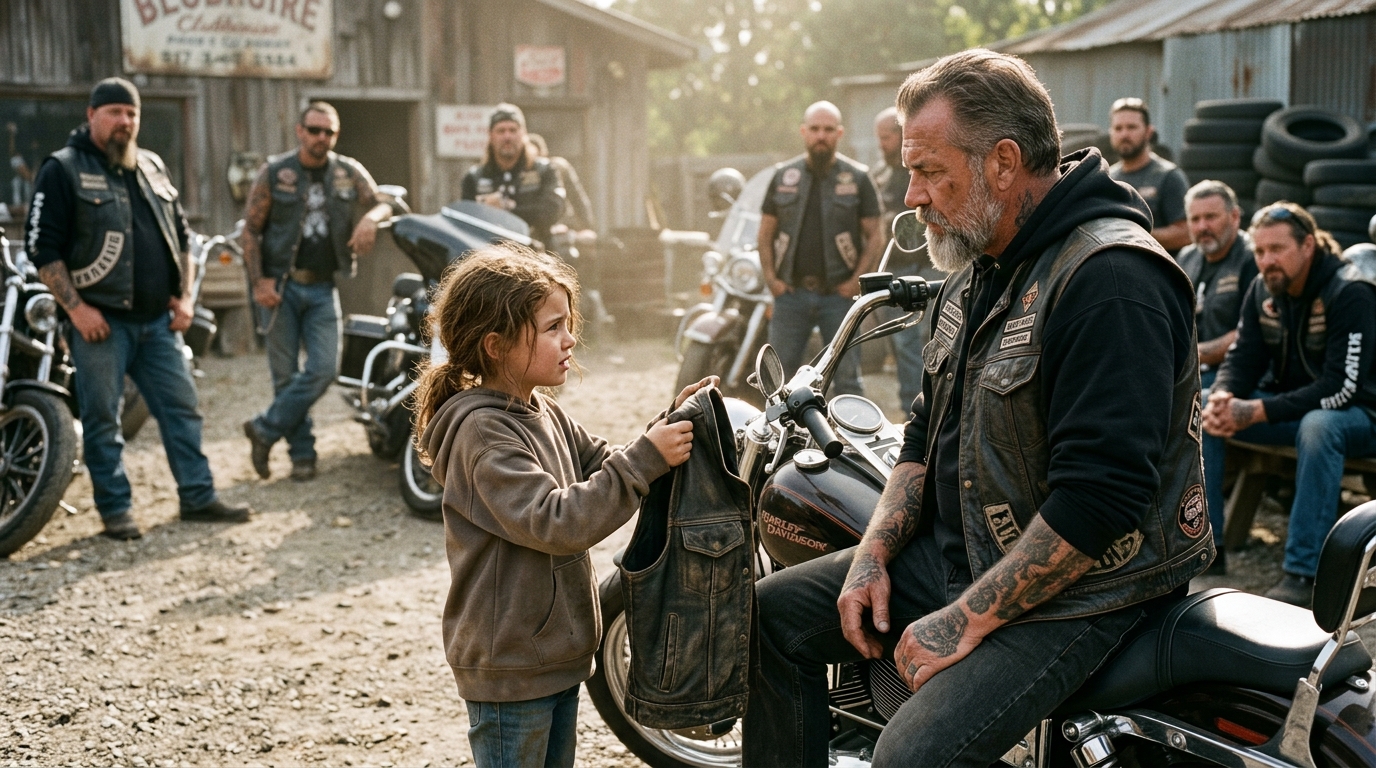
The girl stopped in front of him and lifted the vest.
“Please, sir,” she whispered. “Please buy it.”
Her voice was soft.
Too soft for that yard.
But something inside it made three men stop smiling.
Grave looked down at her.
Then at the vest.
“What is this, kid?”
“It’s real,” she said. “My daddy wore it.”
Now she had their attention.
A few bikers leaned in.
Grave took the vest carefully.
The leather was cracked from age and weather. The front patch had been ripped partly away, but the back still carried the faded winged skull of the Iron Saints.
Grave turned it over.
His fingers froze on the stitching near the left shoulder.
Not the club patch.
Something smaller.
A black thread mark hidden beneath the seam.
A crooked cross.
Only five vests had ever carried that mark.
Original road captains.
Men who built the club before it became a name people whispered.
Men who swore never to abandon another brother on the road.
Grave’s face changed.
No one spoke.
“Why are you selling it?” he asked.
The girl swallowed.
“My daddy…” Her voice cracked. “He won’t wake up.”
The last laughter in the yard disappeared.
Gone.
Grave crouched slowly so he was eye level with her.
“Where did you get this?”
She looked straight at him.
“My daddy said you would know.”
His expression tightened.
“What’s your father’s name?”
The girl hugged the vest tighter.
For one heartbeat, she seemed too afraid to say it.
Then she whispered:
“Elias Boone.”
The entire yard froze.
One biker stepped back.
Another shook his head slowly.
“No,” someone muttered. “That’s not possible.”
Grave did not move.
Did not blink.
His hands tightened around the vest.
Because Elias Boone was not just familiar.
Elias Boone was his younger brother.
And Elias Boone had been buried nine years ago.
The Name on the Memorial Wall
Inside the clubhouse, Elias Boone’s name was carved into dark oak.
Third row.
Seventh name.
ELIAS “SAINT” BOONE
Brother. Road Captain. Gone but never left behind.
Grave had carved the letters himself.
His hands had shaken so badly the first time that he had to sand the board down and start again.
Nine years earlier, Elias had disappeared after a warehouse fire near the river road. The fire burned so hot that the building collapsed before rescue crews could enter.
They found a body.
They found a burned motorcycle frame.
They found a belt buckle.
They found enough for officials to say the words nobody wanted to hear.
Positive identification.
The club buried Elias with full colors.
Hundreds of bikes followed the hearse. Grave rode first, alone, with his brother’s helmet tied to the back of his seat.
He did not cry at the funeral.
Not where anyone could see.
But for nine years, every time he passed the memorial wall, his eyes stopped on that name.
Now a barefoot girl stood in his yard with Elias’s vest.
And said her father would not wake up.
Grave’s voice came out low.
“What’s your name?”
“Maddie.”
“How old are you?”
“Eight.”
Eight.
Grave felt the number hit him.
If Elias had lived, if the timeline made any kind of impossible sense, this child could be his.
The men around them were silent now.
Dust moved across the yard in thin sheets.
Engines idled.
Nobody revved.
Nobody joked.
Grave looked at the vest again.
There was a tear near the inside seam.
He slipped two fingers beneath it and found something folded into the lining.
A photograph.
Old.
Creased.
Protected by plastic.
He pulled it out.
The yard seemed to tilt.
The picture showed Elias Boone, older than Grave remembered from the funeral photo, standing beside a woman with dark hair. In her arms was a baby wrapped in a yellow blanket.
On the back, written in Elias’s rough handwriting, were four words:
Tell Grave I lived.
Grave stood so fast Maddie stepped back.
“Where is he?” he asked.
Maddie pointed down the road.
“Not far.”
No one questioned her now.
No one asked if this was a trick.
No one laughed.
Grave grabbed his keys from the workbench.
“Diesel. Rook. Angel. With me.”
Three men moved at once.
Engines roared to life.
Maddie climbed onto the back of Grave’s bike, still clutching the vest against her chest. He handed her his spare helmet. It was too large, but she held it steady with both hands.
Before they pulled out, she leaned close and whispered, “He said don’t call the police yet.”
Grave turned slightly.
“Why?”
Her voice shook.
“Because the man who buried him still comes at night.”
The House Beyond the Gravel Road
They followed Maddie past the edge of town.
Past the gas station.
Past the boarded church.
Past the last row of mailboxes where the pavement gave way to dirt.
The farther they rode, the quieter the men became.
The road narrowed between trees. Branches scraped against shoulders. The air smelled of wet leaves, old mud, and something metallic after the previous night’s storm.
Maddie tapped Grave’s arm and pointed to a broken fence.
“There.”
Behind the fence stood a small house half-hidden by weeds.
Not abandoned.
Not lived in properly either.
The porch sagged. One window was covered with cardboard. A sheet hung where a front curtain should have been. Beside the steps was a plastic bucket filled with rainwater and empty cans.
Grave cut the engine.
The sudden silence felt wrong.
Maddie jumped down and ran toward the house.
Grave caught her before she reached the door.
“Slow.”
“He needs help.”
“I know. But we go careful.”
She looked furious for a second.
Then scared.
“He said if I found you, you’d know what to do.”
Grave looked at the house.
Then at the men behind him.
He did know what to do.
He had done it in deserts, on highways, in hospital rooms, beside wrecked bikes at two in the morning.
Walk in calm.
Look first.
Trust nothing.
He pushed open the door.
The room inside was dim and hot.
A single lamp burned near the wall. The air smelled of medicine, old sweat, and canned soup.
On a narrow mattress near the back window lay a man.
Thin.
Bearded.
Face hollow.
But even before the man opened his eyes, Grave knew.
The shape of the jaw.
The scar through the left eyebrow.
The old burn mark across one hand.
Elias.
Alive.
Grave stopped in the doorway.
For nine years, he had carried his brother as a ghost.
Now the ghost was breathing.
Maddie rushed to the mattress.
“Daddy, I found him.”
The man’s eyes opened slowly.
Clouded with fever.
Confused.
Then they found Grave.
For one impossible second, neither brother spoke.
Then Elias smiled faintly.
“About time.”
Grave crossed the room and dropped to his knees beside him.
“You’re dead,” he whispered.
Elias coughed.
“Been meaning to correct that.”
Grave grabbed his hand.
It was hot.
Too hot.
“What happened to you?”
Elias tried to answer, but the cough took him again. Maddie reached for a cup of water and held it to his lips with the careful hands of a child who had done too much caregiving too young.
Rook moved through the room, checking windows.
Diesel found medicine bottles on the table.
Angel, who had been a medic in the Army before he ever wore a biker patch, knelt beside Elias.
“He needs a hospital,” Angel said.
Elias gripped Grave’s wrist.
“No local hospital.”
“Eli—”
“No.” His voice sharpened with old strength. “He owns the intake nurse. Owns a deputy too.”
“Who?”
Elias looked past him.
Toward the vest in Maddie’s arms.
“The man who said he found my body.”
Grave’s jaw tightened.
There had been only one man who handled the identification after the fire.
Victor Hale.
Former Iron Saint.
Treasurer.
Friend.
The man who stood beside Grave at Elias’s funeral.
The man who cried with one hand on the coffin.
The man whose name was still on the club’s account ledgers.
Diesel whispered, “No.”
Elias closed his eyes.
“He didn’t just bury me, brother.”
His hand tightened around Grave’s.
“He buried what I found.”
The Brother Who Never Died
They did not take Elias to the county hospital.
They took him to Angel’s clinic.
It was small, private, and two towns over, run by a doctor who owed the Iron Saints his son’s life after a roadside accident years earlier.
Maddie refused to let go of the vest.
Not in the truck.
Not in the clinic.
Not while Angel started fluids and treated the fever.
Grave sat beside Elias’s bed, one hand resting on the rail, afraid that if he looked away too long, his brother might vanish back into the grave the world had given him.
It took hours before Elias could speak clearly.
When he did, the story came out in pieces.
Nine years earlier, Elias had discovered that money raised through the Iron Saints’ charity rides had not all gone to families, hospitals, and veterans’ funds.
Someone was skimming from the accounts.
Not small amounts.
Enough to matter.
Enough to ruin the club if it became public.
Elias traced it to shell accounts connected to Victor Hale.
But Victor had not been working alone.
He was laundering money for men outside the club—contractors, local officials, and a private security company using charity fronts to move cash.
Elias planned to bring the proof to Grave.
He never made it.
“The warehouse fire?” Grave asked.
“Set.”
The room went cold.
Elias nodded weakly.
“Victor called me there. Said he wanted to explain. When I arrived, the place was already burning. Two men jumped me. I got out through the back before the roof came down.”
“Then whose body did they bury?”
Elias looked away.
“A man from the security crew. Already dead when they brought him in.”
Grave’s stomach turned.
“They put your buckle on him.”
“And my ring.”
“And the dental record?”
Elias’s mouth tightened.
“Paid dentist.”
Diesel swore under his breath.
Elias continued.
“I tried to come back. Victor had men watching the clubhouse, watching you, watching every road in. Then he found me once.” He lifted his sleeve.
Old scars crossed his forearm.
Maddie looked down.
She had seen them before.
Too many times.
“Her mother saved me,” Elias said.
“Who was she?”
“Lena. Nurse at a roadside clinic. She hid me. Helped me heal. We were supposed to leave together after Maddie was born.”
His voice broke.
Grave understood before he said the rest.
“Victor found her?”
Elias nodded.
“Not at first. Years later. She got sick. We needed medicine. Had to come closer to town. He saw her at the pharmacy.”
“What happened?”
Elias closed his eyes.
“She died last winter.”
Maddie climbed onto the chair beside the bed and pressed the vest to her chest.
Grave looked at the child.
Eight years old.
Barefoot in his yard.
Selling the only thing left of her father because he would not wake up.
“And the proof?” Grave asked.
Elias opened his eyes.
“In the vest.”
Grave turned toward Maddie.
She looked confused.
“The vest?”
Elias gave a faint smile.
“Your mama sewed better than I did.”
Grave took the vest gently and turned it inside out.
The lining near the back patch had been repaired with darker thread.
Not random.
A hidden seam.
Angel brought scissors.
Inside was a flat oilcloth packet.
Grave unfolded it.
Bank records.
Names.
Transfer receipts.
Photographs.
Signed statements.
A list of shell companies.
And at the top, one handwritten page.
If I do not make it back, Victor Hale killed the truth before he buried me.
Grave looked at his brother.
Elias whispered, “He’ll come when he knows Maddie reached you.”
“How would he know?”
Elias looked at the clinic window.
“Because someone in your yard still reports to him.”
The Traitor at the Clubhouse
Grave returned to the Iron Saints yard before sunrise.
He did not bring Maddie.
He did not bring Elias.
He brought the vest.
And the packet.
The yard was quieter than usual when he arrived. Men stood in small groups, pretending not to watch him. News had already spread that the dead man might be alive.
Nothing travels faster than impossible hope.
Victor Hale was waiting near the clubhouse door.
He was older now, gray at the temples, still wearing his vest, still carrying himself like a man who believed he belonged in every room he entered.
He looked at the vest under Grave’s arm.
Then at his face.
“You found something,” Victor said.
Grave stopped a few feet away.
“I found my brother.”
A murmur went through the yard.
Victor did not flinch.
That was the first thing Grave noticed.
A shocked man would have asked where.
A guilty man measured distance.
“Elias is dead,” Victor said.
“No.”
Victor’s jaw tightened.
“We buried him.”
“We buried a lie.”
The men around them shifted.
Rook closed the gate.
Diesel stood near the garage.
Angel appeared from behind the clubhouse with two more old members, men who had ridden with Elias before Maddie was born.
Victor noticed.
His eyes moved from face to face.
“You all need to be careful,” he said. “Grief can make men stupid.”
Grave opened the packet and held up the first record.
“Charity ride account. Missing funds. Your signature.”
Victor sighed.
“Accounting mistakes.”
Second record.
“Shell account. Your brother-in-law’s company.”
Victor’s mouth flattened.
Third.
“Payment to the dentist who falsified the body identification.”
The yard went dead silent.
Victor’s face changed.
Just once.
A crack.
Then the mask returned.
“You don’t understand what Elias found.”
Grave stepped closer.
“Then explain.”
Victor looked around at the men.
And for one strange second, he seemed almost sad.
“That club was dying back then. Bills unpaid. Lawsuits coming. You think toy drives paid for this yard? You think hospital rides kept the lights on?”
Grave’s voice was low.
“You stole from sick kids.”
“I kept us alive.”
“No,” Diesel said from the side. “You kept yourself rich.”
Victor turned on him.
“You have no idea what I carried.”
Grave pulled out the photograph from the vest.
Elias.
Lena.
Baby Maddie.
“You carried my brother’s coffin while he was breathing somewhere alone.”
Victor’s face hardened.
“He should have stayed gone.”
That sentence ended him.
Everyone heard it.
Rook pulled his phone from his pocket.
“Got it.”
Victor looked at him.
Then at the phone.
The red recording light was on.
For the first time, fear entered Victor Hale’s eyes.
He reached toward his jacket.
Grave moved faster.
So did Diesel.
Victor was on the gravel before the weapon cleared the pocket.
No one beat him.
No one needed to.
They held him there until state police arrived.
Not local deputies.
State police.
Grave had learned something from Elias’s warning.
Never hand a buried truth back to the people who helped dig the grave.
The Ride Home
Victor talked before trial.
Not because he felt remorse.
Because men like him think confession is just another negotiation.
He named the security company.
The contractors.
The deputy.
The dentist.
The man whose body had been placed in the warehouse.
The forged identification report.
The shell accounts.
The charity fraud.
The attempts to find and silence Elias.
The investigation reached further than the Iron Saints expected.
Town officials resigned.
Accounts were seized.
A judge recused himself, then came under investigation.
Several old charity cases were reopened.
The Iron Saints nearly collapsed under the shame.
Not because every man had known.
Most had not.
But ignorance does not feel clean when the stolen money passed through your own yard.
Grave called a meeting.
Every member attended.
Elias was still too weak to stand, but they brought him in a wheelchair, Maddie sitting beside him with her hands folded in her lap.
The room fell silent when they entered.
The memorial wall stood behind Grave.
Elias’s name was still carved there.
For a long time, nobody looked at it.
Then Grave took a knife and pried the wooden nameplate from the wall.
No one spoke.
He carried it to Elias.
His brother looked at it.
Then laughed weakly.
“You spelling my name wrong all these years?”
Grave’s eyes filled.
“Shut up.”
Elias took the plaque in both hands.
For nine years, it had told the club he was gone.
Now it meant something else.
Not death.
Memory.
Warning.
Maddie touched the carved letters.
“Can we keep it?” she asked.
Grave knelt in front of her.
“If your dad wants.”
Elias looked at the wall.
Then at the men who had buried him, mourned him, failed to find him, and now stood ashamed before his daughter.
“No,” he said.
He handed the plaque back to Grave.
“Put it somewhere else.”
“Where?”
Elias looked toward the clubhouse entrance.
“Above the door. So nobody forgets dead men can come back if the truth keeps breathing.”
They mounted it that afternoon.
Not on the memorial wall.
Above the clubhouse door.
Beneath it, Grave added a new line:
Never bury what you have not questioned.
Maddie moved into Grave’s house while Elias recovered.
At first, she slept with the vest folded beside her pillow.
Then on a chair.
Then in the closet.
Months later, she asked if they could hang it in the clubhouse.
Not as proof.
Not as evidence.
“As Daddy’s jacket,” she said.
So they did.
They cleaned it carefully, repaired the lining, and placed it in a glass case beside the road captains’ table.
Children from toy drives would sometimes stare at it and ask whose it was.
Grave always answered the same way.
“A man who was lost longer than he should have been.”
Elias recovered slowly.
Never fully.
Nine years of hiding and illness had taken parts of him no doctor could return.
But he learned to walk across the yard again.
First with a cane.
Then without one.
The first time he rode, the whole club gathered at the gate.
Maddie wore a helmet too big for her and grinned so wide Grave had to look away.
Elias climbed onto his rebuilt bike, hands trembling on the bars.
For a moment, he just sat there.
Then he looked at Grave.
“Lead?”
Grave shook his head.
“No.”
He stepped back.
“You were gone long enough. You lead.”
Elias swallowed hard.
The engines started one by one.
Low.
Deep.
Rolling like thunder over the gravel.
The Iron Saints rode out behind the man they had buried and the daughter who brought him home.
Through town.
Past the courthouse.
Past the warehouse ruins.
Past the cemetery where Elias’s old grave still stood.
They stopped there.
Maddie placed a flower on the empty grave.
Not because her father was dead.
Because a lie had been.
Elias stood beside her for a long time.
Then he looked at Grave.
“You cried at my funeral?”
“No.”
Maddie looked up.
“He’s lying.”
Elias smiled.
For the first time in years, Grave heard his brother laugh without pain in it.
The road back to the clubhouse was lined with people.
Some waved.
Some watched silently.
Some had once feared the Iron Saints and now understood that even men in leather could be betrayed, broken, and brave enough to clean their own house.
At sunset, Maddie stood in the yard where she had first dropped the vest onto the gravel.
This time, no one laughed.
She looked at the glass case inside the clubhouse.
Then at the men around her.
“You would have bought it?” she asked Grave.
“The vest?”
She nodded.
Grave crouched in front of her.
“I would’ve given you every dollar in my pocket.”
She considered that.
Then said, “Daddy said bikers don’t cry.”
Every man in the yard suddenly found something else to look at.
Grave smiled.
“Your daddy lies worse than I do.”
Maddie laughed.
Small.
Clear.
Real.
And the sound moved through the yard more powerfully than any engine.
Because nine years earlier, the Iron Saints had buried a brother.
But on the day a barefoot girl carried his vest through their gate, they learned something the road had been trying to teach them all along.
Some men are not gone just because a grave says so.
Some truths are not dead just because powerful people bury them.
And sometimes the smallest person in the yard is the only one brave enough to carry home what everyone else thought was lost.