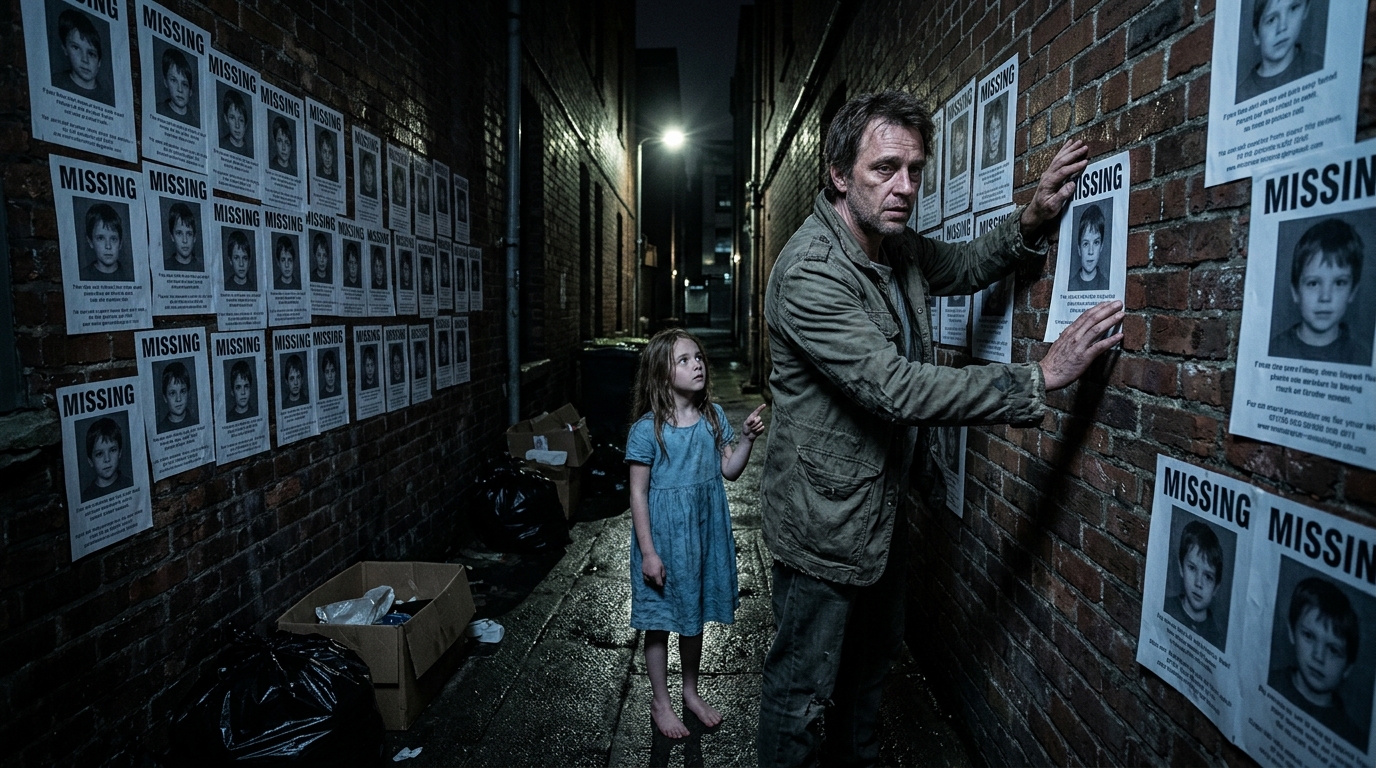
The Girl Beside the Missing Poster
I had plastered my son’s face across the city until every street began to look like a wall of grief.
Train stations.
Bus stops.
Gas stations.
Shelters.
Corner stores.
Abandoned buildings.
The same photograph followed me everywhere.
My boy in a green hoodie, smiling with one front tooth slightly crooked, his brown hair falling into his eyes because he hated haircuts.
NOAH BLAKE — MISSING.
Age seven.
Last seen outside Hartman’s Market.
Blue jacket.
Red sneakers.
May be frightened.
Please call.
By the twelfth night, the posters no longer looked like paper.
They looked like accusations.
Every one of them asked me the same question.
Where were you?
The answer was simple and unbearable.
I had turned away for nine seconds.
Nine seconds in a supermarket parking lot.
Long enough to load two grocery bags into the trunk.
Long enough for Noah to stand beside the cart, humming the little tune he hummed when he was tired.
Long enough for a woman in a gray coat to bend near him.
Long enough for my son to vanish.
Security footage showed almost nothing.
A blur.
A hand.
A car door.
But one detail had survived the grainy image.
A large red ring on the woman’s right hand.
For twelve days, I searched until my body stopped feeling like mine.
I barely slept. I forgot to eat. I walked alleys where the city’s light did not reach and asked questions people were too afraid or too tired to answer.
Most looked away.
Some shook their heads.
A few took the flyer.
No one knew anything.
Then, on the twelfth evening, as rain began to mist over the alley behind a closed laundromat, a little girl in a faded blue dress stopped beside me.
She had no shoes.
Her feet were dirty and scratched.
Her hair was tied with a strip of cloth. Her face was thin, but her eyes were steady in a way that made her look older than any child should.
She looked at the poster in my hand.
Then she said softly, “Sir… that boy lives in my house.”
My heart did not leap.
It stopped.
I turned so quickly the poster nearly tore in my grip.
“What did you say?”
She pointed at Noah’s face.
“That boy. He cries at night.”
The alley seemed to tilt.
My mouth went dry.
“What does he say?”
The girl looked confused by the question, as if the answer were obvious.
“He calls for his dad.”
My knees almost gave out.
Noah had a secret no stranger could guess.
When he had nightmares, he never called out for help.
Never called for his mother, who had died when he was three.
Never screamed.
He only cried one word.
Dad.
I crouched in front of the girl.
“What’s your name?”
“Mara.”
“Where is he?”
Her eyes flicked toward the far end of the alley.
Then back to me.
Fear crossed her face for the first time.
“He’s upstairs,” she whispered. “But you have to be quiet. The lady with the red ring comes back before dark.”
The poster in my hand crumpled.
Red ring.
The world narrowed to those two words.
“Mara,” I said carefully, “take me to him.”
She turned without answering and ran barefoot down the alley.
I followed.
Past peeling yellow paint.
Past shattered windows.
Past a stray dog sleeping beneath a rusted staircase.
Past dumpsters buzzing with flies and old rainwater.
At the end of the alley stood a decaying apartment building with boarded windows and a dark doorway that seemed too empty to hide anything alive.
Mara stopped at the entrance.
Her small hand gripped the broken doorframe.
“She says we’re not supposed to talk to men,” she whispered. “But he keeps crying.”
I stepped inside.
The hallway smelled of mold, dust, and something else.
Medicine.
Sharp.
Chemical.
Wrong.
Then, from somewhere above, thin and broken through the floorboards, came a little boy’s voice.
“Dad?”
The Room Above the Stairwell
I ran.
Mara grabbed my coat before I reached the stairs.
“Quiet,” she hissed.
It was a child’s whisper.
But it stopped me.
Because she was not being dramatic.
She was terrified.
I looked at her.
She pointed upward.
“Second floor. Last door. The lock sticks.”
“How many are inside?”
She swallowed.
“Four today.”
Today.
The word hit me hard.
Not four children.
Four today.
I moved slower then.
Every step on the staircase threatened to groan beneath my weight. The rail was sticky with old paint and grime. Somewhere inside the walls, water dripped steadily.
From above came another sound.
A cough.
Then a small whimper.
Then my son’s voice again, weaker this time.
“Dad?”
I reached the second-floor landing.
The last door had once been green, but most of the paint had peeled away. A chain hung across it from the outside, looped through a cheap metal bracket.
My hands shook so badly I struggled to lift it.
Mara stepped forward and showed me how.
She had done it before.
That knowledge hurt.
Inside, the room was dim and bare.
No bed.
No toys.
No curtains.
A mattress lay against one wall with a blanket so thin it looked like cloth from a hospital discard bin. A plastic basin sat near the corner. Beside it were paper cups and two medicine bottles without labels.
And on the mattress—
Noah.
For a second, I could not move.
My son was curled on his side, his face pale, his lips dry, his red sneakers gone. His blue jacket had been replaced by a gray sweatshirt too large for him. One wrist was tied loosely with a cloth strip, not tight enough to restrain him fully, just enough to remind him not to run.
“Noah.”
His eyes opened.
They were unfocused at first.
Then they found me.
“Dad?”
I crossed the room and dropped to my knees beside him.
He reached for me with both hands.
I pulled him into my arms.
He felt smaller.
That was the first thing I noticed.
Not just thinner.
Smaller.
As if fear had folded him inward.
“I came,” I whispered into his hair. “I came, buddy. I’m here.”
He began to cry.
No sound at first.
Only shaking.
Then a broken sob that tore through my chest.
“I waited,” he whispered. “I knew you’d see the posters.”
“I’m sorry.”
“I told them you’d come.”
“I’m sorry.”
It was all I could say.
Too little.
Too late.
Still true.
Behind us, three other children watched from near the wall.
A boy about nine.
A toddler with a shaved patch near her temple.
And a teenage girl with bruised eyes who held the toddler protectively against her chest.
Mara stood in the doorway.
She did not come in.
As if she had never been allowed to belong even in the room she called home.
I looked at the medicine bottles.
“What did they give him?”
The older girl answered.
“Sleep drops.”
Her voice was flat.
No drama.
Only experience.
“They put it in juice if someone cries too much.”
My stomach turned.
I reached for my phone.
No signal.
Of course.
The building was thick concrete and rot, but something else was interfering. There was a small black device plugged into the only outlet.
A jammer.
Cheap.
Illegal.
Effective.
“Mara,” I said. “Is there another way out?”
She nodded.
“Back stairs. But the lady locks the bottom door when she leaves.”
“When does she come back?”
Mara looked toward the broken window.
“The sky is almost dark.”
The older girl stood.
“She’ll know.”
“Know what?”
“That Mara left.”
Mara’s face tightened.
The toddler began to whimper.
Noah clung to my shirt.
“Dad,” he whispered, “she has my backpack.”
“Who?”
“The red-ring lady.”
The room went still.
Noah’s voice shook.
“She said if I behaved, she’d give it back before my new parents came.”
New parents.
The phrase landed like ice.
This was not one kidnapping.
Not a ransom.
Not revenge.
This was something organized.
Something that moved children like packages.
I untied the cloth around Noah’s wrist.
My hands were gentle.
My anger was not.
Then, from downstairs, a door opened.
Heavy.
Slow.
Mara went white.
“She’s early,” she whispered.
And from below, a woman’s voice floated up the stairwell.
“Mara?”
The Woman With the Red Ring
The children reacted before I did.
The older girl pulled the toddler behind the mattress. The nine-year-old boy backed into the corner and covered his mouth with both hands. Mara stepped inside quickly and shut the door without letting it latch.
Noah buried his face against my chest.
The voice came again.
Soft.
Almost kind.
“Mara, sweetheart. I told you not to wander.”
Footsteps on the stairs.
Slow.
Measured.
Not hurried.
Whoever she was, she did not think she had anything to fear.
I moved Noah behind me and looked around the room.
No weapon.
No real exit.
The window faced a drop into the alley.
The chain was outside the door.
The woman reached the landing.
Through the crack, I saw her first as a shape.
Gray coat.
Dark hair.
Leather gloves.
Then her hand touched the doorframe.
And there it was.
A large red ring.
Oval stone.
Gold setting.
The exact shape from the surveillance footage.
My body went cold.
She pushed the door open.
For half a second, she did not understand what she was seeing.
Then her eyes found me.
Recognition flashed.
Not of my face personally.
Of what I represented.
A father who had not stopped looking.
“Oh,” she said softly.
That was all.
No scream.
No panic.
Just mild disappointment, as if she had found a stain on a white tablecloth.
I stood.
“Where are the other children?”
She smiled.
“My name is Dr. Evelyn Cross.”
“I didn’t ask your name.”
“No. But you should know it. It may help you understand that this situation is more complicated than it appears.”
She stepped into the room.
The children shrank away.
Dr. Evelyn Cross.
I knew that name.
Everyone in the city did.
Child psychologist.
Founder of Crossway Family Recovery.
Regular guest on morning news programs.
Expert on “at-risk youth relocation.”
A woman praised for helping lost children find stable homes.
A woman who wore a red ring while stealing them from parking lots.
I took one step toward her.
She lifted a hand.
Not frightened.
Warning.
“There are cameras in the hallway,” she said. “If you touch me, you become the unstable father who broke into a therapeutic residence and assaulted a physician.”
I almost laughed.
Therapeutic residence.
This rotting building.
These frightened children.
My drugged son.
“You took Noah from a supermarket.”
“I removed him from an unsafe environment.”
“My environment?”
Her eyes moved over me calmly.
“Grief. Obsession. Instability. Your wife’s death left you fragile, Mr. Blake. We build profiles before we intervene.”
Intervene.
The word made my hands curl.
“You drugged him.”
“We sedated him during transition.”
“He is seven.”
“Children adapt.”
Mara whispered, “No, they don’t.”
Evelyn’s eyes snapped toward her.
Mara immediately looked down.
There was a history there.
A long one.
I saw it in the girl’s shoulders.
“You live here?” I asked Mara.
She did not answer.
Evelyn did.
“Mara is in our long-term care program.”
The older girl spoke from the corner.
“She means nobody picked her.”
Evelyn’s face hardened.
“Quiet.”
I looked at Mara.
Her bare feet.
Her faded dress.
The way she knew the locks.
The way she led me here because a boy cried for his father.
She had not stumbled onto this place.
She had survived it.
Evelyn reached into her coat pocket.
“Now, Mr. Blake, we’re going to settle this carefully. You will leave the children here. You will come downstairs. You will speak to the officers who are already on their way.”
“Officers?”
She smiled.
“I called them when I saw you enter.”
My stomach tightened.
Of course she had.
She had built a system that expected desperate parents to look guilty.
A missing child’s father breaking into an abandoned building.
A famous doctor claiming therapeutic custody.
Children too drugged, scared, or undocumented to be believed.
It was elegant.
Horrifying.
And practiced.
Then Noah tugged my sleeve.
“Dad,” he whispered, “my backpack.”
Evelyn’s smile faded.
“The blue one.”
Her hand froze.
Noah swallowed.
“I heard her say the papers were in it.”
I looked at Evelyn.
For the first time, fear appeared in her face.
Real fear.
“What papers?” I asked.
Mara answered.
“The adoption names.”
Evelyn turned toward her.
But Mara did not look down this time.
She pointed to the ceiling.
“She keeps them upstairs. In the room with no windows.”
The Room With No Windows
The police sirens arrived before we reached the third floor.
That should have brought relief.
It didn’t.
Evelyn smiled when she heard them.
She believed sirens belonged to her.
She moved toward the door.
I blocked her.
Her eyes narrowed.
“You are making things worse for yourself.”
“No,” I said. “I’m just done making them easy for you.”
The older girl moved first.
She grabbed the toddler and slipped past us into the hall. The nine-year-old followed. Mara took Noah’s hand.
I wanted to carry him, but he shook his head.
“I can walk.”
He could barely stand.
But I understood.
After twelve days of being taken, dragged, drugged, and told what would happen next, my son needed to choose one step for himself.
We moved up the back staircase while Evelyn shouted below us.
“Help! He’s taking the children!”
Her voice changed completely.
Terror.
Desperation.
Perfectly performed.
For a moment, even I would have believed it if I hadn’t seen the room.
The third floor smelled worse.
More medicine.
More dust.
Something sweet and chemical beneath the mold.
Mara led us to a metal door at the end of the hall.
No window.
Three locks.
She reached behind a loose brick beside the frame and pulled out a key.
I stared at her.
She said, “I used to hide things too.”
The door opened.
Inside was Evelyn’s real office.
Not luxurious.
Functional.
A folding table.
File cabinets.
Laptop.
Printer.
Stacks of clothing.
Children’s backpacks lined against the wall.
Noah saw his instantly.
Blue canvas.
Rocket patch.
He stumbled toward it.
I caught him before he fell.
“Slow.”
He opened the backpack with shaking hands.
Inside were his allergy medicine, a small dinosaur toy, his school folder, and a sealed envelope I had never seen before.
On the front, in block letters:
PLACEMENT HOLD — BLAKE CHILD.
My stomach turned.
The file cabinet beside the table was unlocked.
The older girl opened it without hesitation.
“Mara,” she said.
Mara nodded, as if they had imagined this moment many times.
Inside were folders labeled with children’s names.
Some real.
Some crossed out.
Some replaced.
Noah Blake — pending.
Samuel Ortiz — transferred.
Mara Bell — retained.
Grace Holloway — delivered.
Leo Martin — failed placement.
Failed.
Delivered.
Retained.
Words used for inventory.
Not children.
In Noah’s file, I found documents already prepared.
Emergency custody petition.
Psychological assessment of parent instability.
Relocation authorization.
New identity profile.
Private adoption payment schedule.
My name appeared in the report.
Subject displays obsessive tendencies after spouse’s death. Likely to misinterpret protective intervention as abduction.
They had written my grief before they even met me.
They had planned how to use it.
Mara pulled open the bottom drawer.
Inside was a stack of old photographs.
She sorted quickly, then froze.
Her face emptied.
“What is it?” I asked.
She held up a photo.
A younger woman stood outside this same building, holding a baby wrapped in a pink blanket.
The woman wore the same red ring.
But she was not Evelyn.
She was older.
Sharper.
And standing beside her, in the background, was a little girl in a blue dress.
Mara.
Much younger.
On the back of the photograph was written:
Mara Bell — intake age 3. Mother noncompliant. Remove memory triggers.
Mara’s hands began to shake.
“I had a mother?”
No one answered.
Because no answer could be gentle enough.
Then we found the ledger.
It was hidden in the printer cabinet, taped beneath a stack of blank forms. The older girl knew where to look.
“She puts it there when the man in the brown car comes,” she said.
The ledger contained names.
Payments.
Judges.
Doctors.
Private foster agencies.
Adoption brokers.
Police contacts.
And at the top of one page, I saw the name that made everything worse.
Crossway Family Recovery — Founder: Margaret Bell.
Bell.
Mara’s last name.
I looked at her.
The red-ring woman in the photograph had not stolen Mara from the outside.
She had started with her own family.
Evelyn Cross was not the founder.
She was the successor.
And Mara was not just a child trapped in the system.
She was the granddaughter of the woman who built it.
Before I could speak, boots thundered up the stairs.
Police.
Evelyn’s voice rang below them.
“He’s armed! He has the children!”
My blood ran cold.
The officers reached the landing with weapons drawn.
“Hands where we can see them!”
The children screamed.
I raised both hands slowly.
Noah clung to my side.
Mara stepped in front of him.
Barefoot.
Shaking.
Furious.
“He’s not the bad man,” she said.
The officer shouted, “Move away from him!”
Mara did not move.
Instead, she lifted the ledger with both hands.
“My grandma started selling kids,” she said. “And Dr. Cross kept doing it.”
The hallway went silent.
Then from behind the officers, a woman’s voice said:
“Lower your weapons.”
Evelyn whispered, “No.”
A detective stepped into view, holding a federal badge.
She looked at the ledger.
Then at Mara.
Then at me.
“My name is Agent Ruiz,” she said. “We’ve been looking for that book for six years.”
The Children Who Were Finally Seen
Evelyn Cross was arrested in the stairwell.
Not dramatically.
Not with the power she had carried into that room.
One moment, she was shouting about kidnapping and unstable fathers.
The next, federal agents were reading her rights while the local officers who had arrived ready to believe her stood frozen, unsure where to put their shame.
Agent Ruiz took Noah’s file first.
Then the ledger.
Then the contents of the windowless room.
Every child was photographed, documented, medically checked, and moved under federal protection before sunset.
No one slept in that building again.
Noah was taken to the hospital.
So was Mara.
So were the others.
My son had been drugged repeatedly but not permanently harmed. Those were the doctor’s words.
Not permanently harmed.
As if harm only counted when the body refused to heal.
For three nights after he came home, Noah slept with the light on and one hand wrapped around my wrist.
Each time he woke, he whispered, “Dad?”
Each time, I answered.
“I’m here.”
Even when my voice cracked.
Especially then.
The investigation turned the city inside out.
Crossway Family Recovery had operated for years as a celebrated nonprofit that claimed to rescue children from unstable homes, homelessness, addiction, and trafficking.
In truth, it had become part of the very system it pretended to fight.
Some children were taken from vulnerable parents through fraudulent court filings.
Some were intercepted during shelter intake.
Some were abducted and retroactively assigned paperwork that made the theft look like intervention.
The red ring had belonged first to Margaret Bell, Crossway’s original founder.
When she died, Evelyn Cross inherited the ring, the network, and the habit of believing children were easier to sell when everyone agreed their parents were flawed.
Mara’s mother had tried to expose them years earlier.
She disappeared.
Mara, too young to remember clearly, was kept inside the network, renamed, relocated, and trained to obey.
But memory is strange.
It survives in corners.
A song.
A smell.
A locked door.
A barefoot walk down an alley.
Mara had seen dozens of children come and go.
Most cried for mothers.
Some for siblings.
Noah cried for his father every night.
And because my posters covered the streets, because Mara had seen his face beside the word MISSING, she understood something adults had missed.
A child with a father searching that hard was not supposed to be there.
She led me to him.
That made her a witness.
Then a protected witness.
Then, slowly, a child again.
It was not easy.
People love stories where rescued children smile by the final paragraph.
Real rescue is slower.
Noah panicked in parking lots.
He hated gray coats.
He refused juice for months.
Mara slept on the floor at first, even when given a bed. She hid food in pillowcases. She kept shoes beside the door but rarely wore them. She asked every adult the same question before entering a room.
“Can I leave if I want?”
We always said yes.
And we meant it.
Six months after the raid, Agent Ruiz asked if I would consider fostering Mara temporarily.
I said yes before she finished the sentence.
Not because I was heroic.
Because my son asked me to.
“She found me,” Noah said. “We can find her too.”
The first time Mara came to our house, she stood on the porch and looked at the welcome mat as if it might be a trick.
Noah opened the door.
“You don’t have to knock,” he said.
She looked uncertain.
He added, “But you can if you want.”
That seemed to help.
Mara stayed one night.
Then a weekend.
Then longer.
She chose shoes for herself at a store two months later.
Blue sneakers.
Not because she needed them.
Because she wanted them.
The adoption case came later.
Carefully.
With therapy.
With hearings.
With enough time for yes to mean yes.
The day Mara’s adoption was finalized, she wore the blue sneakers and carried a small folded paper in her pocket.
After court, she gave it to me.
It was one of Noah’s missing posters.
Old.
Wrinkled.
The one she had seen in the alley.
“I kept it,” she said.
I looked at the paper.
At my son’s face.
At the word MISSING.
Then at the girl who had changed it.
“Why?”
She shrugged, embarrassed.
“Because it was the first time I saw proof that someone could be looked for.”
I had no answer.
Some truths are too large for words.
Years later, the building at the end of the alley was torn down.
The city wanted to erase it quickly.
Bad buildings make officials nervous.
But before demolition, families of recovered children were allowed inside to collect anything that might matter.
Mara chose nothing from the rooms.
No toys.
No clothes.
No papers.
At the doorway, she stopped and looked up the stairwell.
Noah stood beside her.
Their shoulders touched.
“Do you want to go?” he asked.
Mara nodded.
Then she looked at me.
“Can we put something here?”
So we did.
A small plaque near the sidewalk after the new community center was built.
Not grand.
Not dramatic.
Just bronze letters set into stone.
For the children who were hidden here.
And for the ones brave enough to be seen.
On the anniversary of Noah’s return, we still visit that corner.
Not every year with sadness.
Sometimes with flowers.
Sometimes with silence.
Sometimes with pizza afterward because Mara says grief should not get the whole day.
She is right.
My son is taller now.
Mara wears shoes almost everywhere.
And I still keep one missing poster folded in my desk drawer.
Not because Noah is missing anymore.
Because the poster reminds me what desperation can become when it refuses to stop moving.
Twelve nights, I walked the city looking for my son.
But in the end, it was a barefoot girl who found the road.
Sometimes hope does not arrive dressed like hope.
Sometimes it appears in a faded blue dress, whispering in an alley.
Sometimes it points to a decaying doorway and tells you to be quiet.
And sometimes, from the darkness above, the voice you thought you might never hear again calls out—
Dad.