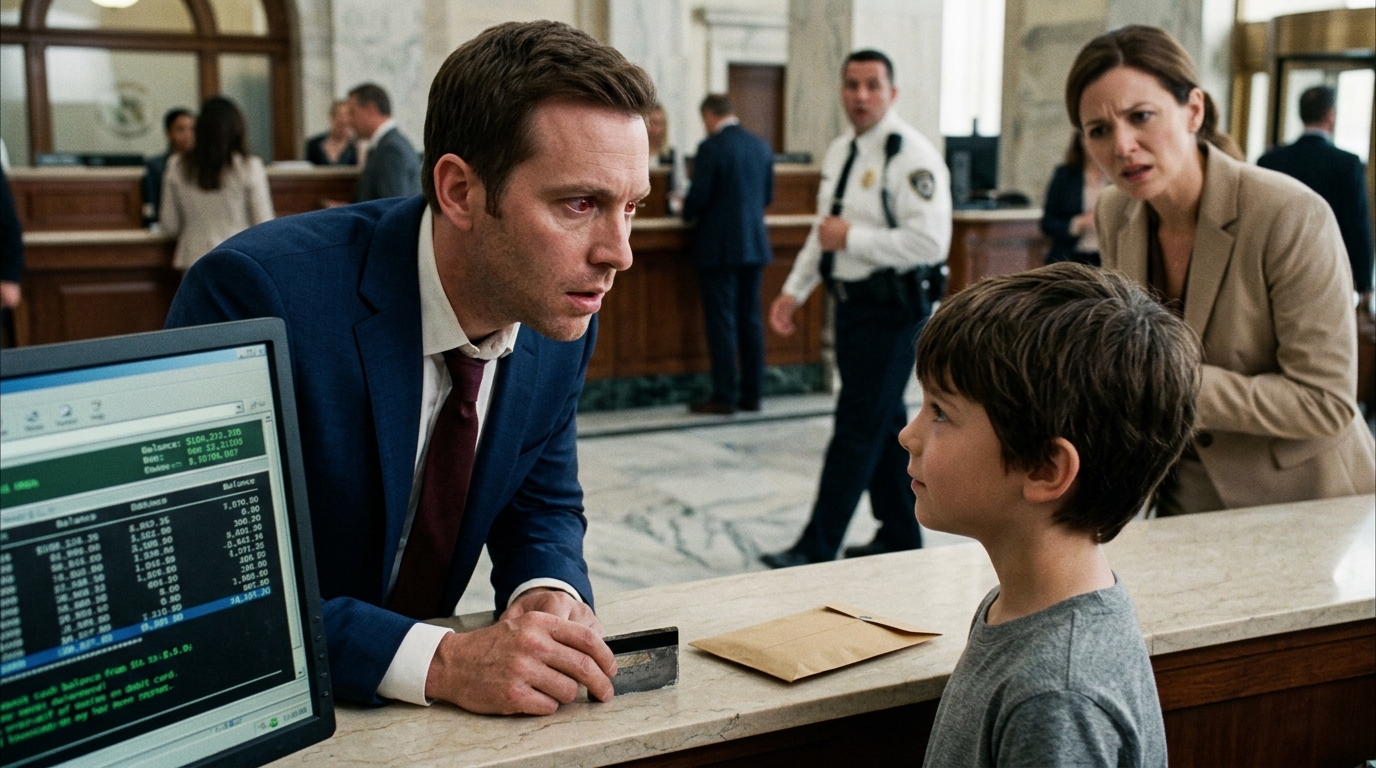
The Boy at the Counter
The bank was never meant for silence.
It thrived on motion.
Shiny shoes gliding over marble.
Soft voices behind glass offices.
Fingers moving across keyboards.
Money passing invisibly from one life to another.
Blackwell & Crown was the kind of bank where people did not ask how much something cost.
They asked whether it could be moved quietly.
That morning began like any other.
Until the boy walked in.
He could not have been more than seven years old.
Small.
Still.
Too calm.
He wore a simple gray T-shirt beneath an oversized jacket, with sneakers that looked like they had survived more sidewalks than playgrounds. His hair was neatly combed, but his face carried the tired seriousness of a child who had learned early that adults were not always safe.
No one came in with him.
No mother.
No father.
No nanny.
No driver waiting near the door.
Just the boy.
He crossed the lobby slowly, ignoring the curious looks from clients sitting beneath the tall windows. A woman in pearls pulled her handbag closer. A man in a navy suit frowned as if a child alone was an inconvenience to the architecture.
I was at counter three, processing a wire transfer for a real estate investor who smelled like expensive cologne and impatience.
The boy stopped in front of my window.
He waited.
The investor looked down at him, annoyed.
“This is a private banking line,” the man said.
The boy said nothing.
When the investor left, I leaned forward with the practiced expression of a man already tired before noon.
“What is this?”
The boy lifted a small brown envelope and placed it on the counter.
Then he set down a black card.
Worn.
Scratched.
Plain.
No logo.
No chip.
No embossed name.
It looked like something pulled from the bottom of a drawer.
I sighed.
“Where did you get this?”
The boy looked at me.
“My mom said to bring it here.”
“Is your mother in the bank?”
He shook his head.
“Outside?”
Another shake.
“Do you know her phone number?”
The boy did not answer.
Instead, he pushed the card closer.
“My mom said you have to type it in.”
I almost called security.
Not because the boy had done anything wrong.
Because banks like Blackwell & Crown trained employees to treat anything unusual as risk before treating it as human.
A child alone at the counter was unusual.
A blank black card was unusual.
A brown envelope sealed with tape was unusual.
And unusual things made managers nervous.
Still, something in the boy’s face stopped me.
Not fear.
Expectation.
As if he already knew the answer and was waiting for me to catch up.
I picked up the card.
It felt heavier than it looked.
Cold too.
On the back, almost hidden beneath scratches, was a string of numbers.
No bank name.
No expiration date.
Just twelve digits and a tiny symbol pressed into the corner.
A raven inside a circle.
My hand stopped.
I had seen that symbol once before.
Seven years earlier.
On a locked internal file my supervisor told me never to open again.
I turned to the terminal and typed in the numbers.
At first, nothing happened.
The system lagged.
Then the screen flickered.
A red warning box appeared.
Not the normal fraud alert.
Not insufficient funds.
Not account closed.
This was different.
A private internal protocol I had only heard about in training, the kind reserved for kidnapping, death disputes, frozen estates, and high-risk trust beneficiaries.
The words appeared one line at a time.
LEGACY ACCESS TOKEN ACCEPTED.
MINOR BENEFICIARY PRESENT.
DO NOT RELEASE CARDHOLDER.
DO NOT NOTIFY LOCAL GUARDIAN.
FEDERAL TRUST ALERT INITIATED.
My fingers froze over the keyboard.
Then the account opened.
The numbers on the screen were so large my mind refused to read them correctly.
Trust assets.
Property holdings.
Offshore recovery accounts.
Insurance reserves.
Frozen voting shares.
Total value: $482,000,000.
My breath slowed.
Then stopped.
The red warning reflected off the glass partition and into my eyes. For one strange second, it felt as if the screen had lit something inside my skull.
A memory.
A file.
A missing woman.
A baby declared dead.
A family that owned half the city.
The boy looked up at me.
Still calm.
Still waiting.
Then he said, “My mom said if the screen turns red, I should not leave with anyone.”
Behind him, near the lobby entrance, a woman in a tailored white suit had just stepped inside.
And the moment she saw the boy, her smile vanished.
The Woman in the White Suit
Her name was Vivian Ellery.
Everyone at Blackwell & Crown knew her.
Not because she came in often.
People that rich rarely did.
They sent attorneys, assistants, advisors, or threats written politely on letterhead.
Vivian was different.
She liked appearing in person when something mattered. She liked watching people realize the room had become hers.
She was the widow of Charles Ellery, founder of Ellery Medical Systems, a company worth more than most small nations. She chaired a children’s hospital board, funded scholarship galas, and appeared on magazine covers beneath words like grace, resilience, and legacy.
She was also the woman named in the sealed file with the raven symbol.
I had been twenty-five then.
A junior associate.
Too ambitious.
Too obedient.
A woman named Lena Hart had come into the bank carrying a baby wrapped in a blue blanket and documents tied with string. She claimed the Ellery family had stolen her child’s inheritance. She said Charles Ellery had secretly named the baby as his sole biological heir before he died.
My supervisor took the documents.
Vivian Ellery arrived twenty minutes later.
Lena Hart left the bank crying.
By the end of the week, the file vanished.
By the end of the month, Lena Hart was reported missing.
And the child?
Declared dead from complications that never appeared in any public record.
I remembered the baby only because of the eyes.
Gray.
Steady.
Too serious for an infant.
The boy at my counter had the same eyes.
Vivian crossed the lobby quickly, but not too quickly. She would never run in public. Her heels struck the marble with sharp, controlled sounds.
“Jonah,” she said.
The boy did not turn.
His small hands curled around the edge of the counter.
I looked down at the screen.
Cardholder name:
JONAH HART ELLERY.
Status:
PRESUMED DECEASED — LEGAL HOLD OVERRIDDEN BY PHYSICAL TOKEN PRESENTATION.
My stomach turned.
Vivian stopped beside him and placed a hand on his shoulder.
The boy flinched.
That small movement told me more than any file could.
“There you are,” she said warmly, for the lobby to hear. “You frightened everyone.”
The boy stared straight ahead.
“She said not to go with you.”
Vivian’s smile tightened.
“Children say strange things when they’re tired.”
A security guard moved closer.
So did my branch manager, Paul Drayton, his face already pale. He had seen the red alert from his office monitor.
“Mrs. Ellery,” Paul said carefully. “Is this your grandson?”
Vivian looked at him.
One glance.
Just one.
And Paul lowered his eyes.
That was how power worked in our building.
It did not shout.
It trained people to step aside before the command arrived.
“He is a confused child,” Vivian said. “His mother is unwell. I’ll take him home.”
The boy pulled the brown envelope toward himself.
“No.”
The word was small.
But it landed hard.
Vivian’s fingers tightened on his shoulder.
I saw pain flash across his face.
Something inside me shifted.
Maybe it was guilt.
Maybe it was memory.
Maybe it was the red screen staring at me like an accusation.
I spoke before fear could stop me.
“Mrs. Ellery, I can’t release him.”
The entire lobby seemed to inhale.
Vivian turned her head slowly.
“Excuse me?”
My voice nearly failed.
But the system was still blinking.
DO NOT RELEASE CARDHOLDER.
“I said I can’t release him.”
Paul stepped closer to me, whispering through clenched teeth.
“Nathan, be careful.”
Too late.
Vivian leaned toward the glass.
“Young man, I have known this bank longer than you have been alive.”
“I understand.”
“No, you don’t.”
Her smile disappeared.
And for one second, the philanthropist was gone.
What remained was older.
Colder.
Hungrier.
“You are making a terrible mistake.”
The boy slid the brown envelope under the glass partition toward me.
“My mom said to give you this if the woman in white came.”
Vivian’s face changed.
Not much.
Enough.
I opened the envelope.
Inside was a photograph.
Lena Hart, younger than I remembered, standing outside Blackwell & Crown in the rain with a baby in her arms.
On the back, in faded blue ink, were six words:
She will call him confused first.
I looked up.
Vivian was no longer smiling.
And on my terminal, a new line appeared in red.
FEDERAL TRUST OFFICER EN ROUTE.
Estimated arrival: 07 minutes.
The File That Was Never Deleted
Seven minutes is not long.
Unless you are standing between a powerful woman and half a billion dollars.
Then seven minutes becomes a lifetime.
Vivian’s attorney arrived in three.
Of course he did.
Men like that did not wait in traffic. They materialized when wealth required a shield.
His name was Malcolm Pierce, and he carried a leather folder, a silver pen, and the exhausted arrogance of someone used to making laws feel optional.
“This child is in the lawful care of Mrs. Ellery,” he said before introducing himself. “You are interfering with a family medical matter.”
The boy whispered, “I’m not sick.”
Vivian did not look at him.
Pierce placed a document on the counter.
Emergency guardianship order.
Signed.
Stamped.
Official-looking.
I had seen enough official-looking lies in private banking to know paper could wear a costume too.
Paul took the document with trembling hands.
“Nathan,” he murmured, “we need legal.”
“Legal has been notified by the system.”
Pierce’s expression hardened.
“What system?”
I turned the monitor slightly so only Paul could see.
His face went white.
He knew what a red trust alert meant.
It meant the bank no longer controlled the situation.
It meant federal fiduciary authorities had been automatically notified.
It meant every action from that moment forward was recorded, preserved, and reviewable.
It meant Vivian’s money could not save her quietly.
Not inside this building.
The boy reached into his pocket and pulled out a small object.
A hospital bracelet.
Yellowed with age.
Tiny.
Cracked.
He placed it beside the black card.
The name printed on it was almost gone, but still readable.
Baby Boy Hart-Ellery.
Vivian inhaled sharply.
Pierce reached for it.
I covered it with my hand.
“Don’t.”
He stared at me.
I stared back.
For the first time in my career, I realized how many bad things happen because decent people are afraid of being impolite in expensive rooms.
I was done being polite.
The boy looked at me.
“My mom said there was a file.”
“What file?”
He pointed toward the screen.
“The raven file.”
I felt the blood leave my face.
Vivian whispered, “Lena should have burned that card.”
That was the first mistake she made.
She said the name.
Lena.
Not “his mother.”
Not “the woman.”
Lena.
The boy heard it.
So did I.
So did three clients standing close enough to pretend they weren’t listening.
Paul stepped back from the counter.
“I’m calling corporate security.”
“No,” Vivian snapped.
The whole lobby froze.
Her control slipped only for a second, but in that second, everyone saw the fear beneath it.
I turned back to the terminal.
The red alert had unlocked a restricted archive link.
RAVEN PROTOCOL — ELLERY SUCCESSION DISPUTE.
My access should not have been enough.
But the black card was still on the scanner.
The boy’s presence had opened what the bank buried.
I clicked.
A scanned video file appeared.
Date: seven years earlier.
Camera: Private Consultation Room B.
I knew that room.
I had walked past it that day.
I had heard a woman crying behind the door and kept walking because my supervisor told me to keep walking.
Now the video played on my screen.
Lena Hart sat at a table holding a baby.
Vivian stood across from her.
Malcolm Pierce stood beside Vivian, younger then, but just as cold.
Lena’s voice came through the speaker, shaking but clear.
“Charles signed the acknowledgment. Jonah is his son. The trust belongs to him when he turns seven.”
The boy beside me went very still.
His seventh birthday.
That was why he had come today.
The trust activated today.
On screen, Vivian smiled.
“No court will believe a hospice nurse over me.”
Lena clutched the baby closer.
“I have the card.”
Pierce leaned forward.
“Then you have something very dangerous.”
The recording cut off.
Another file appeared.
Internal memo.
I opened it.
My supervisor’s name was there.
Paul Drayton’s too.
So was mine.
Junior associate present in building. No direct knowledge. Contain if necessary.
My stomach dropped.
They had documented my cowardice better than I had.
The next attachment was a death certificate.
Jonah Hart Ellery.
Age: four months.
Cause: respiratory failure.
Filed by: Dr. Elias Voss.
Attached beneath it was another document.
Payment transfer: $3,000,000.
Recipient: Voss Medical Consulting.
Origin: Ellery Family Discretionary Account.
The lobby around me blurred.
This was not just inheritance fraud.
This was a child declared dead so his fortune could be stolen before he learned his own name.
And that child was standing at my counter, wearing worn sneakers and holding the only proof his mother had managed to keep alive.
Then the bank doors opened.
Two federal officers walked in.
Behind them came a woman in a dark coat carrying an official badge and a sealed warrant.
Vivian turned pale.
The woman looked directly at Jonah and said, “We’ve been looking for you for seven years.”
The Mother Who Refused to Vanish
Her name was Special Fiduciary Agent Rachel Monroe.
She did not raise her voice.
She did not need to.
Within minutes, Blackwell & Crown changed from a private bank into a federal scene.
Doors locked.
Accounts frozen.
Security footage preserved.
Client movement restricted.
Every phone call logged.
Vivian stood near the counter with Pierce whispering urgently into her ear, but even he looked shaken now.
Jonah stayed close to me.
I did not deserve that trust.
But children in danger often choose the nearest adult who finally does not hand them back.
Rachel knelt slightly so she could speak to him eye to eye.
“Are you Jonah?”
The boy nodded.
“My mom said you might ask me that.”
“Where is your mother?”
His face changed.
For the first time that morning, the calm cracked.
“She said I had to come alone.”
Rachel’s expression softened.
“Is she safe?”
Jonah looked down.
“I don’t know.”
Those four words hit the lobby harder than the red alert.
Rachel stood.
“Mr. Vale,” she said to me, reading my name badge, “what did he give you?”
“The card. The envelope. The bracelet.”
“Anything else?”
Jonah reached beneath his shirt and pulled out a small key on a string.
Vivian made a sound.
Not loud.
Not dramatic.
But pure fear.
Rachel saw it immediately.
“What does the key open, Jonah?”
“The place Mom said she used to hide when the nurse came.”
“What nurse?”
“The one who made her sleep.”
The bank went silent.
Vivian closed her eyes.
Just once.
Another mistake.
Rachel held out her hand.
Jonah placed the key in her palm.
Attached to it was a plastic tag with three faded letters.
B17.
I knew that too.
Basement storage.
Old private vault level.
Most employees believed it had been sealed after the flood eight years ago.
But Blackwell & Crown did not throw away valuable secrets.
It stored them where ordinary people stopped asking questions.
Rachel’s team moved downstairs with bank security and a warrant.
I was asked to come because my employee access still worked on older doors.
Paul came too, trembling so badly he nearly dropped his keycard.
Vivian demanded to follow.
Rachel said no.
It was the first time I had ever seen Vivian Ellery refused by someone who did not apologize after.
The basement smelled of dust and cold metal.
The B17 corridor was behind an old records cage. The door was smaller than I expected, painted gray, with a lock that looked cheap enough for a broom closet.
Jonah’s key opened it.
Inside was not a vault.
It was a room.
A small cot.
Old blankets.
Medical supplies.
A cracked mirror.
Bottles of prescription sedatives.
Stacks of documents.
And on the wall, taped beneath a strip of plastic, were photographs.
Jonah as a baby.
Jonah as a toddler.
Jonah at five.
Jonah sleeping on a bus seat.
Jonah holding a cupcake with one candle.
Lena had been alive.
Not dead.
Not vanished.
Alive and running.
Rachel lifted one of the documents.
Medical guardianship order.
Declaring Lena Hart delusional.
Signed by Dr. Elias Voss.
Paid for by Ellery accounts.
Another file contained letters addressed to me.
Nathan Vale.
I stared.
Rachel handed them over.
My hands shook as I opened the first.
Mr. Vale,
You were there the day I came to Blackwell & Crown. You looked at me like you wanted to help. I am writing because I believe some part of you still might.
If my son ever reaches your counter, please do not send him away.
The page blurred.
There were six letters.
One for each year Jonah survived.
Lena had tried to reach the bank again and again.
Every letter had been stamped undeliverable and filed here.
Not by accident.
By design.
Paul found a locked cabinet at the back of the room.
Inside was a laptop wrapped in cloth.
Rachel opened it with a forensic technician.
The first video file showed Lena Hart.
Older.
Thinner.
Sitting in the same basement room.
Her voice was weak but steady.
“If this is found, my name is Lena Hart. My son is Jonah Hart Ellery. He is alive. Vivian Ellery forged his death certificate to seize control of the Ellery trust. Malcolm Pierce arranged the medical papers. Dr. Voss drugged me and kept me under false psychiatric holds.”
She paused, breathing hard.
Then she looked directly into the camera.
“Nathan Vale, if you are seeing this, I forgive you for walking away once. But please don’t do it twice.”
I had to turn away.
No accusation had ever hurt me more.
Rachel’s voice was quiet.
“She knew you were the weak link.”
I almost laughed.
“Is that supposed to comfort me?”
“No,” Rachel said. “It’s supposed to tell you she saw something human.”
A shout came from upstairs through the radio.
Vivian had tried to leave.
The building locked down before she reached the lobby doors.
Rachel looked at Jonah’s key.
Then at the cot.
Then at the photographs.
“Where is Lena now?” I asked.
Rachel did not answer.
Because the final video had started playing.
Lena appeared again.
This time, in darkness.
Only her face was visible.
“If Jonah is seven, the trust will activate. They will come for him. I am sending him to the bank because it is the one place Vivian cannot erase him without witnesses.”
Her eyes filled.
“My sweet boy, if you see this one day, I did not leave you. I put every road I had left beneath your feet.”
Then she looked past the camera.
A noise sounded off-screen.
Lena whispered one last sentence before the video cut to black.
“They found the room above us.”
The Red Screen
They found Lena in the old apartment above the bank.
Not immediately.
Not alive in the way Jonah needed her to be.
But alive.
Barely.
Blackwell & Crown owned several floors in the historic building. The upper levels had once held private client suites, then executive storage, then nothing official.
Behind a locked service door on the fifth floor, federal agents found a small hidden room.
Lena Hart was inside.
Dehydrated.
Drugged.
Weak.
But breathing.
When Rachel told Jonah, he did not cry.
Not at first.
He simply sat on a leather bench in the lobby, holding the worn black card in both hands.
Then he whispered, “She said she would try to wait.”
That broke half the room.
Even Paul turned away.
Vivian was arrested before noon.
So was Malcolm Pierce.
Dr. Voss was taken from his private clinic that afternoon.
By evening, three Blackwell & Crown executives had resigned.
By midnight, they were under investigation.
The red screen had not only revealed Jonah.
It had exposed everyone who profited from his disappearance.
The headlines came fast.
Missing Ellery heir found alive after walking into private bank.
Billion-dollar trust fraud investigation expands.
Philanthropist Vivian Ellery accused in forged death scheme.
But headlines never capture the small truths.
They did not show Jonah refusing to let go of the brown envelope.
They did not show Rachel sitting beside him for forty minutes without asking another question.
They did not show me standing behind counter three, staring at the place where a seven-year-old boy had waited for an adult to finally do the right thing.
Lena survived.
Recovery was slow.
There were hearings before Jonah could even visit safely. Doctors had to clear her. Federal protection had to be arranged. Vivian’s lawyers tried to challenge everything, including Jonah’s identity, Lena’s sanity, and the validity of Charles Ellery’s acknowledgment.
But the black card had been built for that.
Charles Ellery, dying and apparently less trusting of his family than the world believed, had created the Raven Protocol before his death. If his biological child ever physically presented the token after turning seven, all disputed estate authority froze automatically until federal review.
He had known Vivian would try something.
He simply had not lived long enough to stop it.
Lena had.
Barely.
And Jonah had finished the journey.
The trial took eleven months.
I testified.
I told the court about the first day Lena came in. About how I saw her crying behind the consultation room door and did nothing. About how I followed orders because I was young, afraid, and eager to remain employed by powerful people.
Vivian’s attorney tried to use that against me.
“So you admit you are not a reliable moral witness, Mr. Vale?”
I looked at Jonah sitting beside Rachel in the front row.
Then at Lena, pale but upright, her hand resting on her son’s shoulder.
“No,” I said. “I admit I became one too late.”
The jury believed the documents.
The videos.
The payment trails.
The forged death certificate.
The room above the bank.
The letters that never reached me.
Vivian Ellery was convicted of conspiracy, fraud, unlawful confinement, falsifying medical records, kidnapping-related charges, and financial exploitation of a minor beneficiary.
Malcolm Pierce took a deal.
Dr. Voss lost more than his medical license.
Blackwell & Crown was fined, investigated, gutted, and eventually sold.
Counter three disappeared during renovations.
I was asked to resign.
I did.
But before I left, I returned to the lobby one last time.
The marble still shone.
The keyboards still clicked.
Money still moved.
Banks are stubborn that way.
They survive scandal by polishing the floor and changing the plaque.
But I stood where Jonah had stood and remembered the red glow on my screen.
Not magic.
Not fire.
A warning.
A chance.
A judgment.
Months later, I received a letter.
No return address.
Inside was a photograph.
Jonah and Lena sitting on a park bench beneath autumn trees. She looked thin but alive. He was smiling, not fully, not carelessly, but enough.
On the back, Lena had written:
You didn’t walk away twice.
I kept the photograph.
Not as forgiveness.
Forgiveness belongs to the harmed, not the guilty.
I kept it as instruction.
I now work for a legal aid group that helps families challenge guardianship fraud and frozen trust abuse. The pay is smaller. The office carpet is terrible. The coffee tastes like burnt paper.
I sleep better.
Every year on Jonah’s birthday, a donation arrives anonymously to the group.
Seven dollars the first year.
Eight the next.
Then nine.
Always in a small brown envelope.
Always with no note.
I know who sends it.
I never cash it.
I pin each envelope on the wall above my desk to remind myself that sometimes the most powerful thing in a room is not the largest account, the richest client, or the person everyone fears.
Sometimes it is a child with a worn black card.
Standing calmly at a counter.
Waiting for one adult to type the numbers in.
And stay.