The Challenge in the Grand Hall
“I’LL GIVE YOU TEN THOUSAND IF YOU OPEN IT!”
The challenge rang through the grand hall, loud enough to turn every head.
Crystal chandeliers glittered above a sea of expensive suits and silk gowns. Champagne glasses paused halfway to painted lips. Conversations died in layers, first near the stage, then along the marble columns, then across the balcony where guests had been laughing over silent auction cards.
At the center of it all stood the vault.
Enormous.
Golden.
Ancient-looking, but engineered with ruthless precision.
It had been placed on the raised platform as the centerpiece of the evening — a restored private vault from the old Harrington estate, polished until it shone beneath the lights like a monument to wealth itself.
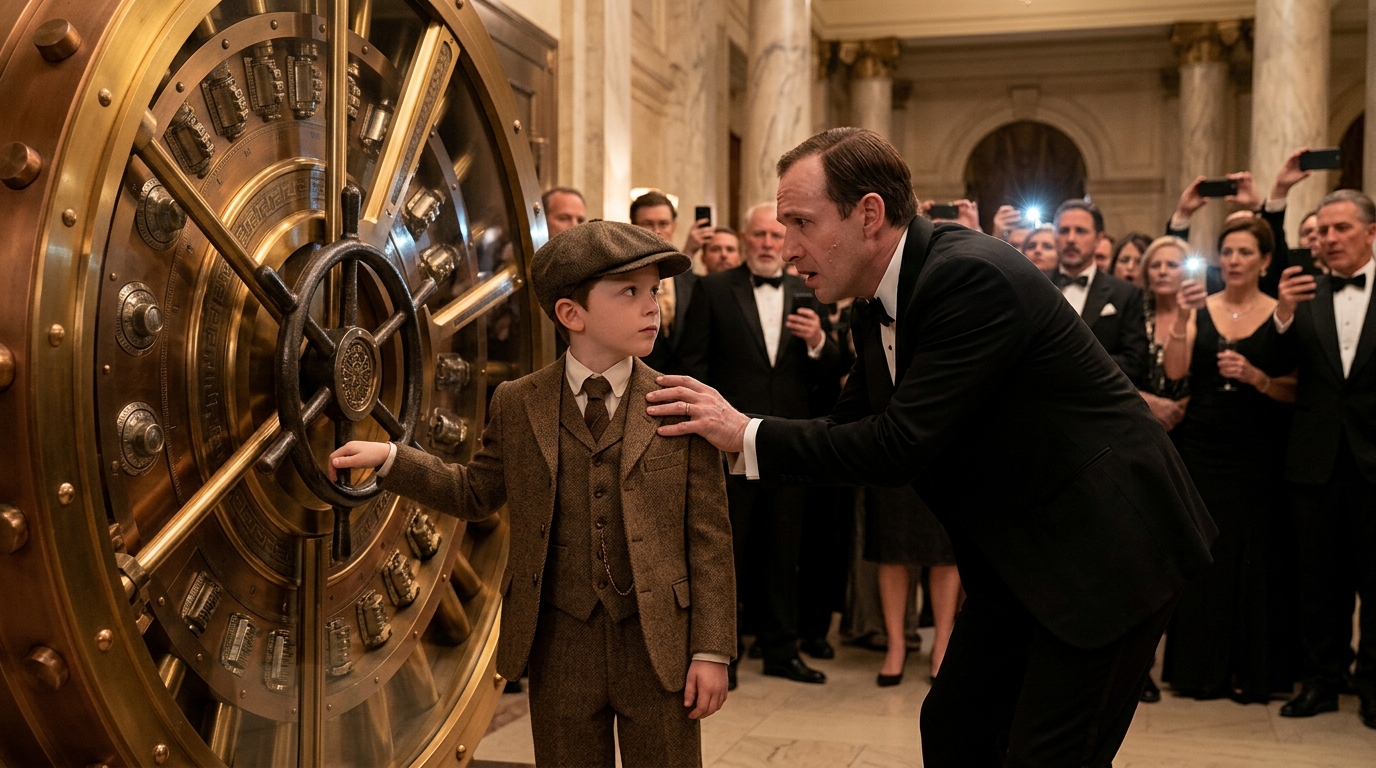
Beside it stood Lawrence Vale, billionaire collector, hotel heir, and tonight’s host.
He wore a black tuxedo, a diamond pin, and the smirk of a man who had spent his life discovering that most rooms bent toward him before he even spoke.
In front of him stood a boy.
Seven years old.
Small.
Dressed in a worn brown tweed jacket that was too formal for him and slightly too short at the sleeves. His shoes were polished, but old. His hair had been combed carefully, though one stubborn curl kept falling over his forehead.
His name was Noah Reeves.
And every wealthy adult in that hall thought he was about to be humiliated.
A few guests had already lifted their phones.
The situation was too perfect not to record.
A poor child, invited by some charity program, standing before a vault no grown man in the room could open without a code.
A rich host offering money as if kindness and mockery were the same thing.
A harmless spectacle.
At least, that was what they believed.
Lawrence spread his arms theatrically.
“Come on, young man. You were so confident a moment ago. You said you knew this vault.”
Low laughter rippled through the hall.
Noah did not look at the guests.
He looked only at the vault.
Its golden face reflected him in warped pieces: small hands, solemn eyes, a boy standing before a machine built to keep secrets.
A woman near the back of the hall pushed forward anxiously.
“Noah,” she whispered. “Don’t.”
His mother, Clara Reeves, wore a black catering uniform and carried a tray she had forgotten to set down. Her face was pale, and her eyes were full of the particular fear of a woman who had spent years learning what powerful people could do when embarrassed.
Lawrence noticed her.
His smile sharpened.
“Oh, let the boy try. He seems eager.”
Clara’s lips trembled.
“He’s only a child.”
“Then there is no harm.” Lawrence looked toward the crowd. “Unless, of course, he knows something we don’t.”
More laughter.
Noah finally turned.
Not to Lawrence.
To his mother.
“It’s okay,” he said softly.
That should have made her feel better.
It didn’t.
Because his voice was too calm.
Too certain.
Too much like his father’s.
Then Noah stepped toward the enormous golden vault.
The crowd leaned in.
Phones rose higher.
He placed both small hands on the cold iron wheel.
For a moment, nothing happened.
Then—
Click.
The sound moved through the hall like a crack in glass.
Noah turned the wheel a fraction.
His fingers shifted to the smaller brass dial beneath it.
Click. Click.
The heavy tumblers moved inside the steel door.
Not randomly.
Not like a child playing.
With rhythm.
With memory.
With unsettling accuracy.
Lawrence’s smirk faded.
Only slightly at first.
Then more.
The room grew still.
The guests no longer laughed.
They listened.
Noah’s hand moved again.
Left.
Right.
Pause.
Half-turn.
Press.
The vault answered him.
Click.
Lawrence stepped closer.
His voice, when it came, no longer sounded amused.
“Who taught you that?”
Noah did not turn back.
“My father built this safe.”
The sentence dropped into the hall and changed the temperature.
Clara covered her mouth.
Lawrence’s face went pale.
Only for an instant.
Then he lunged forward and grabbed the boy’s shoulder.
“Stop.”
The room fell into a stunned silence.
Noah turned slowly beneath Lawrence’s grip.
He did not cry.
He did not flinch.
His gaze was icy.
Knowing.
And far too old.
“Why?” the boy asked quietly. “Is your name still inside?”
The phones kept recording.
But the laughter was gone.
The Man Who Built the Vault
Noah’s father had been named Thomas Reeves.
To most of the people in the grand hall, the name meant nothing.
To Lawrence Vale, it meant a door he had spent seven years trying to keep locked.
Thomas Reeves had been a master safe engineer.
Not a locksmith.
Not a repairman.
An engineer.
He understood old security systems the way musicians understand instruments. He could hear misaligned tumblers by sound. He could restore century-old vaults without replacing their souls. He believed every safe had two histories: the one written in its paperwork and the one hidden in its scratches, repairs, and secret modifications.
The Harrington vault had been his final project.
Seven years earlier, Lawrence Vale purchased the vault from the collapsed Harrington estate. It had once belonged to one of the wealthiest families in the city, and rumor said it had protected diamonds, war bonds, blackmail letters, and private ledgers powerful men would have killed to keep sealed.
Lawrence loved the rumor.
He loved owning things other men feared.
He hired Thomas Reeves to restore the vault and prepare it for public display before selling it to a European collector.
Thomas worked on it for six months.
During those months, he discovered something wrong.
Not with the lock.
With the history.
The vault had not been empty when Lawrence bought it.
Someone had opened it before the estate sale.
Someone had removed documents.
Someone had resealed the mechanism improperly.
And inside the secondary chamber — a hidden compartment built behind the inner wall — Thomas found a ledger.
Not jewelry.
Not cash.
Names.
Transfers.
Payments.
Shell companies.
A list of people who had used the Harrington estate to launder money through charity auctions and private art sales.
At the top of several pages was one name:
Lawrence Vale.
Thomas made the mistake honest men often make.
He assumed truth had authority.
He told Lawrence the vault contained records that needed to be turned over to investigators.
Three days later, Thomas Reeves was arrested for theft.
Police claimed he had stolen rare gold certificates from the Harrington vault during restoration. Lawrence testified that Thomas had been acting suspiciously. A security guard said he saw Thomas remove a package from the estate workshop. The guard later left the country.
The stolen certificates were found in Thomas’s garage.
Clara Reeves swore they had been planted.
No one listened.
Thomas refused a plea deal.
He insisted there was a hidden chamber in the vault.
He insisted the real evidence was still inside.
But by then, Lawrence had moved the vault to a private storage facility and claimed it was undergoing preservation work.
Thomas never got a chance to prove what he found.
He died in jail eight months later, after a sudden illness that Clara never believed was natural.
Noah was only a baby.
He grew up knowing his father through notebooks, photographs, whispered stories, and the way his mother went silent whenever Lawrence Vale appeared on television.
But Thomas had left something behind.
A set of drawings.
Not full blueprints.
Fragments.
Hidden in the spine of a children’s book he had given Clara before his arrest.
Inside those drawings was a note addressed to his son.
If Noah ever stands before the Harrington vault, tell him this:
A safe does not only protect valuables. Sometimes it protects the truth until the right hands return.
Clara had never meant for Noah to learn the sequence.
But children listen when adults think grief is sleeping.
Noah learned.
Quietly.
Patiently.
From sketches.
From old recordings of his father explaining lock theory.
From the rhythm Thomas used to tap on tables when thinking.
And that night, in the grand hall, Lawrence Vale made the mistake of challenging a boy who had spent his whole childhood hearing his dead father’s voice inside a vault.
The Host Loses Control
Lawrence’s hand remained clamped on Noah’s shoulder.
Too tight.
Clara saw her son’s face tighten.
That broke the fear holding her in place.
She rushed forward.
“Take your hand off him.”
Lawrence did not look at her.
“This child is interfering with private property.”
A man in the crowd muttered, “You told him to open it.”
Someone else said, “We all heard you.”
Lawrence’s jaw worked.
“This is a charity event, not a circus.”
Noah looked up at him.
“You offered ten thousand.”
The crowd shifted.
A woman near the stage whispered, “He did.”
A phone camera moved closer.
Lawrence seemed to notice the phones again. His expression rearranged itself, smoothing into wounded dignity.
He released Noah’s shoulder.
“Of course. I simply don’t want the boy to hurt himself.”
Noah rubbed his shoulder but did not step back.
The vault stood behind him, half-awake now.
The tumblers had moved.
The first internal lock had released.
There was no pretending anymore that he had been guessing.
A silver-haired man near the front stepped forward.
“Mr. Vale,” he said carefully, “if the child truly knows the mechanism, perhaps we should let him continue.”
Lawrence’s eyes flashed.
“I’m sorry, who are you?”
“Arthur Bell. I chair the museum board.” He looked at the vault. “And that safe was once promised to our historical collection before its private sale.”
Lawrence smiled coldly.
“Then you know it is mine.”
“Do I?”
The room tightened.
Arthur Bell’s question did not sound casual.
Lawrence turned back to Noah.
“This is over.”
Noah reached into the pocket of his tweed jacket.
Clara inhaled sharply.
“Noah…”
He pulled out a folded piece of paper.
Old.
Soft at the creases.
Carefully preserved.
He held it toward Lawrence.
“My father wrote this.”
Lawrence stared at the paper as if it were a snake.
Noah read aloud.
His voice was small, but the hall was so quiet that every word carried.
“‘The man who fears the inner chamber will always stop the outer door.’”
A slow murmur moved through the crowd.
Clara’s tears began falling.
Noah looked at Lawrence.
“You stopped me before the inner chamber.”
Lawrence stepped back.
“That proves nothing.”
Noah tilted his head.
“Then let me finish.”
No one spoke.
The challenge now belonged to Lawrence.
If he refused, every camera would capture his fear.
If he agreed, the vault might expose him.
For the first time all evening, the billionaire was trapped by the same thing he had used against others:
An audience.
Arthur Bell looked toward the guests.
“I think we would all like to see whether Mr. Vale’s generous challenge can be completed.”
A few people nodded.
Then more.
Then someone clapped once.
Another joined.
Soon applause spread through the grand hall — not joyful, not celebratory, but demanding.
Lawrence looked around.
His smile had vanished entirely.
Finally, he said through his teeth:
“Fine.”
Noah turned back to the vault.
The Inner Chamber
The second sequence was harder.
Thomas Reeves had written that old safes were like stubborn men: they revealed nothing if rushed.
Noah breathed slowly.
He placed one hand against the vault door and felt the vibration of the mechanism through the metal.
The crowd watched in complete silence.
Even the waiters had stopped moving.
Clara stood a few steps behind her son, one hand pressed to her chest, torn between terror and something she had not allowed herself in years.
Hope.
Noah turned the iron wheel backward.
Then stopped.
Pressed the lower brass pin.
Turned the dial right.
Paused.
Tapped twice on the metal plate beneath the manufacturer’s mark.
Something shifted deep inside the door.
A sound like a chain dropping.
Lawrence’s face turned gray.
Noah whispered, “Thank you, Dad.”
Then he pulled.
The enormous vault door opened.
Not fully.
Only three inches at first.
A breath seemed to move through the hall.
Cold air.
Metal and dust.
The smell of something sealed away too long.
Arthur Bell stepped closer, eyes wide.
Several guests gasped.
The vault was not empty.
Inside were shelves lined with old boxes, leather-bound books, sealed envelopes, and a smaller interior panel with a brass plate at its center.
Noah did not touch the boxes.
He reached for the brass plate.
Lawrence moved again, but this time Arthur Bell stepped between him and the boy.
“I wouldn’t,” Arthur said quietly.
Lawrence glared at him.
Noah pressed the brass plate.
Nothing happened.
Then he inserted a tiny flat key from his pocket.
Clara gasped.
That key had belonged to Thomas.
She thought it had been lost.
Noah turned it.
The inner panel clicked open.
Behind it was a narrow chamber.
Inside sat a black metal case, wrapped in oilcloth.
Noah lifted it with both hands.
It was heavier than he expected.
Clara rushed forward to help him, but he shook his head.
“I can do it.”
He placed the case on the table beside the vault.
The hall gathered closer.
Lawrence backed away half a step.
The case had no lock.
Only a clasp.
Noah opened it.
Inside were papers.
A ledger.
A small recorder.
And a photograph.
The photograph showed Thomas Reeves standing beside the open Harrington vault seven years earlier. He was younger than Clara remembered him now, smiling tiredly, one hand resting on the inner chamber.
Beside him stood Lawrence Vale.
Not as a client.
As a man caught inside a place he later claimed he had never entered.
On the back of the photograph, in Thomas’s handwriting, were six words:
If I disappear, start with him.
Clara made a broken sound.
Noah picked up the photograph and turned toward Lawrence.
“My father didn’t steal from you,” he said.
Lawrence’s voice came out low.
“You have no idea what you’re holding.”
Noah’s eyes stayed on him.
“I think you do.”
The Ledger Speaks
Arthur Bell called for security.
Not hotel security.
Police.
Lawrence’s private guards hesitated.
Too many cameras were filming now.
Too many people had seen the vault open.
Too many witnesses had watched the billionaire try to stop a child from revealing what was inside.
A woman in a blue gown near the front said, “Put the documents on the screen.”
Lawrence snapped, “Absolutely not.”
Arthur looked at the host.
“You wanted spectacle, Mr. Vale.”
The woman in blue turned out to be a judge.
Retired, but still known.
Her name was Elaine Porter, and she had once presided over one of the early hearings in Thomas Reeves’s case before being removed for reasons she now seemed to understand.
She walked to the table and examined the ledger without touching it.
“Photograph everything before anyone moves it,” she said.
People obeyed.
Not because she shouted.
Because authority sounds different when it has no need to perform.
Phones moved over the pages.
Names appeared.
Dates.
Payment trails.
Vault access records.
A private seal connected to Lawrence’s investment group.
Then the recorder.
Arthur lifted it carefully with a napkin and placed it near the microphone stand from the evening’s earlier auction announcements.
“Don’t,” Lawrence said.
His voice cracked.
Everyone heard it.
Arthur pressed play.
Static.
Then Thomas Reeves’s voice filled the hall.
Clara covered her mouth with both hands.
Noah went still.
It was the first time he had heard his father’s voice outside old home recordings.
This voice was different.
Frightened.
Urgent.
But steady.
“My name is Thomas Reeves. Date: October 14. I am inside the Harrington vault restoration room. Lawrence Vale has offered me money to alter the inner chamber and remove ledger materials before the estate audit. I refused. If this recording is found, I believe I am in danger.”
A murmur rose.
The recording continued.
Another voice entered.
Lawrence’s voice.
Younger.
Angrier.
“You repair locks, Mr. Reeves. You don’t decide what truth survives.”
Thomas replied, “I decide what I will not hide.”
Lawrence said, “Men with families should be more careful.”
Clara closed her eyes.
Noah stared at Lawrence.
The recording crackled.
Then came the sound of movement.
A chair scraping.
Lawrence again.
“You will take the money, or you will take the blame.”
The recording ended.
The hall remained silent.
Not stunned anymore.
Certain.
Lawrence looked around the room at faces that had once admired him.
Now they were recording him like evidence.
He turned toward the exit.
Two uniformed officers entered before he reached it.
Clara’s Voice
The police did not arrest Lawrence immediately in the dramatic way guests seemed to expect.
Power does not always fall in one clean motion.
Questions came first.
Securing the vault.
Protecting documents.
Identifying witnesses.
Calling detectives.
Preventing Lawrence’s attorneys from swallowing the room.
But something had shifted forever.
Clara stood beside the table, one hand on Noah’s shoulder, staring at the photograph of Thomas.
For seven years, she had been called many things.
Grieving.
Obsessed.
Poor.
Unstable.
A woman who could not accept her husband’s guilt.
She had written letters no one answered.
Filed appeals no one funded.
Begged reporters who found the story sad but not useful.
Raised a son on catering shifts, thrift store clothes, and bedtime stories about a father the world called a thief.
Now the vault had opened.
And Thomas’s voice had returned.
A detective approached Clara.
“Mrs. Reeves?”
She looked at him.
For once, she did not shrink from official attention.
“Yes.”
“We’ll need your statement.”
She nodded.
Then looked toward Lawrence, who stood surrounded by officers, lawyers, and the ruins of his own performance.
“You’ll have it.”
Noah leaned against her.
Only then did he begin to shake.
Clara crouched immediately.
“Oh, sweetheart.”
“I did it,” he whispered.
She pulled him into her arms.
“Yes.”
“Dad was right.”
Her eyes filled.
“Yes.”
The boy’s face crumpled.
“He didn’t steal.”
Clara held him tighter.
“No. He didn’t.”
The crowd watched quietly.
No phones moved closer now.
Something about the sight of the mother and child on the marble floor seemed to remind everyone that this was not entertainment.
This was a family standing in the first light after years underground.
Arthur Bell removed his tuxedo jacket and draped it around Noah’s shoulders.
The boy looked up, surprised.
Arthur’s voice was gentle.
“Your father was a great craftsman.”
Noah swallowed.
“He said safes remember.”
Arthur looked at the open vault.
“Yes,” he said softly. “Apparently they do.”
The Case Reopens
By morning, the story had spread across the city.
Not as a rumor.
As footage.
Thousands of people had watched Lawrence Vale offer a child ten thousand dollars to open a vault.
Thousands watched the boy do it.
Thousands heard Thomas Reeves’s recording.
The district attorney announced a review before noon.
By evening, Thomas Reeves’s conviction was formally questioned.
Within a week, the stolen gold certificates supposedly found in his garage were traced to a storage unit leased by one of Lawrence’s shell companies.
The security guard who testified against Thomas was located in Portugal. He had been receiving payments for seven years.
Marcus Hale, Lawrence’s former private security chief, made a deal and admitted the evidence had been planted.
The original judge from Thomas’s criminal case stated publicly that he had been misled by falsified documents.
The city that once forgot Thomas Reeves suddenly spoke his name everywhere.
Clara hated that part.
Not because Thomas did not deserve it.
Because the same people who had called him guilty now called him tragic with equal confidence.
Still, correction mattered.
A court vacated Thomas’s conviction three months after the vault opened.
Clara attended with Noah.
The judge read the order.
Thomas Reeves was legally innocent.
The words were formal.
Dry.
Late.
Clara cried anyway.
Noah wore the same tweed jacket, now with the sleeves properly lengthened by a neighbor who refused payment.
After the hearing, reporters crowded the courthouse steps.
“Mrs. Reeves, how do you feel?”
She looked at Noah.
Then at the cameras.
“My husband was innocent before a court said so,” she replied. “But I’m grateful the record finally stopped lying.”
Noah held her hand.
A reporter asked him, “How did you know how to open the vault?”
Noah looked nervous.
Then said, “My dad taught me.”
“But you were a baby when he died.”
Noah’s grip tightened on Clara’s hand.
“He still taught me.”
That line became the headline.
Clara kept the newspaper.
For Noah.
For Thomas.
For the truth that parents can leave behind more than grief.
Lawrence Vale’s Final Performance
Lawrence fought the charges.
Of course he did.
Men like him do not confess when exposed. They reframe.
He claimed the recording was incomplete.
The ledger misinterpreted.
The photograph staged.
The boy coached.
The mother vengeful.
The engineer unstable.
The police pressured by public outrage.
He had explanations for everything except the one question he could never answer:
Why did he stop Noah from opening the inner chamber?
The trial lasted five weeks.
The vault itself was brought into evidence through photographs, scans, and expert testimony. Engineers explained Thomas’s restoration work. Financial analysts traced payments. Former employees testified. Arthur Bell described the moment Lawrence grabbed Noah’s shoulder. Judge Porter testified as a witness to the event, calm and devastating.
Then Clara took the stand.
Lawrence’s attorney tried to soften her into a grieving widow.
“Mrs. Reeves, you loved your husband deeply, didn’t you?”
“Yes.”
“And that love may have made it hard to accept his mistakes?”
Clara looked at Lawrence.
“No. That love is why I knew the difference between his mistakes and your client’s lies.”
The courtroom went still.
The attorney tried to recover.
“You spent years teaching your son that his father was innocent?”
“I spent years telling my son the truth.”
“You trained him to open the vault?”
“No.”
“But he knew how.”
“My husband left notes.”
“Convenient.”
Clara’s eyes hardened.
“What was convenient was accusing a dead man who could not defend himself.”
The attorney stopped smiling.
Noah did not testify.
Clara refused.
The court agreed.
He had opened the vault.
He did not need to be opened too.
Lawrence was convicted of conspiracy, evidence tampering, obstruction, and multiple financial crimes tied to the Harrington ledger. Other charges followed. Civil suits multiplied. His reputation, built over decades, collapsed in weeks.
At sentencing, he finally looked smaller.
Not sorry.
Just reduced.
The judge asked if he wished to speak.
Lawrence stood.
He adjusted his cuffs.
Even then.
Even there.
He said, “I made errors in judgment.”
Clara almost laughed.
Errors.
That was what powerful men called destruction when it belonged to someone else.
The judge did not accept the phrasing.
“Mr. Vale,” she said, “you did not make an error. You made a choice. Then you framed a man, let his family suffer, and allowed a child to grow up under the weight of your lie.”
Lawrence’s face tightened.
The sentence came down.
Not enough to restore Thomas.
Enough to mark the truth.
The Vault’s New Home
The Harrington vault was not sold to Europe.
Arthur Bell made sure of that.
After the trial, it was transferred to the city museum as part of a permanent exhibit on corruption, craftsmanship, and hidden records.
Clara initially refused to attend the opening.
“I don’t want Thomas turned into a display,” she said.
Arthur visited her apartment personally.
He sat at her kitchen table drinking tea from a chipped mug while Noah built a model safe from cardboard nearby.
“Mrs. Reeves,” Arthur said gently, “the exhibit is not about displaying your husband’s pain. It is about correcting what was displayed before — his guilt.”
Clara looked toward Noah.
The boy was listening while pretending not to.
Arthur continued.
“Children will see his name beside the word engineer. Not thief.”
That was what changed her mind.
The exhibit opened one year after the gala.
The golden vault stood behind glass, restored but not polished too brightly. Its scratches remained. Its inner chamber was visible. Beside it was a photograph of Thomas Reeves, not the police photo that had haunted old articles, but one Clara chose.
Thomas smiling in his workshop, sleeves rolled up, a pencil behind his ear.
The plaque read:
Thomas Reeves
Master Safe Engineer
His final work preserved the truth that cleared his name.
Noah stood before the plaque for a long time.
Clara waited behind him.
Finally, he said, “They should put that he liked pancakes.”
Arthur, standing nearby, smiled.
“We can add that to the audio guide.”
Noah nodded seriously.
“He also snored.”
Clara laughed for the first time all day.
The sound surprised her.
Then warmed her.
The vault no longer felt like a monster.
It felt like a witness.
Ten Thousand Dollars
People often asked about the ten thousand dollars.
The challenge that started everything.
The money Lawrence promised.
Legally, it became a strange footnote. Since Lawrence had publicly offered it and Noah had completed the task, several guests joked that the boy had a claim.
Clara wanted nothing from Lawrence.
Not one dollar.
But Noah surprised her.
“I want it,” he said.
She stared.
“Why?”
“He said he’d give it.”
“Yes, but—”
“And Dad said men who break small promises break big ones too.”
That sounded so much like Thomas that Clara had to sit down.
Through the civil settlement, the ten thousand dollars was paid into an education account for Noah. But he asked Clara to take out a small part.
“How much?”
“Enough for tools.”
“Tools?”
He nodded.
“I want to build things that open.”
So Clara bought him a beginner’s mechanical kit, then a workbench, then lessons with a retired locksmith who had known Thomas.
Noah did not become obsessed with safes because of revenge.
That worried Clara at first.
But she soon understood.
To Noah, mechanisms were not about hiding.
They were about listening.
About patience.
About the belief that even the most sealed thing had a way to open if approached with care and truth.
On his tenth birthday, he built Clara a small wooden box.
Inside was a photograph of Thomas, Clara, and baby Noah.
The lid had no visible lock.
“How do I open it?” she asked.
Noah smiled.
“You already know.”
She turned it over.
On the bottom, carved carefully, was one word:
Trust.
She pressed the letters.
The box opened.
Clara cried for twenty minutes.
Noah pretended not to notice, which was his version of mercy.
What the Boy Really Opened
Years later, people still retold the story of the boy and the golden vault.
They told it with drama.
The billionaire’s challenge.
The child’s tiny hands.
The clicks echoing through the grand hall.
The question that drained the host’s face:
“Is your name still inside?”
It became one of those stories people shared as proof that arrogance can destroy itself when it underestimates the wrong person.
But Clara knew the deeper truth.
Noah did not only open a vault that night.
He opened a grave without disturbing the dead.
He opened a courtroom that had closed too soon.
He opened the mouths of witnesses who had been paid to stay silent.
He opened a path back to Thomas’s name.
Most of all, he opened something in the people watching.
For a few minutes, they were forced to see how easily they had prepared to laugh at a child.
How quickly they had accepted Lawrence’s power as the shape of truth.
How naturally they had raised phones for humiliation and accidentally recorded justice instead.
That was the part Clara never forgot.
When Noah stepped toward the vault, the room expected embarrassment.
When he opened it, the room discovered shame.
And shame, when faced honestly, can become the beginning of repair.
Not for everyone.
Some guests simply moved on to the next scandal.
But others wrote statements.
Shared footage.
Donated to Thomas’s legal fund before the conviction was cleared.
Supported the museum exhibit.
One woman from the gala later wrote Clara a letter.
I lifted my phone because I thought your son was about to be mocked. I kept filming because I realized the adults were the ones being exposed. I am sorry it took me so long to understand the difference.
Clara kept that letter too.
Not because apology fixed anything.
Because it showed that truth, once released, can keep turning locks long after the first door opens.
The Sound That Remained
Noah remembered the sound most.
Not Lawrence’s challenge.
Not the gasps.
Not the applause.
The clicks.
The tumblers inside the vault.
He remembered how the metal answered his hands.
How the sequence felt less like something he had memorized and more like something he had inherited.
Sometimes, late at night, he asked Clara to tell him again about his father’s workshop.
She would describe the smell of oil and brass.
The old radio Thomas kept near the window.
The way he hummed when concentrating.
The tiny burns on his fingers from soldering.
The way he kissed Noah’s forehead before leaving for the Harrington project and said, “Take care of your mom, little key.”
Noah loved that nickname.
Little key.
It meant he had not been forgotten.
One evening, years after the trial, Clara found Noah asleep at his workbench, cheek pressed against a notebook, pencil still in hand.
On the page was a drawing of the Harrington vault.
But Noah had changed it.
Instead of gold, he shaded it in warm brown.
Instead of a locked door, he drew it open.
Inside, he did not draw ledgers or evidence.
He drew three people.
Thomas.
Clara.
Himself.
Standing together.
Clara touched the page gently.
For years, she thought justice meant proving what happened.
Now she understood it also meant allowing a child to imagine his family without the lie standing between them.
The Question Lawrence Couldn’t Answer
Before Lawrence was transferred after sentencing, he requested one meeting with Clara.
She refused.
Then he requested one with Noah.
Clara’s answer was so immediate the lawyer flinched.
“No.”
Noah asked about it later.
“Why did he want to see me?”
Clara considered lying.
Then chose truth.
“Because men like Lawrence want the last word.”
Noah thought about that.
“Did Dad get the last word?”
Clara smiled sadly.
“In a way.”
“What was it?”
She took out the folded note Thomas had hidden in the children’s book.
The one Noah had read from at the gala.
He knew it by heart now.
The man who fears the inner chamber will always stop the outer door.
Noah traced the words with one finger.
“Dad knew he’d try to stop me.”
“Your father knew guilty men fear what they cannot control.”
Noah looked up.
“Was I scared?”
Clara brushed hair from his forehead.
“Yes.”
He frowned.
“I don’t remember.”
“I do.”
“Was Dad scared?”
Clara’s eyes filled.
“Yes.”
“But he still made the recording.”
“Yes.”
Noah nodded slowly.
“Then scared doesn’t mean stop.”
“No,” Clara whispered. “Not always.”
He folded the note carefully.
Then said, “I’m glad his name was inside.”
Clara looked at him.
“Whose? Lawrence’s?”
Noah shook his head.
“Dad’s.”
She did not understand at first.
Then she did.
Thomas’s name had been inside the vault too.
On the recording.
On the photograph.
In the notes.
In the craftsmanship.
In every hidden mechanism that waited for the right hands.
Lawrence’s name was inside as guilt.
Thomas’s name was inside as truth.
That was the difference.
The Vault Opens Every Day
At the museum, children loved the vault.
Not because of corruption.
Not because of legal history.
Because it was huge and golden and looked like something from a treasure story.
The exhibit included an interactive model that allowed visitors to turn a wheel and hear tumblers click. Noah helped design it when he was older. He insisted the model include not just one lock, but two.
“The first lock is what everyone sees,” he told the museum team. “The second is where the truth waits.”
Arthur Bell smiled.
“Spoken like your father’s son.”
Noah pretended not to care.
But Clara saw him blush.
On the wall near the model was a quote from Thomas Reeves:
A lock is only honorable when it protects the right thing.
Clara did not know where Arthur found it.
Some old interview.
Some trade journal.
Some piece of Thomas the world had missed.
Every time she read it, she felt him near.
Years later, when Noah gave his first public talk at the museum, he wore a tweed jacket again.
Not the same one.
A new one.
Properly fitted.
He stood beside the vault and looked out at a room full of students.
“My father built safes,” he said. “A bad man used one to hide what he did. But my father also left a way to open it. That taught me something.”
He paused.
Clara sat in the front row, hands clasped tightly.
Noah continued.
“Anything built to hide a lie should be studied until it tells the truth.”
The room erupted in applause.
Clara cried quietly.
Arthur handed her a tissue without looking, as if he had expected it.
The Boy and the Bet
The ten-thousand-dollar challenge became a footnote in history.
A ridiculous sentence spoken by an arrogant man who believed money could turn a child into entertainment.
But for Noah, it remained the moment the room chose sides before understanding the battle.
The wealthy onlookers had expected him to fail.
Lawrence had expected him to be embarrassed.
His mother had feared he would be hurt.
His father, somehow, had prepared him.
Not by teaching him revenge.
By teaching him patience.
Listen.
Feel the mechanism.
Do not force the door.
Truth has a sequence.
Noah carried that lesson into adulthood.
He became an engineer, like Thomas.
Not a safe engineer exactly, though he loved locks all his life. He specialized in forensic mechanical analysis, helping courts understand failures, tampering, sabotage, and hidden design.
He opened things.
Machines.
Records.
Accidents that were not accidents.
Stories that powerful people tried to seal behind technical language.
And on his desk, always, sat a small photograph.
A boy in a tweed jacket standing before a golden vault.
Beside it was another photograph.
Thomas Reeves in his workshop.
Same focused eyes.
Same stubborn mouth.
Same belief that built things remember the hands that shaped them.
Clara once asked Noah if he ever wished the gala had never happened.
He thought for a long time.
“I wish Dad had lived,” he said.
She nodded.
That was the truest answer.
Then he added, “But if the vault had stayed closed, people would still think he was guilty.”
“Yes.”
“So I’m glad it opened.”
Clara looked at him.
“So am I.”
The Name Inside
In the end, the question Noah asked Lawrence Vale became famous.
“Is your name still inside?”
People quoted it in articles, documentaries, courtroom retrospectives, and museum tours. They liked the sharpness of it. The poetic justice. The child confronting the criminal.
But Noah always heard it differently.
When he asked it, he was not trying to sound clever.
He was remembering something his father wrote in the margins of the old drawings:
Every hidden chamber has a memory of who needed it hidden.
Lawrence’s name was inside because guilt leaves fingerprints.
Even when polished.
Even when protected.
Even when surrounded by wealth, lawyers, chandeliers, and applause.
But Thomas’s name was inside too.
Not written in guilt.
Written in craft.
In courage.
In the tiny hidden path he left behind for a son too young to remember his face but old enough to finish his work.
That was what the vault had protected all along.
Not only evidence.
A father’s last act of faith.
Faith that Clara would keep going.
Faith that Noah would one day stand before the door.
Faith that truth, sealed away long enough, does not die.
It waits.
In metal.
In paper.
In memory.
In a child’s hands.
And when the room is finally quiet enough, it clicks open.