The Woman Beneath the Shutter
“DAD, HEY DAD, LOOK! YOU’RE NOT GONNA BELIEVE WHO THAT IS!”
Ethan’s voice cut through the chilly night air.
His father did not stop.
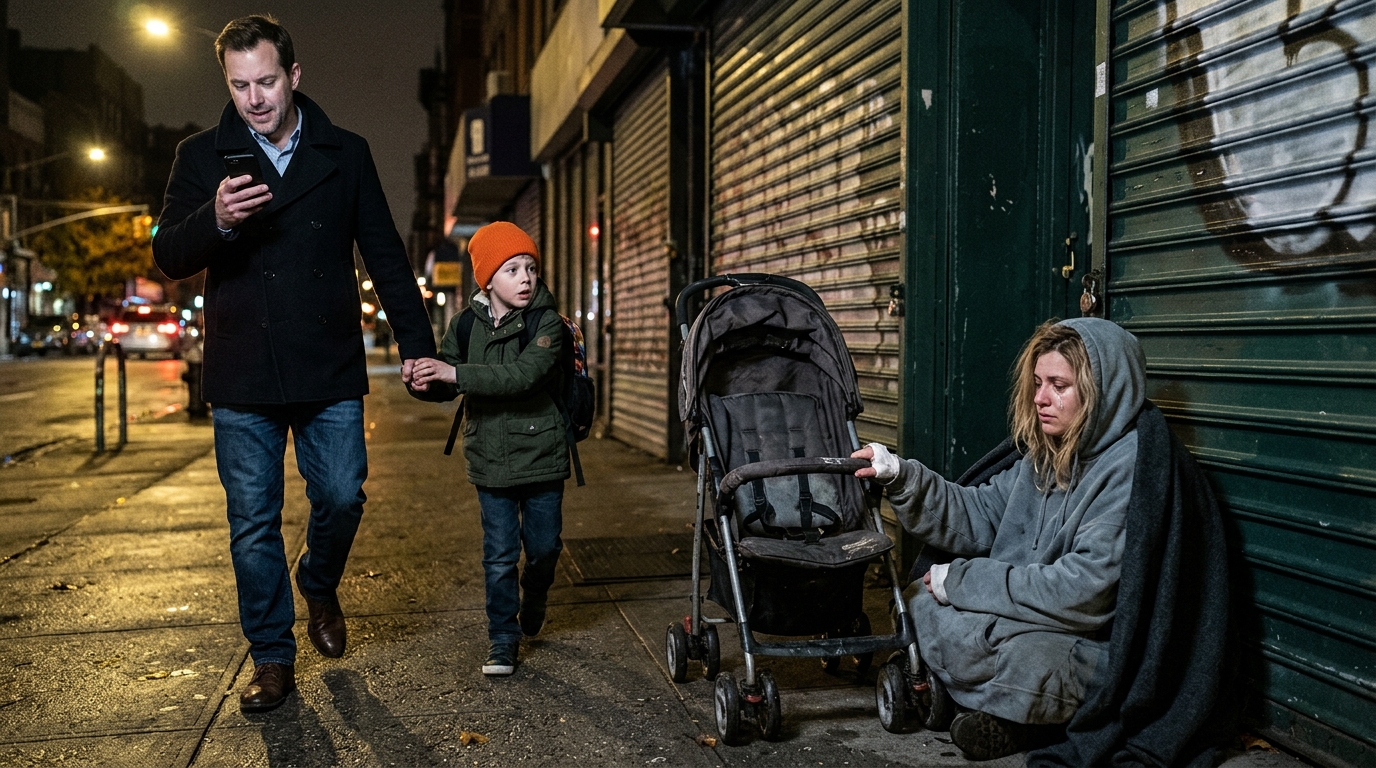
Nathan Whitmore moved through the city sidewalk like a man being pulled by invisible wires — one hand holding his phone to his ear, the other gripping Ethan’s wrist just tightly enough to keep the boy moving beside him.
The street was crowded but cold. Cars hissed over wet pavement. Neon signs reflected in puddles. A line of taxis crawled past the curb while office workers hurried home with their collars up against the wind.
Nathan was speaking in a low, controlled voice.
“No, Martin, I said the Singapore call needs to happen before the closing. I don’t care what they promised. Get the revised numbers on my desk by morning.”
Ethan tugged his sleeve.
“Dad, please. Look.”
“Not now, Ethan.”
“But Dad—”
Nathan tightened his grip without meaning to.
“Ethan, not now.”
They passed the shuttered storefront.
It used to be a flower shop. Now the metal gate was pulled down, sprayed with old graffiti, the doorway dark except for a strip of yellow light falling from the deli next door.
A woman sat curled against the shutter.
Her coat was thin and soaked at the hem. Her tangled blonde hair covered most of her face. One arm was wrapped around her knees. The other was stretched toward a baby stroller beside her.
The stroller was old.
Worn.
Empty.
Its small blanket fluttered in the wind.
Most people walked past without looking.
Some glanced once, then quickly looked away.
Another homeless woman.
Another piece of city sadness tucked into a doorway.
But Ethan stopped walking.
Or tried to.
His sneakers scraped against the pavement as his father pulled him along.
“Dad, wait!” he cried.
Nathan pressed the phone harder to his ear.
“I said not now.”
Ethan twisted around, eyes locked on the woman.
For one brief second, the woman’s hair shifted.
The streetlight touched her cheek.
A tear slid down her face.
Ethan saw it.
He saw her hand too — white-knuckled around the stroller handle, gripping it as if someone might still try to take what was already gone.
The woman did not call out.
She did not lift her head fully.
But her eyes followed the boy.
And Ethan’s face changed.
Not curiosity.
Recognition.
The kind that begins somewhere deeper than memory.
“Dad,” he whispered.
But Nathan had already pulled him farther down the sidewalk.
Behind them, the woman closed her eyes.
Her grip tightened around the empty stroller.
And the city swallowed her again.
Ethan Refuses to Forget
Nathan Whitmore did not hear his son cry in the car.
Not at first.
He was still on the phone when they reached the black sedan waiting by the curb. His driver opened the door. Nathan guided Ethan inside, then slid in after him without looking up.
The call continued for another nine minutes.
Numbers.
Contracts.
Margins.
Deadlines.
The language of men who believed everything important could be measured before morning.
Ethan sat on the far side of the back seat, face turned toward the window. His breath fogged the glass. His hands were clenched in his lap.
When Nathan finally ended the call, the silence felt heavier than the conversation.
He loosened his tie.
“Sorry, buddy. That was important.”
Ethan did not answer.
Nathan looked over.
“Ethan?”
His son’s reflection stared back from the window.
Eight years old.
Dark hair.
Pale face.
Eyes too serious for a child.
“What is it?” Nathan asked.
Ethan swallowed.
“You didn’t look.”
“At what?”
“The woman.”
Nathan sighed.
“Ethan, we can’t stop for every person on the street.”
“She wasn’t every person.”
Nathan rubbed his forehead.
It had been a long day. A brutal week. The kind of week that made him impatient with anything that did not come with a scheduled solution.
“What do you mean?”
Ethan turned slowly.
His voice was small now.
“I think that was Mom.”
The car seemed to lose sound.
Nathan stared at him.
“What did you say?”
Ethan’s eyes filled.
“The lady by the flower shop. I think it was Mom.”
Nathan’s expression hardened by instinct before his heart could respond.
“Ethan, don’t say that.”
“But—”
“Your mother is gone.”
“You always say missing.”
Nathan looked away.
That was true.
He never said dead.
Not because he had hope.
Because he had never been given a body to bury.
Five years earlier, his wife, Clara, disappeared on a winter afternoon.
There had been a car found near the river.
A purse inside.
Blood on the steering wheel.
No Clara.
The police called it a likely accident.
Then a possible suicide.
Then a disappearance.
Nathan called it the day the world divided into before and after.
Ethan had been three.
Too young, Nathan told himself, to remember clearly.
Too young to carry the full shape of the loss.
But children remember differently.
In smells.
In songs.
In gestures.
In the way a mother’s hand once brushed hair away from their forehead.
Nathan’s voice lowered.
“Ethan, you saw a woman who reminded you of her. That’s all.”
“No.”
“Buddy—”
“She had Mom’s eyes.”
Nathan closed his eyes.
The words hurt more than they should have.
“She was sitting in the dark. You couldn’t see properly.”
“She was holding a stroller.”
Nathan opened his eyes.
“So?”
Ethan’s voice trembled.
“Mom used to hold my stroller like that when she was scared I’d roll away.”
Nathan’s throat tightened.
“That doesn’t mean—”
“And she had the little scar.”
“What scar?”
“The one here.”
Ethan touched the corner of his own eyebrow.
Nathan stopped breathing.
Clara had a tiny scar near her right eyebrow from falling off a horse when she was twelve. Barely visible unless the light hit it just right.
He had not thought of that scar in years.
Ethan looked at him desperately.
“Please go back.”
Nathan looked out the windshield.
Traffic moved slowly.
Rain touched the glass.
Every rational part of him resisted.
It could not be her.
It could not.
He had searched hospitals, shelters, police databases, private investigators, riverbanks, morgues, old contacts, distant relatives, and dead ends for two years until grief became a locked room he could no longer enter.
If he went back and it was not her, he would lose her again.
If he went back and it was her—
He could not finish the thought.
“Turn around,” Nathan told the driver.
The driver glanced up.
“Sir?”
Nathan’s voice cracked.
“Turn around. Now.”
The Empty Doorway
The doorway was empty.
By the time the car returned to the old flower shop, the woman was gone.
Only the shutter remained.
Wet pavement.
A crushed paper cup.
A dark stain from old rainwater.
And the empty stroller.
It stood beside the doorway, one wheel caught in a crack in the sidewalk.
The thin blanket inside fluttered in the wind.
Ethan was out of the car before Nathan could stop him.
“Ethan!”
The boy ran to the stroller.
Nathan followed, heart pounding.
The stroller was old, but clean. Too clean for the sidewalk. Someone had cared for it. Someone had wiped the handles. Someone had tucked the blanket carefully around empty space.
Ethan touched the handle.
“She was here.”
Nathan looked down the street.
“Clara!” he shouted.
People turned.
A man leaving the deli frowned.
A taxi honked.
No answer.
Nathan ran to the corner.
Nothing.
He checked the alley beside the flower shop.
Empty crates.
Wet brick.
A cat slipping under a dumpster.
No woman.
When he returned, Ethan was kneeling beside the stroller.
His face had gone white.
“What is it?”
Ethan pointed.
Tucked into the side pocket of the stroller was something small.
A pink baby sock.
Nathan stared at it.
His stomach dropped.
He crouched and pulled it out carefully.
The sock was tiny.
Newborn size.
Embroidered along the cuff in fading thread was one letter.
L.
Nathan’s hand began to shake.
Ethan whispered, “Dad?”
Nathan did not answer.
Because he remembered something he had buried under years of unanswered questions.
The week before Clara disappeared, she had been trying to tell him something.
She had seemed nervous.
Distracted.
She asked him twice to come home early.
He had been buried in a merger.
He told her they would talk on the weekend.
The weekend never came.
After she vanished, police found a pharmacy receipt in her purse.
Prenatal vitamins.
Nathan had stared at the receipt until the room blurred.
The detective said it might have been for a friend.
Nathan wanted to believe that.
Because the alternative was unbearable.
Clara had disappeared pregnant.
And now, five years later, a woman who might be Clara had been clutching an empty stroller with a baby sock inside.
Nathan stood too quickly.
“Dad, what does L mean?”
Nathan closed his fist around the sock.
“I don’t know.”
But he did.
Or part of him did.
Clara had once said if they ever had a daughter, she wanted to name her Lily.
The Man Who Remembered Her
The deli owner saw more than most people.
His name was Mr. Alvarez, and he had run the corner deli for twenty-six years. He had watched stores open, fail, change names, and become shadows. He had seen rich men step over sleeping bodies and poor women share sandwiches with strangers.
When Nathan entered with Ethan beside him and the pink sock in his hand, Mr. Alvarez looked up from behind the counter.
“We’re closing soon.”
Nathan placed a hundred-dollar bill on the counter.
“I need to know about the woman outside.”
Mr. Alvarez did not touch the money.
“Which woman?”
“The blonde woman with the stroller.”
The old man’s expression changed.
Not surprise.
Recognition.
Nathan leaned forward.
“You’ve seen her?”
Mr. Alvarez looked at Ethan, then back at Nathan.
“She comes sometimes.”
“How long?”
“A few weeks.”
Nathan’s pulse hammered.
“Do you know her name?”
“She doesn’t talk much.”
“Does she have a child?”
Mr. Alvarez’s eyes dropped to the sock.
“She had a blanket. A stroller. No baby.”
Ethan stepped closer.
“She was crying.”
Mr. Alvarez looked at him gently.
“She cries often.”
Nathan gripped the edge of the counter.
“Where did she go?”
“I don’t know.”
“Please.”
The old man studied his face.
Then said, “Two nights ago, a man came looking for her.”
Nathan went still.
“What man?”
“Tall. Gray coat. Scar on his chin. Not police. Not friend.”
“Did she know him?”
“She saw him through the window and ran.”
Nathan’s blood chilled.
“Did he follow her?”
“Yes.”
“Where?”
Mr. Alvarez pointed toward the side street.
“There’s an old women’s shelter near the church. Closed officially. But people sleep nearby. Maybe she went there.”
Nathan turned toward the door.
Mr. Alvarez called after him.
“Wait.”
He reached beneath the counter and pulled out a folded napkin.
“She left this once. I kept it in case she came back.”
Nathan took it.
On the napkin, written in shaky blue ink, were two names.
Ethan. Lily.
Nathan’s knees nearly weakened.
Ethan saw the names.
His voice was barely a whisper.
“She knows me.”
Nathan folded the napkin carefully and pressed it against his palm.
For five years, he had believed Clara had vanished from his life.
Now it seemed she had been circling the edges of it, close enough to write their son’s name on a deli napkin, too afraid to come home.
Clara’s Last Day at Home
Nathan had replayed Clara’s final day thousands of times.
But memory changes when new evidence enters it.
Before, he remembered an ordinary morning.
Clara at the kitchen island, wearing his old sweater, twisting her wedding ring around her finger.
Ethan on the floor with toy trains.
Nathan checking emails while drinking coffee too fast.
Clara asking, “Can you come home early tonight?”
Nathan saying, “I’ll try.”
She asked again.
He became annoyed.
“Clara, I said I’ll try. This deal matters.”
She went quiet.
He kissed Ethan’s head, kissed Clara’s cheek, and left without noticing she had not kissed him back.
That was the last ordinary memory.
Now, with the napkin in his pocket and the pink sock in his hand, the memory sharpened.
Clara had been pale that morning.
She had flinched when her phone buzzed.
She had looked toward the window twice.
A week earlier, she had mentioned seeing a man near Ethan’s preschool.
Nathan had dismissed it.
“You’re anxious,” he said.
She had been anxious.
But maybe not without reason.
After Clara disappeared, Nathan’s mother had encouraged him to stop searching.
“She had struggles,” Evelyn Whitmore said softly. “You know that.”
Clara had struggled after Ethan’s birth, yes.
Postpartum anxiety.
Sleepless nights.
Fear that something would happen to the baby.
But she recovered.
Nathan knew she recovered.
Or thought he did.
His mother had said, “Some women are better at appearing well than being well.”
He hated hearing it.
But grief made him vulnerable to explanations.
The police found no proof of foul play.
His mother handled calls.
Lawyers.
Public statements.
Household matters.
She told him to focus on Ethan.
He did.
Or tried.
Now he wondered what else she had handled.
What had been kept from him?
What had been reshaped while he was too broken to question it?
Nathan pulled out his phone and called the one person he should have called years earlier.
His private investigator, Marcus Hale.
Marcus answered with sleep in his voice.
“Nathan?”
“I saw Clara.”
Silence.
Then Marcus was fully awake.
“Where are you?”
“Downtown. Near Miller Street. Ethan saw her first.”
Another pause.
“Are you sure?”
“No.”
“Is Ethan sure?”
Nathan looked at his son holding the stroller handle on the sidewalk.
“Yes.”
Marcus exhaled.
“Don’t move. Send me your location.”
The Shelter Near the Church
The old women’s shelter sat behind St. Brigid’s Church, though shelter was too generous a word now.
The official shelter had closed years earlier after funding collapsed. But the covered steps, basement vents, and narrow alley behind the building still drew women who had nowhere else to sleep.
Nathan arrived with Ethan and Marcus just after midnight.
Marcus was broad-shouldered, careful-eyed, and dressed in a dark coat that made him blend into the shadows. He had investigated Clara’s disappearance for eighteen months and never forgiven himself for finding nothing.
He crouched beside Ethan before they approached.
“You stay with me or your dad. No running. No calling out unless we say. Understand?”
Ethan nodded.
His face was pale but determined.
They found three women near the church steps.
None was Clara.
One older woman recognized the description.
“Blonde. Stroller. Talks to herself sometimes?”
Nathan’s chest tightened.
“Where is she?”
“She don’t talk to men.”
Marcus stepped forward.
“We’re trying to help.”
The woman laughed without humor.
“Men always are.”
Ethan pulled the pink sock from his pocket.
“She might be my mom.”
That changed something.
The old woman looked at him for a long time.
Then pointed toward the back alley.
“She sleeps near the boiler vent when the guards don’t chase us. But if Redcoat came, she runs.”
“Redcoat?” Marcus asked.
“Man with the gray coat. Scar here.”
She touched her chin.
Nathan and Marcus exchanged a look.
“Did he come tonight?”
The woman nodded.
“Half hour ago.”
Nathan moved before Marcus caught his arm.
“Wait.”
“My wife—”
“If he’s here, we don’t know what he wants.”
“I know what he wants,” Ethan said suddenly.
Both men looked at him.
The boy swallowed.
“The stroller.”
Nathan stared.
“What?”
Ethan pointed toward the alley.
“When we passed her, she was holding it tight. Like someone was trying to take it.”
Marcus’s eyes sharpened.
“Good catch.”
They moved carefully into the alley behind the church.
The smell of damp brick and old smoke filled the narrow space.
At the far end, near a rusted basement door, someone had left a blanket.
A plastic bag.
A woman’s shoe.
Nathan picked up the shoe.
He knew it.
Not from recent years.
From another life.
A black flat with a small silver buckle.
Clara used to wear shoes like that when she walked Ethan to preschool because heels made too much noise in the hallway and woke him.
Then Ethan whispered, “Dad.”
A sound came from behind the basement door.
A muffled cry.
Marcus pulled out his phone and called 911 while Nathan stepped toward the door.
“Clara?” he said.
The cry stopped.
Then a woman’s voice, broken and terrified, came from behind the metal.
“No.”
Nathan’s eyes filled.
He knew that voice.
Older.
Rougher.
But hers.
“Clara,” he whispered. “It’s me.”
Silence.
Then:
“Don’t let him take Lily.”
The Stroller Was Not Empty
Police arrived within minutes.
To Nathan, it felt like hours.
The basement door had been chained from the outside. Marcus cut through the lock with a tool from his car before officers reached them, but he made Nathan wait until they could enter safely.
Inside was an old storage room beneath the church.
Cold.
Damp.
Lit by a single emergency bulb.
Clara sat against the wall, wrists bruised, hair tangled across her face. She looked thinner than memory, older than grief, and more alive than any hope Nathan had allowed himself to keep.
Beside her was a small girl.
Four years old.
Curled beneath Clara’s coat.
Blonde hair.
Nathan’s eyes.
A pink sock missing from one foot.
Ethan made a sound behind Nathan.
The little girl lifted her head.
Clara immediately pulled her closer.
“No,” she whispered, still not understanding. “Please.”
Nathan dropped to his knees.
He did not reach for her.
Something in Clara’s face told him touch had to be earned again.
“Clara,” he said, voice breaking. “It’s Nathan.”
She stared at him.
Her eyes moved over his face as if memory had to push through years of fear.
Then her gaze shifted to Ethan.
The boy stood behind Marcus, crying silently.
Clara covered her mouth.
“Ethan?”
He ran forward before anyone could stop him.
“Mom!”
Clara opened one arm.
Ethan collapsed into her, sobbing into her shoulder.
She held him and made a sound Nathan would remember for the rest of his life — grief, relief, apology, and love all torn into one breath.
The little girl stared at Ethan.
Then at Nathan.
Clara looked up at him.
Her voice shook.
“This is Lily.”
Nathan’s hand closed around the pink sock.
The empty stroller had not been empty because the child was gone forever.
It had been empty because the child had been taken from it.
The man in the gray coat was found two blocks away after trying to flee through an alley. His name was Daniel Voss. He had been hired, years earlier, through a private security firm with ties to Nathan’s mother.
When police searched his coat, they found Clara’s old identification, a burner phone, and a folded document authorizing “retrieval of minor child property.”
Minor child property.
Nathan nearly broke when Marcus told him.
Lily was not a person to them.
She was something to control.
The Truth His Mother Buried
Clara told the story in pieces.
At the hospital first.
Then to police.
Then to Nathan, much later, when her body was warm, her children were safe, and the first layer of terror had loosened enough for words.
She had been pregnant when she disappeared.
She had wanted to tell Nathan properly.
But someone else found out first.
Evelyn Whitmore.
Nathan’s mother.
Evelyn had never liked Clara.
Not openly.
Open cruelty would have made Nathan defensive.
Instead, she used concern.
Clara was fragile.
Clara was anxious.
Clara needed supervision.
Clara was not suited for the demands of the Whitmore family.
When Evelyn discovered Clara was pregnant again, she reacted not with joy but calculation.
Nathan was in the middle of a major merger. The family company was restructuring. A second child, especially if Clara’s mental health could be questioned, complicated trusts, inheritance planning, and control.
Evelyn arranged for Clara to meet a “specialist” outside the city.
Clara refused.
Then came threats.
Medical records twisted.
Old postpartum notes exaggerated.
A forged claim that Clara had endangered Ethan as an infant.
Clara planned to tell Nathan everything the night she asked him to come home early.
He did not.
That afternoon, a car forced her off the road near the river.
She remembered the crash.
Then waking in a private clinic.
No phone.
No visitors.
No Nathan.
They told her Nathan had signed papers.
They told her Ethan was better off without her.
They told her she was unstable.
When Lily was born months later, they took the baby away for two days.
Clara screamed until they sedated her.
A nurse finally helped her escape with Lily.
Not because the nurse was brave at first.
Because she had a daughter too.
For years, Clara lived hidden under false names, afraid that if she returned, Evelyn’s people would take Lily and have Clara committed.
She tried once to contact Nathan.
A letter.
A phone call.
Both led to someone finding her within days.
So she ran again.
Poverty followed.
Fear followed.
Exhaustion followed.
Then, two months ago, Daniel Voss found them.
He stole their papers.
Tracked them shelter to shelter.
That night by the flower shop, Clara had seen Nathan and Ethan before they saw her.
She tried to call out.
Then she saw Voss across the street.
If she shouted, he would take Lily.
So she stayed silent.
Until Ethan saw her.
Until Nathan came back.
Until everything finally broke open.
Nathan Faces Evelyn
Nathan did not confront his mother immediately.
Marcus and the police warned him not to.
Evidence first.
Statements.
Records.
Financial links.
Security contracts.
Clinic documents.
The nurse who helped Clara escape had kept copies.
Daniel Voss began talking when he realized Evelyn would sacrifice him without hesitation.
By the time Nathan entered his mother’s house, he was not a grieving son looking for answers.
He was a man carrying proof.
Evelyn Whitmore sat in her sunroom, wrapped in a pale cashmere shawl, looking fragile beneath the winter light.
For years, Nathan had mistaken fragility for innocence.
No longer.
She looked up when he entered.
“Nathan,” she said calmly. “I heard you had a difficult evening.”
He placed Clara’s old identification on the table.
Then Lily’s birth record.
Then the contract bearing Daniel Voss’s signature.
Evelyn’s face did not change.
That was how he knew.
No shock.
No confusion.
Only the mild annoyance of a woman whose locked drawer had been opened.
“You found her,” Evelyn said.
Nathan stared at her.
“My wife.”
“She stopped being your wife when she abandoned her family.”
“She was taken.”
“She was unstable.”
“She was pregnant.”
Evelyn’s mouth tightened.
“For all we knew, the child could have been—”
“Finish that sentence,” Nathan said.
His voice was so cold that even Evelyn paused.
He stepped closer.
“You stole my wife. You stole my daughter. You let my son grow up thinking his mother disappeared because you wanted control.”
Evelyn looked toward the garden.
“You were drowning. I preserved the family.”
“You destroyed it.”
“I protected Ethan.”
“No,” Nathan said. “Ethan recognized his mother on a sidewalk while I was too busy to look. A child saw what I didn’t because you trained me to doubt her.”
For the first time, Evelyn’s composure cracked.
“Clara would have ruined you.”
Nathan leaned over the table.
“No. You did.”
He straightened.
“My attorneys will contact you. So will the police.”
Evelyn’s eyes flashed.
“You would do that to your own mother?”
Nathan thought of Clara behind the basement door.
Of Lily missing one pink sock.
Of Ethan crying into a mother he had been told was gone.
“Yes,” he said. “For my family.”
Then he left her sitting in the sunroom, surrounded by everything she had tried to protect and no one left to believe it was worth the cost.
Coming Home
Clara did not return to the mansion right away.
Nathan asked once.
She said no.
He did not ask again.
Trust, he understood now, could not be commanded back into existence by grief.
So he rented a quiet house near the hospital garden, small enough for Clara to see every door, warm enough for Lily to sleep without a coat, close enough for Ethan to visit every day.
The first night, Ethan refused to leave.
Nathan let him stay.
He slept on the floor beside Clara’s bed, one hand touching the blanket like he was afraid she might vanish again.
Lily watched Nathan from behind Clara’s knees for two days before speaking to him.
On the third day, she held up the pink sock he had kept.
“Mine.”
Nathan crouched.
“Yes. It fell from the stroller.”
She took it from him carefully.
“You found it?”
“Yes.”
She considered this.
Then held out her foot.
He looked at Clara.
Clara nodded faintly.
Nathan put the sock on Lily’s foot with hands that trembled.
It was the first thing his daughter ever allowed him to do for her.
He went into the bathroom afterward and cried silently with the water running.
Clara heard.
She did not comfort him.
Not then.
He did not deserve comfort from her yet.
But later that evening, when Lily fell asleep and Ethan was drawing at the table, Clara stood beside Nathan at the kitchen sink.
“She looks like you,” she said.
Nathan closed his eyes.
“I’m sorry.”
“I know.”
“I should have listened.”
“Yes.”
“I should have come home.”
“Yes.”
He nodded.
No defense.
No excuse.
Clara looked at him then.
Really looked.
For the first time since the basement.
“You can’t fix five years with guilt,” she said.
“I know.”
“Good.”
He swallowed.
“What can I do?”
She looked toward the children.
“Show up. Tell the truth. Don’t rush us because your regret is uncomfortable.”
He nodded again.
“I can do that.”
Clara’s voice softened.
“We’ll see.”
It was not forgiveness.
But it was not a closed door.
And after five years of locked doors, Nathan understood the difference.
The Stroller in the Hall
Months later, the empty stroller stood in Nathan’s house.
Not the mansion.
The smaller house.
The one Clara eventually agreed to share while they decided what their family could become.
Nathan wanted to throw the stroller away.
Clara said no.
“It carried her,” she said.
“It was empty when I found it.”
“It kept her place.”
So the stroller stayed in the front hall for a while.
Ethan hated it at first.
Then one day, he placed a stuffed bear inside.
Lily saw it and climbed in herself, though she was too big.
Clara laughed.
A real laugh.
Nathan was in the kitchen when he heard it.
He stood still, afraid to move and break the sound.
The stroller slowly became something else.
Not a symbol of loss.
A strange family relic.
The thing that had brought them back to the doorway where truth began.
Eventually, Clara folded it and placed it in the attic.
But not before taking out the blue blanket.
She washed it.
Dried it.
Folded it carefully.
Then placed it at the foot of Lily’s bed.
Lily asked, “This mine?”
Clara kissed her forehead.
“Yes.”
Ethan said, “It helped me find you.”
Lily looked confused.
Nathan smiled sadly.
“In a way, yes.”
Years Later
Years later, Ethan still remembered the night by the flower shop.
He remembered his father’s hand pulling him forward.
The business call.
The woman beneath the shutter.
The tear on her cheek.
The empty stroller.
The terrible feeling of knowing something true while the adult beside him refused to see it.
That feeling shaped him.
He became the kind of person who stopped.
For lost dogs.
For crying children.
For old women struggling with groceries.
For classmates who said they were fine in voices that meant they were not.
Nathan once told him, “You don’t have to save everyone.”
Ethan answered, “I know. But I can look.”
Nathan had no response.
Because that was what he had failed to do.
Look.
Clara healed slowly.
Some days fear returned without warning. Some nights she checked locks three times. Some mornings she woke disoriented and reached for Lily before remembering they were safe.
Nathan learned not to call it over.
Trauma did not end because the villains were exposed.
Evelyn faced legal consequences, though wealth made the process slow and imperfect. Daniel Voss went to prison. The private clinic was investigated, then shut down after other families came forward.
Clara testified once.
Only once.
Nathan sat behind her, not beside her, because she asked for space.
When she finished, she walked past him, paused, and took his hand.
Only for a moment.
But enough.
Their marriage did not magically return to what it had been.
It became something else.
More honest.
Less polished.
Built not on the fantasy that love prevents harm, but on the harder promise to believe each other when harm appears.
The Woman Everyone Passed
People often told the story later as if it began with Ethan recognizing his mother.
But Clara knew it began earlier.
With every person who walked past her.
The man from the office.
The woman with shopping bags.
The couple laughing beneath an umbrella.
The taxi driver who glanced once and drove on.
Nathan, too, at first.
All of them saw a homeless woman.
Ethan saw a face.
That was the difference.
Not because children are magical.
Because children have not yet fully learned the adult habit of making suffering ordinary.
The city had taught people to survive by looking away.
Ethan had not learned that lesson well enough.
Thank God.
On the anniversary of that night, the family returned to the old flower shop.
It had reopened under new owners.
Bright yellow flowers filled buckets outside the entrance.
The metal shutter was gone.
In its place was a painted blue door.
Lily, now nine, stood beside the doorway and looked around.
“This is where I was?”
Clara squeezed her hand.
“This is where your stroller was.”
Lily looked at Ethan.
“And you saw Mom?”
Ethan nodded.
“She looked scary.”
Clara laughed softly.
“I probably did.”
“You looked sad,” Ethan corrected.
Nathan stood a few steps away, hands in his coat pockets.
Clara looked at him.
There was no accusation in her eyes now.
Not none.
But less.
He looked at the sidewalk where he had walked past her.
“I’m sorry,” he said.
He had said it many times.
But some places required repetition.
Clara nodded.
“I know.”
Lily tugged Ethan’s sleeve.
“Did Dad believe you?”
Ethan looked at Nathan.
Nathan answered before he could.
“Not fast enough.”
Lily considered that.
“But you came back.”
Nathan looked at Clara.
Then Ethan.
Then the doorway.
“Yes,” he said. “Because your brother made me look.”
The Lesson in the Stroller
The empty stroller was eventually donated to a family shelter.
Clara insisted.
Nathan hesitated.
It felt too personal.
Too painful.
Clara said, “Then let it become useful.”
So they cleaned it, repaired one wheel, and took it to the shelter together.
A young mother there accepted it with tears in her eyes. Her baby was due in three weeks. She had nothing ready.
Clara did not tell the whole story.
Only enough.
“This stroller helped bring my daughter home,” she said. “I hope it helps carry your baby somewhere safe.”
The young woman cried.
Clara hugged her.
Nathan watched from the doorway and understood something he had not understood before.
Objects hold what people give them.
A necklace can become proof.
A letter can become a door.
A toy can become memory.
A stroller can be empty and still carry a family back to one another.
That night, Ethan asked if they would miss it.
Clara said yes.
Lily said no because it squeaked.
Nathan laughed.
Then Clara laughed too.
The sound filled the kitchen.
Warm.
Ordinary.
Impossible once.
Real now.
Who Was She?
Years after the night on the sidewalk, Nathan still asked himself the question the city had failed to ask.
Who was this woman?
Not a homeless soul.
Not an inconvenience.
Not a shape beneath a shutter.
She was Clara.
A wife.
A mother.
A woman betrayed by people who knew exactly how to make power look like concern.
A woman who survived private clinics, forged documents, stolen years, and nights cold enough to make hope feel foolish.
A woman who gripped an empty stroller because letting go would mean admitting Lily was gone.
A woman whose son saw her when everyone else saw a problem.
That was the truth Ethan knew before Nathan did.
And it changed all of them.
Nathan stepped back from the company eventually.
Not entirely.
But enough.
Enough to be at school pickups.
Enough to answer when Ethan said, “Look.”
Enough to learn that attention is a form of love when given before catastrophe demands it.
One evening, long after the legal cases ended, Nathan found Ethan sitting on the porch.
He was thirteen then, taller, quieter, with Clara’s seriousness and Nathan’s stubborn jaw.
“Do you ever wonder what would’ve happened if I hadn’t seen her?” Ethan asked.
Nathan sat beside him.
“Yes.”
“What do you think?”
Nathan looked out at the street.
“I think I would have kept walking through my own life thinking I was awake.”
Ethan frowned.
“That’s depressing.”
“It’s true.”
Ethan leaned back.
“Mom says truth doesn’t have to be cheerful to save you.”
Nathan smiled.
“She would.”
They sat in silence.
Then Ethan said, “I’m glad we went back.”
Nathan’s throat tightened.
“So am I.”
Inside the house, Lily laughed at something Clara said.
The sound drifted through the open window.
Nathan closed his eyes.
Five years had been stolen.
Nothing returned them.
But the night Ethan saw the woman beneath the shutter, one thing had been given back.
The chance to stop walking.
The chance to turn around.
The chance to see a person where the world had trained him to see nothing.
And sometimes, that is where rescue begins.
Not with sirens.
Not with certainty.
Not with a hero arriving in time.
But with a child tugging on his father’s sleeve, refusing to let the truth disappear into the cold.
“Dad, look.”
This time, Nathan did.