The Photograph in the Lunchbox
The principal called the little girl a liar in front of everyone.
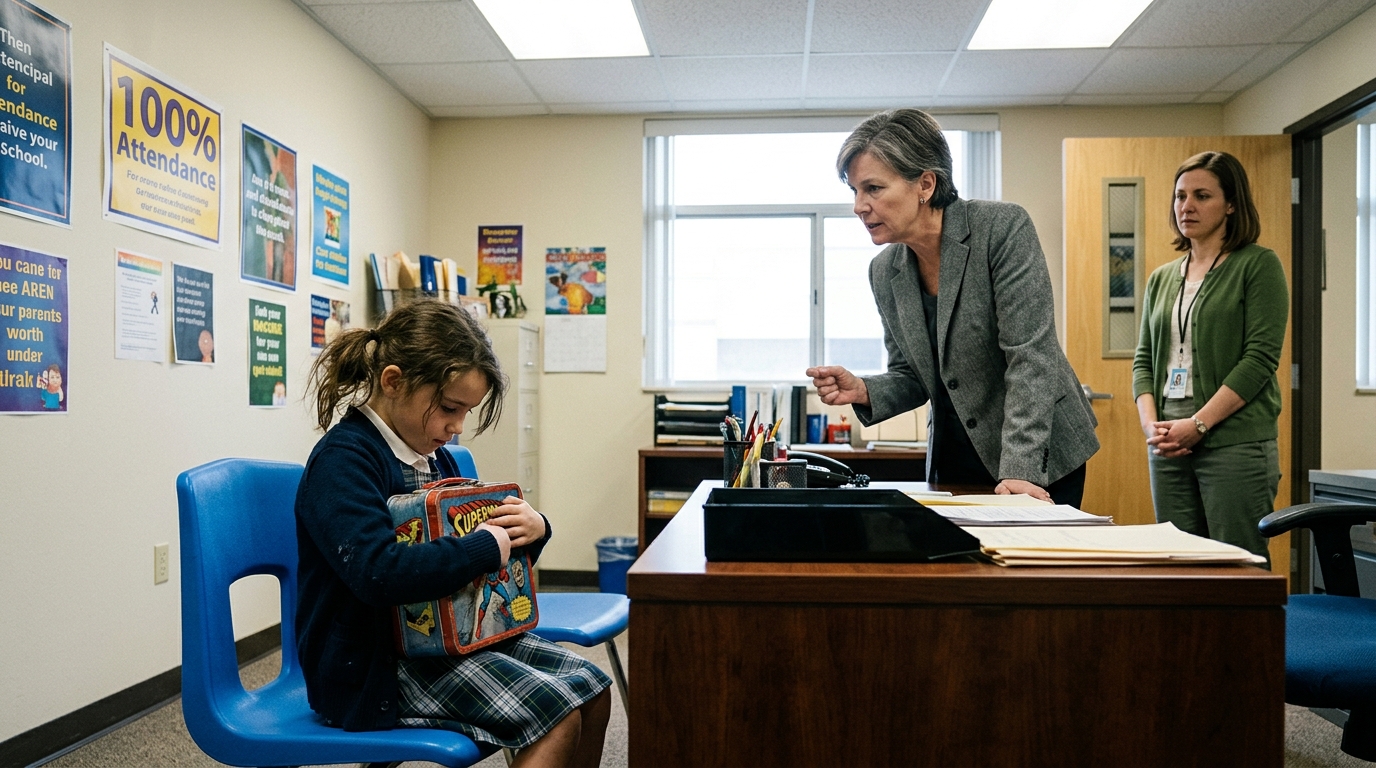
The school office was bright, neat, and cold. Perfect attendance posters covered the walls. A glass bowl of wrapped candies sat untouched on the receptionist’s desk. Outside the windows, children laughed on the playground, unaware that one small girl was being quietly broken inside the office.
Mia Carter sat in a plastic chair with both arms wrapped around a dented metal lunchbox.
Her shoes were muddy.
Her sweater sleeves were stretched from being pulled over her hands.
Her eyes were red, but she kept them fixed on the woman behind the desk.
Principal Elaine Porter folded her hands neatly.
“You need to stop saying your mother is alive.”
The words were calm.
That made them worse.
Mia shook her head.
“She came here.”
A social worker named Grace Bell stood near the door, holding a folder against her chest. She had been called because Mia kept insisting that her missing mother had returned to the school.
Principal Porter sighed loudly, like the child was wasting everyone’s time.
“Your mother disappeared two years ago.”
Mia’s eyes filled with tears.
“No. She came here.”
“Mia,” the principal said, voice sharpening, “children sometimes invent stories when they are frightened.”
“I’m not inventing.”
“You told your teacher your mother was in this office.”
“She was.”
“You told another student your mother left something here.”
“She did.”
Principal Porter leaned forward.
“That is enough.”
Mia’s grip tightened around the lunchbox.
Grace watched quietly.
Something about the girl’s posture bothered her. This was not a child performing for attention. This was a child protecting the last object she trusted.
Principal Porter stood and reached for the lunchbox.
“Mia, give that to me.”
The girl pulled back.
“No.”
“Mia.”
“No!”
The box slipped from her hands and hit the floor.
It popped open.
A folded photograph slid out across the tile.
Grace moved first.
She bent down and picked it up.
At first, she only frowned.
Then the blood drained from her face.
In the photo, Mia’s mother stood beside Principal Porter in that exact office.
Alive.
Thin.
Pale.
Smiling weakly.
Holding a school envelope.
The date stamp in the corner was six months after she supposedly disappeared.
Principal Porter’s face turned white.
She grabbed for the photo.
Too fast.
Too desperate.
Grace stepped back.
“Mia,” Grace said softly, “where did you get this?”
The little girl pointed at the lunchbox.
“Mommy put it inside.”
Grace turned the photo over.
On the back was the school’s official stamp.
And three handwritten words:
She knows everything.
Mia lifted one trembling finger and pointed at the principal’s locked cabinet.
“That’s where Mommy said they put her file.”
Principal Porter whispered:
“You were never supposed to find that.”
Video: The Principal Called a Little Girl a Liar—Then the Photo Proved Her Mother Came Back
The Mother Who Disappeared Twice
Mia’s mother, Clara Carter, had disappeared two years earlier.
At least, that was the official story.
Clara was a cafeteria aide at Hawthorne Elementary. She packed lunches, wiped tables, tied shoelaces, and remembered which children needed extra fruit because dinner at home was never guaranteed.
She was not rich.
Not powerful.
Not the kind of woman people listened to when important people denied knowing her.
But Clara noticed things.
She noticed children being marked absent when they were present.
She noticed special lunch funds disappearing before they reached the cafeteria.
She noticed certain files being pulled from the system and returned with new signatures.
She noticed that Principal Porter met privately with a man from the district office every Friday afternoon.
And she noticed one name appearing again and again:
Carter, Mia.
Her own daughter.
At first, Clara thought it was a clerical error.
Then she found a copy of a transfer request she had never signed.
A request to move Mia into “temporary guardianship review” because her mother was allegedly unstable, unemployed, and under investigation for neglect.
Clara was none of those things.
But the paperwork said she was.
And in a school system that trusted forms more than mothers, paperwork could become a weapon.
Clara began collecting proof.
Copies.
Photographs.
Records.
She hid them in places no one would search.
A cereal box.
A loose floorboard.
And finally, Mia’s old metal lunchbox.
Then Clara vanished.
People said she ran.
Principal Porter said Clara had been overwhelmed.
The district said it was a private family matter.
Mia said her mother would never leave without Rosie, her stuffed rabbit.
No one listened.
Until six months later, Clara came back.
Not home.
Not to the police station.
To Hawthorne Elementary.
Weak.
Terrified.
Carrying a school envelope.
And someone in that office took a photograph before everything was buried again.
The Locked Cabinet
Grace Bell looked at Principal Porter.
“Open the cabinet.”
The principal’s face hardened.
“This is confidential school property.”
Grace held up the photograph.
“This child’s mother was photographed in this office six months after her disappearance.”
“That photo could be altered.”
“It has the school stamp on the back.”
“Stamps can be forged.”
Grace looked at Mia.
The little girl was shaking now, but her finger remained pointed toward the cabinet.
Grace turned back to the principal.
“Open it.”
Principal Porter lifted her chin.
“You don’t have authority.”
Grace pulled out her phone.
“Then I’ll call someone who does.”
That changed the room.
The receptionist, who had been pretending not to hear, slowly stood.
Principal Porter’s eyes flashed toward her.
“Sit down, Carol.”
Carol did not sit.
Her voice came out small.
“She came here.”
Everyone turned.
Principal Porter went still.
Carol looked like she might cry.
“Clara Carter came here. I saw her.”
Mia’s mouth opened.
Grace stepped closer.
“When?”
Carol swallowed.
“Last spring. After dismissal. She was thin. Scared. She asked to see Mrs. Porter. She said something about Mia’s file.”
Principal Porter snapped:
“She was unstable.”
Carol shook her head.
“She was afraid.”
The office went silent.
Grace lowered her voice.
“Carol, do you know what happened after that?”
Carol looked at the locked cabinet.
“She left an envelope. Mrs. Porter told me to go home early.”
Mia whispered:
“Mommy said the envelope was blue.”
Carol covered her mouth.
“It was.”
Grace turned back to the principal.
“Open the cabinet now.”
Principal Porter did not move.
So Grace called Detective Quinn.
The Blue File
Detective Laura Quinn arrived thirty minutes later.
She did not arrive loudly.
That made Principal Porter more nervous.
No sirens.
No dramatic entrance.
Just a calm woman in a dark coat walking into the school office with the expression of someone who had learned to distrust neat desks.
She listened to Grace.
Looked at the photograph.
Spoke gently to Mia.
Then requested the cabinet key.
Principal Porter refused.
Detective Quinn obtained emergency access through the district supervisor after sending a photo of the evidence.
When the cabinet opened, the office seemed to stop breathing.
Inside were ordinary folders at first.
Attendance reports.
Permission forms.
Staff evaluations.
Then Grace saw it.
A blue folder wedged behind a stack of outdated policy manuals.
No label.
No digital record.
Detective Quinn pulled it out.
Mia stood from the plastic chair.
“That’s it,” she whispered.
The folder opened.
Inside were copies of documents.
Some old.
Some recent.
All connected by the same pattern.
False absence records.
Altered benefit forms.
Forged guardianship referrals.
Payments routed through a private “student support foundation.”
And at the center of the folder:
Mia Carter — emergency guardianship recommendation
Signed by:
Elaine Porter
And beneath that, a second signature.
Supposedly Clara Carter’s.
Grace looked at Mia.
Then at Principal Porter.
“Did you forge this?”
The principal’s lips pressed into a thin line.
Detective Quinn removed another page.
A handwritten note.
Clara’s handwriting matched the back of the photograph.
If I disappear again, they are trying to take Mia. Porter knows. Harlan knows. The lunchbox has the photo. Do not let them say I abandoned her.
Mia began to cry without sound.
Grace knelt beside her.
“Your mother didn’t leave you.”
Mia clutched the lunchbox.
“I told them.”
Grace’s throat tightened.
“I know.”
The Man From the District
The name Harlan led them to the district office.
Dr. Samuel Harlan was the deputy administrator responsible for student welfare referrals and emergency placement approvals.
On paper, he was respected.
In public, he gave speeches about protecting vulnerable children.
In private, the blue file suggested something else.
Certain children from struggling families were being marked as high-risk even when no real evidence existed. Their cases were routed toward specific private foster contractors and “support organizations” receiving district funds.
Poor mothers became unstable on paper.
Absent fathers became unknown.
Children became numbers.
Money moved.
Mia’s name had been next.
Clara discovered it.
Then disappeared.
When she resurfaced months later with proof, the principal buried the file and called her unstable again.
But there was one question still unanswered:
Where was Clara now?
Mia held the lunchbox in her lap while Detective Quinn asked her carefully:
“Did your mother tell you where she was going?”
Mia nodded.
“She said she had to go back before they noticed.”
Grace froze.
“Back where?”
Mia looked at the floor.
“The quiet house.”
Detective Quinn’s expression changed.
“What quiet house?”
“The place with white curtains. She said people there sleep even when they don’t want to.”
Grace went cold.
A private clinic.
Or worse.
Detective Quinn stood.
“Get me every facility Harlan has referred parents to in the last two years.”
Principal Porter finally spoke.
“You have no idea what you’re accusing people of.”
Detective Quinn turned.
“No. But Clara Carter did.”
The Quiet House
They found Clara Carter the next morning.
Not in another city.
Not hiding.
Not dead.
She was in a private psychiatric facility forty miles away, admitted under an emergency order signed by Dr. Harlan and supported by a school welfare affidavit from Principal Porter.
The record claimed Clara was delusional.
Obsessed with fabricated school corruption.
Unfit to parent.
A danger to herself.
A danger to her child.
The quiet house had white curtains.
Locked doors.
Soft voices.
Medication schedules.
Clara had been there for six months.
When Detective Quinn, Grace, and a court-appointed physician entered her room, Clara was sitting by the window, thin and pale, folding and unfolding a tissue in her hands.
At first, she did not look up.
Then Grace said:
“Clara?”
The woman’s eyes lifted slowly.
“Mia?”
Grace’s face broke.
“She’s safe.”
Clara began to shake.
“She found the lunchbox?”
“Yes.”
Clara covered her mouth.
“She believed me?”
Grace stepped closer.
“She never stopped.”
Clara sobbed then.
Not loudly.
Like someone who had been holding a scream under water for half a year.
When Mia was brought in later under careful supervision, she ran before anyone could stop her.
“Mommy!”
Clara dropped to her knees.
Mia crashed into her arms.
The room fell silent.
Even Detective Quinn turned away for a moment.
Clara held her daughter so tightly the child almost disappeared into her.
“I told them,” Mia sobbed. “I told them you came back.”
“I know, baby. I know.”
“They said you were gone.”
“I tried to get back.”
“I kept the lunchbox.”
Clara kissed her hair.
“You saved us.”
Mia shook her head.
“No. You did. You hid the picture.”
Clara looked at Grace over Mia’s shoulder.
Her voice was weak but clear.
“Porter knows where the rest is.”
Detective Quinn stepped closer.
“The rest of what?”
Clara’s eyes hardened.
“The children before Mia.”
The Other Files
The investigation spread quickly.
Principal Porter was suspended.
Dr. Harlan was arrested after attempting to delete district records.
The blue file became the key to a larger case involving false welfare referrals, private placement contracts, and money siphoned from programs meant for hungry children.
Clara’s records proved she had been telling the truth all along.
She had collected names.
Dates.
Payment trails.
Altered attendance records.
Guardianship referrals.
At least nine families had been affected.
Three children had already been placed outside their homes under questionable claims.
Two mothers had been labeled unstable after challenging school records.
One grandmother had lost temporary custody because a forged school report claimed she failed to pick up her grandson for weeks.
She had not.
The child had been present.
The records had been changed.
Grace Bell testified during the emergency hearing.
So did Carol, the receptionist.
So did Clara.
But the most devastating testimony came from Mia.
She sat with Rosie the rabbit in one hand and the metal lunchbox in the other.
The judge asked gently:
“Why did you keep saying your mother was alive?”
Mia looked confused by the question.
“Because she was.”
The courtroom went quiet.
The judge nodded slowly.
“Yes. She was.”
That sentence mattered.
Because for two years, adults had treated Mia’s truth like childish grief.
But children often know the shape of love better than institutions know the shape of evidence.
The Principal’s Last Lie
Principal Porter tried to protect herself.
She said she trusted Dr. Harlan.
She said Clara was troubled.
She said the photograph had been misunderstood.
She said the blue file was copied for compliance purposes.
But there was one problem.
The locked cabinet had a hidden camera above it.
Installed years earlier after medication records went missing.
Forgotten by almost everyone.
Except the old IT technician who still had access to archived footage.
The video showed Clara entering the office six months after her disappearance.
Alive.
Weak.
Carrying the blue envelope.
It showed Principal Porter taking the file from her.
It showed Clara crying and saying:
“You can’t take my daughter.”
It showed Porter answering:
“You should have stopped digging.”
Then Dr. Harlan entered.
The camera had no audio after that because the microphone was damaged.
But it showed enough.
Clara being led out through the back hall.
Principal Porter placing the blue file in the locked cabinet.
Then writing something on the back of the photograph before slipping it into an envelope.
Detective Quinn later asked her why she wrote the words:
She knows everything.
Porter’s face was blank.
“I panicked.”
Clara, listening from the witness room, whispered:
“No. She warned herself.”
The Office Changes
Months later, Hawthorne Elementary looked different.
Not the walls.
Not the posters.
Those stayed.
But Principal Porter’s name was gone from the office door.
Dr. Harlan’s district portrait was removed.
The student welfare process was placed under external review.
Every guardianship referral from the previous five years was audited.
Families received apologies.
Some received far more than that.
Children came home.
Not all.
Not easily.
But enough for the school to understand that paperwork could wound as deeply as any hand.
Grace Bell became the district’s independent child advocate.
Carol stayed at the front desk, but she changed one thing immediately.
No child was ever again left sitting alone in the office while adults discussed them like a file.
Mia returned to school slowly.
At first, she would not walk past the principal’s office without gripping Clara’s hand.
Then she could pass it alone.
Then, one afternoon, she stopped at the doorway.
The new principal, Mrs. Alvarez, looked up.
“Hi, Mia.”
Mia stared at the locked cabinet.
It was empty now.
The doors had been removed.
No more hidden files.
No more secret blue folders.
Just open shelves with extra notebooks, pencils, and snacks.
Mia looked at Mrs. Alvarez.
“Do you believe kids?”
Mrs. Alvarez put down her pen.
“I try to.”
Mia considered that.
Then nodded.
“Good.”
The Lunchbox
Clara kept the metal lunchbox.
Even after the case ended.
Even after the news vans left.
Even after people stopped whispering in grocery aisles.
It stayed on the kitchen shelf, dented and scratched, beside a framed copy of the photograph.
Mia once asked if they could throw it away.
Then changed her mind before Clara answered.
“No,” Mia said. “It helped.”
Clara smiled sadly.
“It did.”
Mia touched the dent in the corner.
“I was scared when it fell open.”
“I know.”
“But if it didn’t fall…”
Clara nodded.
“They might not have looked.”
For a long time, both of them were quiet.
Then Clara said:
“That doesn’t mean you had to be brave every second.”
Mia leaned against her.
“I wasn’t.”
“I know.”
“I cried in the bathroom.”
“That counts too.”
Mia looked up.
“Crying counts as brave?”
Clara kissed her forehead.
“Sometimes crying is what keeps you from going silent.”
Years later, people still told the story of the little girl in the school office.
They talked about the principal calling her a liar.
The lunchbox falling open.
The photograph.
The school stamp.
The three words on the back:
She knows everything.
But Mia remembered something else most clearly.
The moment before the box fell.
The moment when every adult in the room seemed ready to decide her mother’s truth was just a child’s fantasy.
She remembered holding the lunchbox so tightly her fingers hurt.
She remembered thinking:
Mommy said don’t let go.
And she didn’t.
Not until the truth slipped out on its own.
The principal had called her a liar.
But the photograph had answered.
And once the locked cabinet opened, the whole school learned what Mia had known all along:
Her mother had not disappeared.
She had been hidden.
And a child with a dented lunchbox had brought her back into the light.