The Coffee Pot That Shattered
He had imagined seeing his wife again for seven years.
Through every cold night overseas.
Through every letter that stopped coming.
Through every story his family told him about how she had left town and never looked back.
So when the old soldier walked into the small roadside diner, he only wanted coffee and a quiet answer.
The place smelled like pancakes, rain, and burnt toast. Neon light buzzed faintly over the counter. Outside, water streaked down the windows, blurring the highway into red taillights and gray morning.
A few truckers sat in the corner booths. An old man read a newspaper near the pie case. Somewhere in the back, dishes clattered behind the kitchen door.
The soldier stood near the entrance for a moment, one hand resting on the strap of his worn duffel bag.
His name was Daniel Mercer.
But almost nobody called him Daniel.
Not before the war.
Not before the letters stopped.
Not before the world turned his marriage into a story he never got to verify.
His wife had called him Danny.
Only her.
Only Clara.
He took one step toward the counter.
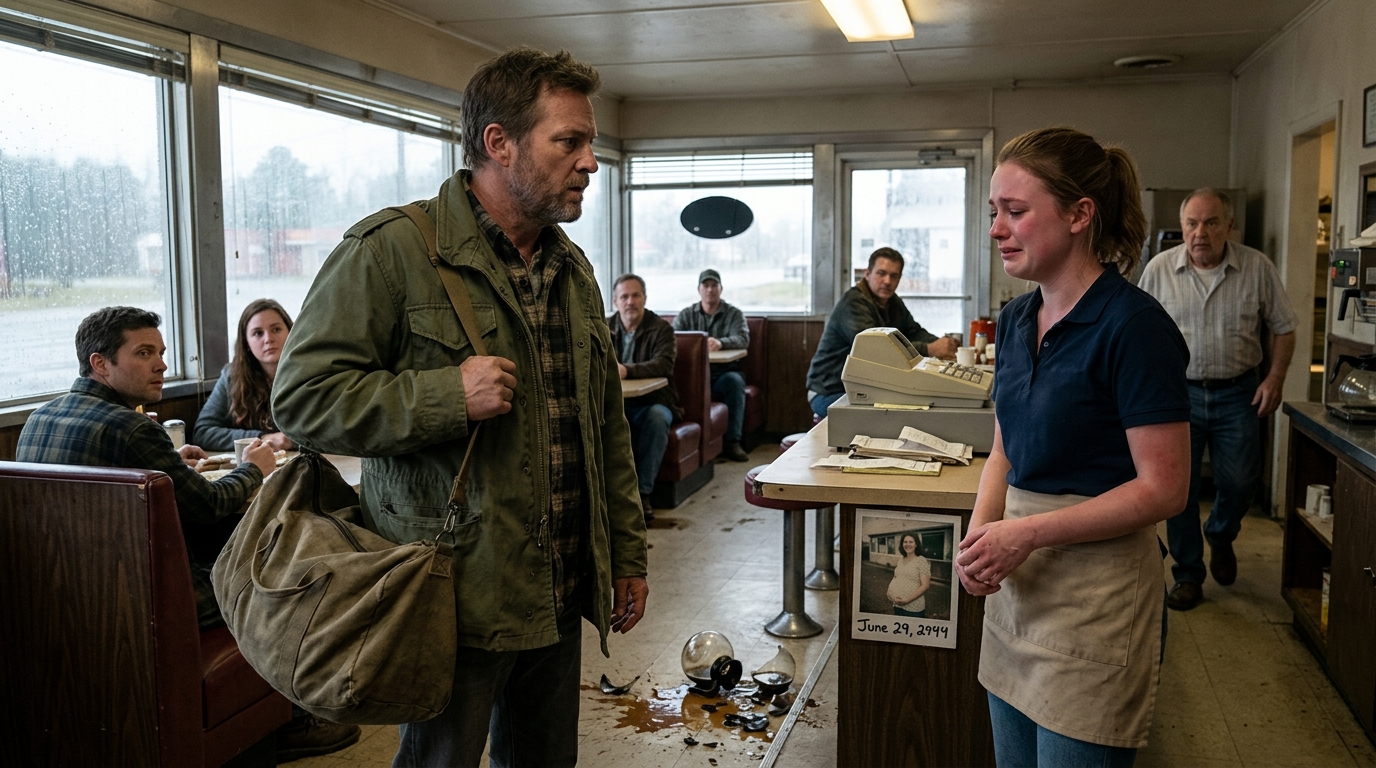
A young waitress moved between booths with a silver coffee pot in her hand. She looked barely twenty. Tired eyes. Brown hair pinned loosely behind her ears. A name tag that read Nora.
Then she saw him.
The coffee pot slipped from her fingers.
It hit the tile floor and shattered.
Hot coffee spread across the white-and-black squares.
Every customer turned.
The soldier froze.
Because the waitress whispered a name no stranger should have known.
“Danny?”
The word struck him harder than any bullet ever had.
His hand tightened around the duffel strap.
“What did you say?”
Nora’s face had gone white.
Her lips trembled.
Behind the counter, half-hidden beneath old receipts and a cracked plastic menu stand, was a faded Polaroid.
Daniel stepped closer.
Slowly.
As if the diner floor might disappear beneath him.
The photo showed his wife.
Clara.
Pregnant.
Smiling.
Standing in front of that same diner.
Her hair was longer than he remembered. One hand rested over the curve of her belly. Behind her, the red neon sign read:
BELL’S DINER — OPEN 24 HOURS
At the bottom of the Polaroid was a date.
Daniel’s breath stopped.
The picture had been taken two months after his family claimed Clara had disappeared.
The diner owner rushed from the kitchen.
He was a heavyset man with gray hair, a stained apron, and panic already written across his face.
“Don’t touch that.”
He reached for the photo.
Too fast.
Too scared.
Daniel snatched it first.
The owner froze.
Nora wiped at her tears with the back of her hand.
Then whispered:
“She told me you would come back someday.”
The diner went silent.
Not quiet.
Silent.
Daniel looked at the young waitress.
His voice broke.
“Where is my wife?”
Nora’s eyes filled harder.
Before she could answer, the owner said sharply:
“Girl, go to the kitchen.”
She did not move.
Daniel turned toward him.
“Why do you have a picture of my wife?”
The owner swallowed.
“I don’t know what you think you saw.”
Daniel held up the Polaroid.
“I saw my wife alive after you all told me she was gone.”
The old man near the pie case slowly folded his newspaper.
Nora stepped around the counter.
“She was here,” she said. “She waited for you.”
The words were soft.
But they cut through seven years of lies.
Video: The Soldier Walked Into the Diner—and the Waitress Knew His Wife’s Secret Name
The Story His Family Fed Him
Seven years earlier, Daniel Mercer had left for his final overseas assignment with one promise folded inside his jacket.
Clara had stood on their porch in a yellow cardigan, trying not to cry.
He still remembered the way the morning looked.
Wet grass.
Gray sky.
One suitcase by the door.
Her hands holding his face like she was trying to memorize the shape of him.
“Come back to me, Danny,” she whispered.
He kissed her forehead.
“Always.”
Two months later, her letters stopped.
At first, Daniel blamed distance.
Then military delays.
Then weather.
Then fear.
He wrote anyway.
Every week.
Sometimes twice.
He wrote about cold nights, bad coffee, the man in his unit who snored louder than artillery, the way he missed Clara’s terrible singing in the kitchen.
No answer came.
Then his older brother, Robert, wrote.
The letter was short.
Cold.
Careful.
Clara left town. She said she couldn’t wait anymore. I’m sorry.
Daniel did not believe it.
Not Clara.
Not the woman who saved every envelope he ever sent.
Not the woman who pressed her hand over his heart before he left and said she would count the days.
He wrote to his father.
No answer.
He wrote to his mother.
She replied once.
Sometimes women make choices men do not understand. Let her go.
Let her go.
As if love were a rope he had been foolish to hold.
Daniel returned home years later with scars in places no one could see. By then, his family had prepared the whole story.
Clara had been restless.
Clara had been seen with another man.
Clara had sold her ring.
Clara had left without saying goodbye because she was ashamed.
Every time Daniel asked for proof, Robert gave him pity.
Every time Daniel asked who had seen her leave, his mother cried.
Every time Daniel said Clara would never abandon him, someone told him grief made men stubborn.
So Daniel stopped asking out loud.
But he never believed them completely.
That was why he came to Bell’s Diner.
Not because he expected to find Clara.
Because one of his old letters had been returned to him years late.
The envelope was damaged, stamped, redirected, marked unreadable.
But on the back, in faint pencil, someone had written:
Bell’s Diner knows.
Daniel had carried that envelope for three months before finding the courage to drive there.
He thought he might get one old rumor.
One memory.
One final answer.
He did not expect a waitress to drop coffee and whisper his wife’s private name.
“She Waited Until the Baby Came”
Nora led Daniel to the last booth near the window.
The diner owner, Marty Bell, stood behind the counter with both hands braced against the edge.
His face looked older by the minute.
“No good comes from digging up this story,” Marty said.
Daniel sat slowly.
“No good came from burying it either.”
Nora placed the Polaroid on the table between them.
Her fingers trembled as she touched the corner.
“I was twelve when she came here,” she said.
Daniel looked at her.
“You knew Clara?”
Nora nodded.
“She came in during a storm. Same kind of rain as today. She was soaked, scared, and pregnant. She asked if anyone had seen a soldier named Daniel Mercer.”
Daniel closed his eyes.
For one second, he could see her.
Clara at the door.
Hand on her stomach.
Asking strangers for him.
Nora continued.
“My mother worked here then. She took Clara into the back and gave her soup. Clara said your family told her you were dead.”
Daniel opened his eyes.
The room blurred.
“What?”
Nora nodded, crying quietly now.
“She said Robert came to your house with papers. He told her your transport had been hit. He said there would be no body to bring home. He said your family didn’t want her around because she was making your mother’s grief worse.”
Daniel’s hand curled into a fist on the table.
“My brother told her I was dead.”
Nora glanced at Marty.
“He told everyone different things.”
Marty looked away.
Daniel’s voice sharpened.
“What did he tell you?”
The diner owner’s jaw worked.
At first, he seemed determined not to answer.
Then the old man near the pie case spoke.
“Marty, tell him.”
Marty closed his eyes.
“They came here looking for her.”
“Who?”
“Your brother. Two men with him.”
Daniel went still.
“When?”
“After the baby was born.”
The word baby struck him like a blow.
Daniel looked at Nora.
His voice became almost soundless.
“Baby?”
Nora swallowed.
“She had a daughter.”
Daniel could not move.
The diner disappeared.
There was no rain.
No coffee.
No old tile floor.
Only the impossible shape of that sentence.
A daughter.
He had a daughter.
Clara had been pregnant in the photograph. He had seen it with his own eyes, but some part of him had not let the truth enter fully until Nora said it.
Marty rubbed both hands over his face.
“Clara stayed above the diner for almost four months. My wife helped deliver the child in the back room because Clara was too afraid to go to the hospital.”
Daniel stared at him.
“And no one told me?”
Marty’s face twisted with shame.
“We thought you were dead at first.”
“And later?”
No one answered.
That silence was answer enough.
Daniel stood so suddenly the booth table shifted.
Nora reached into her apron pocket.
“Wait.”
She pulled out a small envelope.
Old.
Soft from being handled.
“This was hers.”
Daniel took it carefully.
On the front, in Clara’s handwriting, was one word:
Danny
His knees nearly gave out.
He sat back down.
The envelope opened with a whisper.
Inside was a letter.
The ink had faded, but he knew every curve of her writing.
Danny,
If this reaches you, then every person who stood between us has failed at least once. I did not leave you. I waited. I wrote. I begged your family to tell me where you were buried, and when no grave came, I began to wonder if grief was just another way they were controlling me.
Daniel’s breath shook.
Nora looked away, giving him privacy he could barely use.
He kept reading.
Our daughter was born on a rainy morning at Bell’s Diner. I named her Lily because you once said lilies looked too delicate to survive storms, but they do anyway. She has your eyes. I am afraid to write more. Robert has found us. If I run again, it is not because I stopped waiting. It is because I have to keep her alive.
The final line was almost unreadable from water damage.
If you come back, ask for the box under the jukebox.
Daniel lifted his head.
Marty had already gone pale.
The Box Under the Jukebox
The jukebox stood in the back corner beneath a framed photograph of Route 66.
It had not worked in years.
Dust coated the glass. A cracked label still displayed old country songs no one played anymore.
Daniel walked toward it with the letter in his hand.
Marty stepped in front of him.
“Don’t.”
Daniel looked at him.
The diner owner’s eyes were wet.
“I didn’t know how to fix what I helped break.”
Daniel’s voice was low.
“Then move.”
Marty moved.
Nora crouched beside the jukebox and pressed a loose wooden panel near the base.
It clicked open.
Inside was a small metal box.
Daniel recognized it immediately.
It had once belonged to Clara.
She kept sewing needles in it when they were first married.
Nora placed it on a table.
Daniel opened it.
Inside were letters.
Dozens.
Some addressed to him.
Some addressed from him.
His letters.
The ones he had mailed overseas.
Returned.
Unopened.
Hidden.
Stolen.
His hand shook as he lifted the first.
To Mrs. Clara Mercer
Forwarding mark scratched out.
Another letter.
Another.
Another.
All the words he thought had vanished had been here.
Stacked in a diner box beneath a dead jukebox.
Marty whispered, “Robert brought them.”
Daniel turned slowly.
“What?”
“He said Clara had abandoned you. Then later he said you had abandoned her. He paid me to give him anything that came here. My wife begged me not to take the money.”
Daniel’s face hardened.
“You sold my wife’s letters?”
Marty flinched.
“I was in debt. The diner was failing. He said it was family business. He said Clara was unstable. I told myself it wasn’t my place.”
Nora’s voice shook.
“My mother never forgave him.”
Marty looked at her.
“No,” he whispered. “She didn’t.”
Inside the box was one more thing.
A hospital bracelet.
No hospital name.
Just a handwritten tag tied with string.
LILY MERCER
Mother: Clara Mercer
Father: Daniel Mercer
Daniel touched the bracelet like it might burn.
“My daughter,” he whispered.
Nora sat across from him.
“She’s alive.”
Daniel’s head snapped up.
The words came so quietly that at first, he thought he had imagined them.
“What?”
Nora’s eyes filled.
“Lily is alive.”
Daniel stood.
“Where?”
Marty grabbed the counter like his body needed something solid.
“Nora.”
But she ignored him.
“She was here until two weeks ago.”
Daniel stared at her.
Here.
His daughter had been here.
In this diner.
Maybe walking between these booths.
Maybe serving coffee at this same counter.
Maybe looking at the door every time it opened.
His voice cracked.
“Where is she now?”
Nora looked toward the rain-dark window.
“Robert took her.”
Daniel’s face changed.
The whole diner seemed to feel it.
The old soldier who had entered quietly, asking only for coffee, was gone.
In his place stood a man who had just learned the war had not ended overseas.
It had been waiting for him at home.
The Girl Who Had His Eyes
Lily Mercer was six years old when Daniel left.
Or so he thought.
But time had been stolen so thoroughly that even numbers felt like lies now.
Nora explained through tears.
Clara had raised Lily in hiding for the first few years, moving from rooms above diners to boarding houses to farms where no one asked questions.
But Robert always seemed to find them.
Clara believed he had people watching the post office, the clinic, anyone who might help her reach Daniel.
Eventually she returned to Bell’s Diner, not because it was safe, but because it was the only place that still held proof.
She was sick by then.
Not dying, exactly.
Just worn down by years of running.
Lily was nearly seven.
Old enough to ask why her father never came.
Old enough to memorize his photograph.
Old enough to learn that adults could lie while smiling.
Clara had left three weeks earlier to meet an attorney in the next county.
She never came back.
Then Robert arrived.
He claimed Clara had abandoned Lily.
He had papers.
Custody forms.
Family orders.
Threats.
Marty did nothing.
Nora tried.
She still had a bruise near her wrist from where Robert’s driver shoved her away from the truck.
“He said Lily belonged with blood family,” Nora whispered.
Daniel’s eyes were cold.
“She was with blood family.”
Nora nodded.
“She screamed your name.”
Daniel closed his eyes.
A child he had never held had screamed for him.
Because Clara had kept him alive in stories.
Because lies had stolen his body from their life, but not his name.
“Where did he take her?”
Marty spoke this time.
“The old Mercer house.”
Daniel’s expression changed.
His family home.
The place he had refused to visit since returning because every wall in it carried a version of Clara’s disappearance.
“My mother is there?”
Marty nodded.
“Robert too.”
Daniel placed the letters back in the box, except Clara’s last one.
That he folded and put inside his jacket.
Then he picked up the Polaroid.
His voice was quiet.
“Call the sheriff.”
Marty shook his head.
“Robert has friends there.”
Daniel looked at him.
“Then call someone he doesn’t.”
Nora stepped forward.
“I already did.”
Everyone turned.
She held up the phone.
“State police are on the way.”
For the first time since Daniel entered the diner, Marty looked at his daughter with something like pride.
Nora looked at Daniel.
“Clara said if you came back, you’d go straight into fire for them.”
Daniel’s eyes glistened.
“She knew me.”
Nora nodded.
“That’s why she said to make you wait for backup.”
The House That Lied
Daniel did not wait long enough.
No soldier who had lost seven years to lies could sit still while his daughter sat inside the house that made them.
By the time he reached the Mercer estate, rain had turned the gravel drive to mud.
The house looked exactly as he remembered and nothing like home.
White columns.
Dark windows.
Old oak trees bending in the storm.
A place built on family pride and maintained by secrets.
He walked to the front door and knocked once.
Hard.
Robert opened it.
For a moment, neither brother spoke.
Robert looked older.
Broader.
Richer.
But his eyes were the same: calculating, cold, already building the story he planned to tell.
“Daniel,” he said. “This is unexpected.”
Daniel’s fist connected with his brother’s face before Robert finished the sentence.
Robert hit the floor.
A woman screamed from inside.
Daniel stepped over him.
“Where is my daughter?”
His mother appeared at the foot of the stairs, one hand pressed to her pearls.
“Daniel, what have you done?”
He looked at her.
For years, he had imagined confronting her.
Asking why.
Begging for one honest answer.
Now there was only one question that mattered.
“Where is Lily?”
His mother’s face tightened.
“That child has been through enough confusion.”
“Where is she?”
Robert groaned from the floor.
“She is safe.”
Daniel turned toward him.
“She was safe with her mother.”
Robert’s eyes flashed.
“Clara was never fit.”
Daniel grabbed him by the collar and dragged him upright.
“You told her I was dead.”
Robert spat blood onto the floor.
“You were as good as dead. And she was going to ruin everything.”
There it was.
Not denial.
Not guilt.
Ownership.
Daniel’s mother cried, “Your father’s will was complicated. Clara had no place in this family.”
Daniel looked at her.
“She was my wife.”
“She was a waitress.”
“She was my wife.”
The words echoed through the hall.
Then, from upstairs, came a small voice.
“Daddy?”
Daniel froze.
His whole body stopped.
Slowly, he looked up.
A little girl stood at the top of the staircase.
Brown hair.
Bare feet.
One hand clutching the railing.
In her other hand was a folded photograph.
The same Polaroid.
No.
A copy of it.
She stared at him as if she had been looking for his face all her life and was terrified it might vanish if she blinked.
Daniel’s voice broke.
“Lily?”
The child began to cry.
Not loudly.
Not dramatically.
Just silently, with her mouth trembling like she was trying to be brave because someone had taught her crying was dangerous.
Then she ran.
Down the stairs.
Straight into his arms.
Daniel dropped to his knees before she reached him, and Lily crashed against his chest so hard the breath left him.
He held her like the war, the years, the lies, the ocean, the letters, and every cold night overseas had all been leading to this one impossible moment.
She smelled like soap and rain and fear.
He pressed his face into her hair.
“I’m here,” he whispered. “I’m here.”
Lily sobbed into his jacket.
“Mom said you would come.”
Daniel squeezed his eyes shut.
“I tried, baby. I tried.”
Behind him, Robert moved.
Daniel did not turn.
He did not need to.
State police entered through the open door before Robert reached the back hall.
Nora had kept Clara’s final instruction.
She made him wait just long enough.
Clara’s Last Place
Robert did not confess immediately.
Men like him rarely do.
He spoke of duty.
Family reputation.
Inheritance law.
Clara’s instability.
Daniel’s absence.
The need to protect the Mercer name from scandal.
But the box from the diner, the letters, Clara’s note, Lily’s custody papers, and Marty Bell’s statement cracked the story open.
Then investigators found Clara.
Alive.
Not at the estate.
Not at a hospital.
At a private recovery home two towns away, registered under a false name.
She had been admitted after being found unconscious near the attorney’s office she had tried to reach.
Robert claimed she had no family.
He paid the facility in cash.
He instructed them not to allow visitors.
When Daniel entered her room, he nearly collapsed.
Clara sat by the window, thinner than memory, one hand resting on a blanket, face turned toward the rain.
Her hair had streaks of gray now.
There were lines around her mouth that had not existed when he left.
But she was alive.
He stopped in the doorway.
For the first time since the diner, fear took him.
What if she hated him?
What if the lies had done too much?
What if seven years could not be crossed by walking into a room?
Then Clara turned.
Her eyes found his.
For one second, she did not move.
Then her lips parted.
“Danny?”
He broke.
He crossed the room and fell to his knees beside her chair.
Clara reached for his face with shaking hands.
“You’re real.”
He covered her hands with his.
“I wrote to you.”
“I wrote to you too.”
“They took the letters.”
“I know.”
“I came back.”
Her face crumpled.
“I waited.”
“I know.”
“No,” she whispered, tears spilling now. “I waited even when I hated you for not coming.”
Daniel closed his eyes.
“You should have hated me.”
“I did.”
He nodded, crying openly.
“Good.”
She gave a broken laugh through the tears.
“You were always terrible at apologizing.”
He laughed too, and the sound hurt because it belonged to a life stolen from them.
Then Lily stepped into the doorway behind him.
Clara’s breath caught.
“My girl.”
Lily ran to her.
Daniel wrapped both of them in his arms.
Not tightly enough to erase seven years.
Not strongly enough to repair every lie.
But enough to prove they were finally in the same room.
The Trial of the Mercer Family
Robert Mercer was arrested for kidnapping, fraud, unlawful custody interference, evidence tampering, and conspiracy connected to Clara’s confinement.
Daniel’s mother faced charges related to forged statements and concealment of letters.
Marty Bell testified in exchange for reduced charges connected to accepting money and hiding correspondence.
He wept on the stand.
“I told myself it was a family matter,” he said. “But family matters are how cowards excuse cruelty.”
Nora testified too.
She described Clara waiting at the diner window.
Lily sleeping in the booth.
Robert arriving with papers.
The night Lily was taken.
Daniel sat in the courtroom holding his daughter’s hand while Clara testified.
Her voice shook, but it did not break.
The defense tried to suggest she had chosen to leave Daniel.
Clara looked at Robert and said:
“I left danger. I never left my husband.”
The room went silent.
When asked why she kept the Polaroid hidden at the diner, Clara answered:
“Because I needed one place in the world to remember the truth if I couldn’t.”
The Polaroid was shown to the jury.
Clara pregnant.
Smiling.
Standing in front of Bell’s Diner.
The date at the bottom.
Two months after the Mercer family claimed she vanished.
It became the image the case turned on.
Not because it proved everything.
Because it proved enough.
Clara had been alive.
Pregnant.
Waiting.
And someone had made sure Daniel never knew.
Robert was convicted.
Daniel’s mother pleaded guilty to lesser charges.
The Mercer estate went into legal review.
Daniel did not care about the house.
He cared about the letters.
Every one of them was returned to him.
He and Clara read them slowly over months.
Sometimes together.
Sometimes not.
Some nights they could only read one before grief filled the room too heavily.
Other nights they read until sunrise, reclaiming pieces of themselves from envelopes that had arrived too late.
The Diner Window
A year later, Daniel returned to Bell’s Diner with Clara and Lily.
The coffee pot had been replaced.
The tile floor still had a faint stain where it shattered.
Nora was still working there, though now she was studying social work at night.
Marty had aged ten years since the trial.
He approached their booth with three menus and shame in every line of his face.
Daniel looked at him.
For a long moment, neither spoke.
Then Marty said, “I don’t expect forgiveness.”
Daniel nodded.
“Good.”
Marty flinched but accepted it.
Clara looked at him more gently than Daniel could.
“You gave me a room when I had nowhere else.”
“I also took money to stay quiet.”
“Yes,” she said. “Both are true.”
Marty’s eyes filled.
That was the hardest kind of mercy.
The kind that did not erase guilt.
Lily sat by the window, looking at the old neon sign.
“Is this where I was born?”
Clara smiled softly.
“In the back room during a thunderstorm.”
Lily wrinkled her nose.
“That’s weird.”
Daniel laughed.
“It is.”
Nora brought pancakes.
Extra syrup.
No charge.
Daniel looked at the window where rain had once blurred the highway.
He remembered walking in with nothing but a returned letter and a heart full of questions.
He remembered the coffee pot breaking.
Nora whispering Danny.
The Polaroid.
The first crack in the lie.
Clara reached across the table and took his hand.
“You came back,” she said.
Daniel looked at her.
“So did you.”
She smiled.
It was tired.
Older.
Marked by pain.
But real.
Years later, people still talked about the soldier who walked into a roadside diner and found a photograph that exposed his family’s lie.
They talked about the waitress who knew his private name.
The coffee pot.
The Polaroid.
The box under the jukebox.
The daughter hidden in the old Mercer house.
But Daniel remembered the smallest thing most clearly.
The date written at the bottom of the photograph.
Two months after the world told him Clara had disappeared.
Two months after his family began feeding him grief for breakfast.
Two months after his wife stood in front of Bell’s Diner, pregnant, afraid, and still smiling because she believed he would come back someday.
She had been right.
Not soon enough.
Not cleanly enough.
Not before too much was stolen.
But he came.
And the truth, waiting beneath old receipts and diner dust, finally rose to meet him.