The Slap in the Marble Hall
The slap echoed through the estate.
Sharp.
Brutal.
Loud enough to make the servants freeze near the corridor.
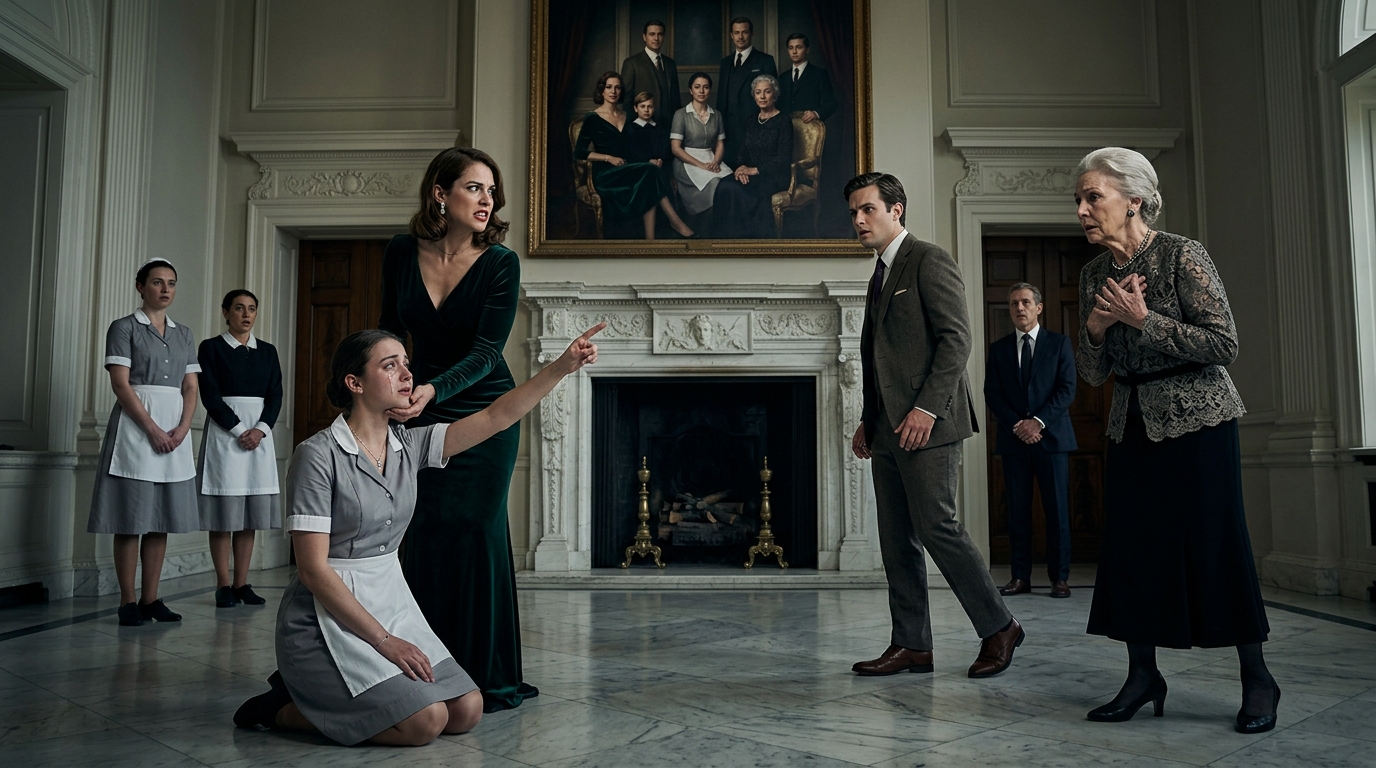
The young maid fell to her knees on the marble floor, one hand pressed against her cheek, tears spilling before she could stop them.
Above her, Vivian Cross, the billionaire heir’s fiancée, stood in a silk cream dress with anger burning behind her perfect smile.
“You returned to extort this family!”
Her voice carried through the grand hall.
Guests turned.
Servants stopped breathing.
At the foot of the staircase stood Adrian Whitmore, the son of the house, pale and stunned in his black suit.
“Vivian,” he said. “Stop.”
But Vivian did not stop.
She grabbed the maid by the chin and forced her face upward.
“Look at him,” she snapped. “Look at him and say what you came here to say.”
The maid’s name was Mara Reyes.
At least, that was the name written on her employment file.
She had been hired two weeks earlier as temporary staff for the engagement dinner. Quiet. Efficient. Invisible in the way rich houses preferred their workers to be invisible.
Until that night.
Until Vivian accused her of stealing.
Until the old envelope slipped from Mara’s apron pocket.
Until Vivian saw Adrian’s last name written across it.
Now the hall was full of people staring at the maid like she was something shameful dragged in from the rain.
Mara’s lips trembled.
But she did not look at Adrian.
Not at first.
Her hand rose slowly.
Shaking.
Then she pointed beyond him.
Toward the fireplace.
Everyone turned.
Above the mantel hung the largest family portrait in the estate.
The Whitmores, painted twenty-five years earlier.
Polished.
Powerful.
Unblemished.
Adrian’s father, Richard Whitmore, stood at the center. His wife beside him. His young son at his knee. And near the edge of the portrait stood a beautiful young woman in a dark green dress.
Richard’s younger sister.
Elena Whitmore.
The lost daughter of the family.
The woman everyone said had died in the east-wing fire before Adrian was old enough to remember her.
Mara pointed at Elena’s neck.
A silver necklace rested against the painted woman’s collarbone.
Delicate.
Oval-shaped.
Set with one tiny blue stone.
Then every eye slowly moved to Mara.
The same necklace hung around her throat.
The room went still.
Adrian stared.
His grandmother, Beatrice Whitmore, stepped forward from beside the staircase. She was eighty now, thin and elegant, her silver hair pinned perfectly at the back of her head.
But when she saw the necklace, the strength left her face.
“That necklace,” she whispered, “was buried after the fire… with my lost daughter.”
Vivian’s hand dropped from Mara’s chin.
The old woman moved closer, trembling.
“That was Elena’s.”
Mara looked up through tears.
Her voice, when it came, was quiet.
Steady.
And no longer afraid.
“Then why did your father hide my identity?”
Adrian stopped breathing.
Because she was not asking Vivian.
She was asking him.
And from the doorway behind them, Richard Whitmore’s cane struck the floor once.
Hard.
Everyone turned.
The old patriarch stood there in a dark suit, his face drained of color.
“Mara,” he said softly.
Not shocked.
Not confused.
Recognizing.
And that was when the room understood.
Richard already knew.
The Girl in the Servants’ Wing
Mara had grown up in the servants’ wing.
Not this servants’ wing.
Another one.
A smaller estate on the edge of the city owned by a woman named Mrs. Vale, who ran a private household staffing agency for wealthy families.
Mara was told her mother had died in childbirth.
She was told her father was unknown.
She was told she had been lucky.
Lucky to have a roof.
Lucky to have work.
Lucky to be trained.
Lucky not to end up on the street.
That word followed her everywhere.
Lucky.
When she was eight, Mrs. Vale gave her the necklace.
Not as a gift.
As a warning.
“This belonged to the woman who ruined your life,” Mrs. Vale said. “Wear it if you want, but never ask where it came from.”
Mara wore it anyway.
Because it was the only thing in the world that seemed to belong to her before anyone else touched it.
Years passed.
She learned how to polish silver, pour wine, change sheets without wrinkling corners, and lower her eyes when people with money spoke sharply.
Then Mrs. Vale died.
And in a locked drawer beneath old payroll ledgers, Mara found an envelope.
Inside was a photograph of Elena Whitmore.
Wearing the necklace.
Pregnant.
Standing in front of the Whitmore estate.
Behind the photo was a letter written in a shaking hand.
If the girl asks where she came from, tell her Richard Whitmore buried the answer with his sister.
Mara did not understand at first.
Then she found more.
A birth record with her name crossed out.
A hospital transfer form.
A payment from Richard Whitmore to Mrs. Vale’s agency.
And one sentence written in the margin:
Child must never be connected to Elena.
So Mara came to the estate.
Not to steal.
Not to extort.
To ask one question.
Who am I?
She had planned to wait until after the engagement dinner. She had planned to speak privately to Adrian because Richard was ill and rarely met staff directly.
But Vivian had found the envelope.
Vivian had read enough to panic.
And panic, in people like Vivian, always turned into cruelty first.
Now Mara stood in the grand hall with half the city watching, the necklace at her throat, and Richard Whitmore frozen in the doorway.
Adrian turned toward his father.
“You know her?”
Richard’s mouth opened.
No answer came.
Beatrice took one step toward Mara.
Her eyes were fixed on the necklace.
“Where did you get that?”
Mara swallowed.
“Mrs. Vale gave it to me.”
The old woman flinched.
“That woman worked here after the fire.”
Richard closed his eyes.
Adrian looked between them.
“What fire?”
No one answered fast enough.
So Mara did.
“The east-wing fire. The one that killed Elena Whitmore.”
Her voice trembled.
“The fire everyone says killed your aunt.”
She touched the necklace.
“But if Elena was buried with this…”
Her eyes moved back to Richard.
“…why am I wearing it?”
The Fire That Built the Lie
The east-wing fire had happened twenty-four years earlier.
Adrian was four.
Too young to understand why people cried in the corridors.
Too young to question why his father ordered half the house rebuilt.
Too young to notice that every photograph of Elena disappeared except the portrait too large to remove without causing talk.
The official story was simple.
Elena Whitmore, Richard’s younger sister, died after a fire broke out in her bedroom suite. The body was badly burned. The family held a private funeral. Richard handled everything.
Beatrice had been recovering from surgery at the time.
She never saw the body.
She was told it would be too cruel.
She believed her son because grief made belief easier than fighting.
But Elena had not been alone that year.
She was pregnant.
That part was hidden from the public.
The family said she had been unwell.
Traveling.
Resting.
Recovering from “nerves.”
In truth, Elena had been preparing to expose her brother.
Richard had been moving money through family trusts. Elena found the documents. She threatened to go to the board. Worse, she planned to name the child she was carrying as a protected heir under her late father’s will.
That would have complicated everything.
The Whitmore fortune was old.
And old fortunes hate complications.
Richard looked at Mara now with the expression of a man watching a locked door open by itself.
Beatrice turned toward him slowly.
“Richard.”
Her voice was quiet.
Deadly.
“Tell me my daughter died in that fire.”
Richard gripped his cane.
“She did.”
Mara reached into her apron pocket and pulled out the second paper from the envelope.
A birth certificate copy.
Her hand shook as she unfolded it.
“Then why does this say Elena Whitmore gave birth three days after the fire?”
The hall went silent.
Adrian stepped closer.
“Let me see.”
Mara handed it to him.
His eyes moved across the page.
Mother: Elena Rose Whitmore
Child: Female
Name: Mara Elena Whitmore
Private transfer authorized by: Richard A. Whitmore
Adrian’s face went white.
Vivian whispered, “This is forged.”
But no one was looking at Vivian anymore.
Beatrice held out her hand.
Adrian gave her the paper.
The old woman stared at it.
Her lips trembled.
“Mara Elena…”
She looked at the maid kneeling on the floor.
Then she looked at her son.
“You told me the baby died with her.”
Richard’s jaw tightened.
“Elena was unstable.”
The room shifted.
There it was.
The sentence powerful families use when a woman’s truth becomes inconvenient.
Beatrice’s eyes filled with tears.
“Where is she?”
Richard looked away.
The silence was answer enough.
Mara’s voice broke.
“My mother is dead, isn’t she?”
Richard said nothing.
Adrian stepped toward his father.
“What did you do?”
The Room Beneath the Ashes
Richard did not confess that night.
Men like him rarely do.
He called the documents fake.
He called Mara an opportunist.
He called Mrs. Vale a liar.
He called Elena disturbed.
Then Beatrice slapped him.
Not hard enough to injure.
Hard enough to return the echo Vivian had started.
“Do not use that word for my daughter again.”
Nobody moved.
Vivian stepped toward Adrian.
“This family is under attack. You need to think.”
Adrian turned to her.
“You hit a woman who might be my cousin.”
Vivian’s face tightened.
“I was protecting you.”
“No,” he said. “You were protecting the lie.”
That ended the engagement dinner.
Guests were escorted out.
Police were called.
The necklace, birth certificate, envelope, and photograph were taken as evidence.
Detective Laura Quinn arrived before midnight.
She had the calm face of someone who had seen wealthy families try to turn crimes into misunderstandings.
She listened to Mara.
Then Beatrice.
Then Adrian.
Richard refused to speak without counsel.
Vivian refused to leave until Adrian told security to escort her out.
For the first time in years, the Whitmore estate belonged to someone other than Richard’s will.
The investigation began in the east wing.
The rebuilt rooms were beautiful now.
Pale walls.
Antique mirrors.
Silk curtains.
No sign of fire.
But beneath the new flooring, investigators found the old foundation marks.
And behind a sealed panel near the fireplace, they found a metal box.
Elena had hidden it.
The box had survived the fire because it had been tucked inside the stone cavity of the chimney.
Inside were letters.
Financial records.
A small blue baby blanket.
And a diary.
Beatrice read the first page and wept.
Richard knows about the baby. He says I am selfish for keeping her. He says I am destroying the family over sentiment. But this child is not sentiment. She is mine.
Mara stood beside her, unable to breathe.
Her mother had written about her.
Not as a problem.
Not as a secret.
As a child.
Mine.
The diary told the rest in pieces.
Elena had discovered Richard’s fraud.
She had planned to leave the estate and meet a lawyer.
She feared Richard would try to have her declared unstable.
She hid documents in the east wing.
The final entry was written the night of the fire.
If anything happens, Mother must know. My daughter must know. Her name will be Mara. I chose it before anyone could take that too.
Mara covered her mouth.
She had thought Mrs. Vale named her.
She was wrong.
Her mother had.
The Daughter Returned as Staff
The truth of the fire took months to fully uncover.
Elena had survived the initial blaze.
That was the first horror.
A private doctor, paid by Richard, transported her under a false name to a clinic outside the city. She gave birth there three days later.
Mara was taken from her within hours.
Elena died not long after.
The clinic record called it “complications.”
Detective Quinn called it a suspicious death.
Too much time had passed for every charge to be proven cleanly, but the concealment was undeniable.
Richard had paid Mrs. Vale to take the child and raise her outside the family.
Not as an adopted daughter.
Not as a ward.
As staff.
Because an heir hidden as a servant is easier to control than an heir hidden in a grave.
Beatrice nearly collapsed when she heard that.
“My granddaughter was alive,” she whispered. “And I walked past girls like her my whole life.”
Mara did not comfort her.
Not because she was cruel.
Because grief deserved honesty before comfort.
Adrian struggled too.
He had inherited the wealth Mara had been denied.
He had slept in rooms she cleaned.
He had complained about servants being slow while his own blood might have been carrying trays in another estate.
One afternoon, he found her in the old east-wing sitting room, holding the blue baby blanket from the metal box.
“I’m sorry,” he said.
Mara did not look up.
“You didn’t do it.”
“No. But I lived inside what it gave me.”
That made her look at him.
It was the first honest thing anyone in the family had said to her without trying to soften the edges.
“Then don’t waste it,” she said.
“I won’t.”
Richard was arrested six weeks later.
Fraud.
Identity concealment.
Falsification of medical and death records.
Conspiracy.
Child trafficking-related charges tied to Mara’s transfer.
Obstruction.
And charges connected to Elena’s death, though those would prove harder to convict.
When police led him out through the same marble hall where Mara had been slapped, he did not look at her.
He looked at Beatrice.
“Everything I did was for this family.”
The old woman’s face hardened.
“No. You did it for the name. You destroyed the family.”
Mara stood at the foot of the staircase, the necklace visible at her throat.
Richard’s eyes flicked to it.
For the first time, she saw hatred there.
Not fear.
Hatred.
Because she had survived the role he wrote for her.
The Trial of Richard Whitmore
The trial lasted nearly a year.
Richard’s lawyers tried to bury the truth under complexity.
Trust structures.
Medical uncertainty.
Missing records.
Old memories.
A dead staffing agent.
A woman long gone.
They called Mara’s claim emotionally driven.
They suggested Mrs. Vale had forged the papers for money.
They implied Elena might have willingly given up the child.
Then prosecutors opened the metal box.
The diary.
The letters.
The baby blanket.
The financial records.
The necklace.
Beatrice testified.
She was eighty-one, fragile, and merciless.
“My son told me my daughter was dead,” she said. “Then he let me bury an empty lie.”
Richard did not look at her.
Adrian testified too.
He described the engagement dinner.
The slap.
The portrait.
The moment Mara asked why his father had hidden her identity.
Vivian was subpoenaed.
She tried to make herself sound like a concerned fiancée protecting the family from extortion. The courtroom video from the estate contradicted her.
The slap.
The accusation.
The fear when the necklace was recognized.
When asked why she tried to seize the documents before police arrived, Vivian said she was overwhelmed.
Mara’s attorney asked, “Overwhelmed by what?”
Vivian had no answer.
Mara testified last.
She wore a simple dark dress and Elena’s necklace.
Not because she needed drama.
Because she refused to hide the one thing her mother had left behind.
Richard’s lawyer asked, “Isn’t it true that you came to the Whitmore estate seeking money?”
Mara looked at him.
“I came seeking my name.”
The room fell quiet.
“And did you expect to inherit from this family?”
“I expected nothing from this family. That is what I was trained to expect.”
Even the judge looked down at that.
Richard was convicted on most charges tied to fraud, concealment, and falsified records. The jury could not convict him fully for Elena’s death.
That hurt.
But the court officially recognized Mara’s identity.
Mara Elena Whitmore.
Daughter of Elena Rose Whitmore.
Granddaughter of Beatrice Whitmore.
Heir to the portion of the family estate Richard had tried to erase.
Not maid.
Not orphan.
Not extortionist.
Daughter.
The Portrait Rehung
The Whitmore estate changed after the trial.
Not beautifully.
Truth rarely redecorates gently.
Richard’s portrait was removed from the main hall.
Beatrice ordered it placed in storage, not destroyed.
“Let the record show he existed,” she said. “That is different from honoring him.”
Elena’s portrait was lowered from above the fireplace and cleaned. For the first time in decades, people stood close enough to see her properly.
The silver necklace in the painting.
The slight curve of her hand over her stomach.
A detail nobody had noticed before.
She had been pregnant when the portrait was finished.
Mara stood before it for a long time.
Adrian stood beside her.
“She looks like you,” he said.
Mara swallowed.
“No. I look like her.”
Adrian nodded.
That distinction mattered.
Beatrice had Elena’s room restored, but Mara did not move into it.
“Too many ghosts,” she said.
Instead, she chose a sunlit room near the garden.
A room no servant had ever slept in.
The first night, she could not stay.
She sat on the floor beside the door until dawn, still expecting someone to tell her she had misunderstood her place.
Healing was not instant.
A legal name did not erase years of being ordered through back corridors.
A bedroom did not make a family.
Money did not make trust.
Beatrice learned that slowly.
At first, she tried to give Mara everything at once.
Clothes.
Jewelry.
Bank accounts.
Old toys that had belonged to Elena.
Mara finally said, “You cannot gift-wrap childhood.”
The old woman cried.
Then listened.
That helped.
Adrian broke off his engagement with Vivian.
She sent letters.
He returned them unopened.
One afternoon, months later, he found Mara in the garden.
She was sitting near the fountain, holding the necklace in her palm.
“Do you ever wish you hadn’t come?” he asked.
She looked toward the house.
“Yes.”
He sat beside her.
“Do you mean that?”
“Some days.”
“And other days?”
She touched the blue stone.
“Other days I think my mother wanted me to know.”
The wind moved through the hedges.
Adrian looked at the estate.
“I don’t know how to make this right.”
“You don’t,” Mara said.
He flinched.
She added, “You make what comes next less wrong.”
That became the rule.
Less wrong.
The family trust was restructured.
Staff contracts were reviewed.
Mrs. Vale’s old agency was investigated, leading to other hidden abuses.
A fund was created in Elena’s name for children trafficked into domestic labor through private household agencies.
Mara insisted the fund not use her face.
“I am not the charity poster for my own stolen life,” she said.
Beatrice agreed immediately.
Adrian smiled when he heard.
“You sound like Elena’s diary.”
Mara did not smile.
But she didn’t walk away either.
That was progress.
The Necklace in the Light
One year after the engagement dinner, Beatrice held a private memorial for Elena.
No guests from society.
No press.
No Vivian.
Only the people who had earned a place in the room.
Detective Quinn came.
So did two former servants who remembered Elena kindly and wept when they saw Mara.
The portrait was placed near the fireplace, but lower now.
Eye level.
No longer watching over the family like a ghost.
Standing with them.
Mara wore the necklace.
For the first time, not under her collar.
Not hidden.
In full view.
Beatrice spoke first.
“I let grief make me obedient,” she said. “I believed my son because questioning him would have meant losing my daughter twice. But the truth was that I lost her every day I allowed silence to stand where her name should have been.”
Then she turned to Mara.
“And I lost you before I knew you.”
Mara’s eyes filled.
Beatrice did not reach for her.
She had learned.
Instead, she waited.
After a moment, Mara stepped forward and took her grandmother’s hand.
The old woman broke.
So did half the room.
Later, Mara stood alone in front of Elena’s portrait.
Adrian approached quietly.
He handed her a small velvet case.
Mara’s face hardened by instinct.
“What is that?”
“Not a gift,” he said quickly. “A return.”
She opened it.
Inside was the original clasp from Elena’s necklace, recovered from the evidence processing after the trial. It had been damaged but repaired.
Mara touched it with one finger.
“Why give it to me?”
“Because it was never ours to keep.”
She looked at him.
This time, she smiled faintly.
“Good answer.”
Years later, the story of the engagement dinner became something people whispered about in wealthy circles.
The fiancée who slapped the maid.
The necklace in the portrait.
The patriarch exposed.
The maid who turned out to be the hidden heir.
But Mara hated that version.
It sounded too clean.
Too entertaining.
Too eager to turn pain into a twist.
The truth was uglier.
A mother died trying to protect her child.
A brother buried his sister’s name to protect money.
A baby was sent away and trained to serve the kind of people who stole from her.
An old woman grieved the wrong death for too long.
A son inherited silence and had to decide what to do when it broke.
And a maid, slapped to the floor in front of strangers, pointed at a portrait because her mother had left her only one clue.
A necklace.
Silver.
Blue stone.
Same as the woman above the fireplace.
That was how the lie ended.
Not with a confession.
Not with mercy.
With a detail no one thought a servant would understand.
Mara kept the necklace all her life.
Not because it proved she belonged to the Whitmores.
But because it proved she had belonged to Elena first.
And that mattered more.
The night Vivian slapped her, everyone thought Mara had fallen.
They were wrong.
That was the moment she finally stood up.