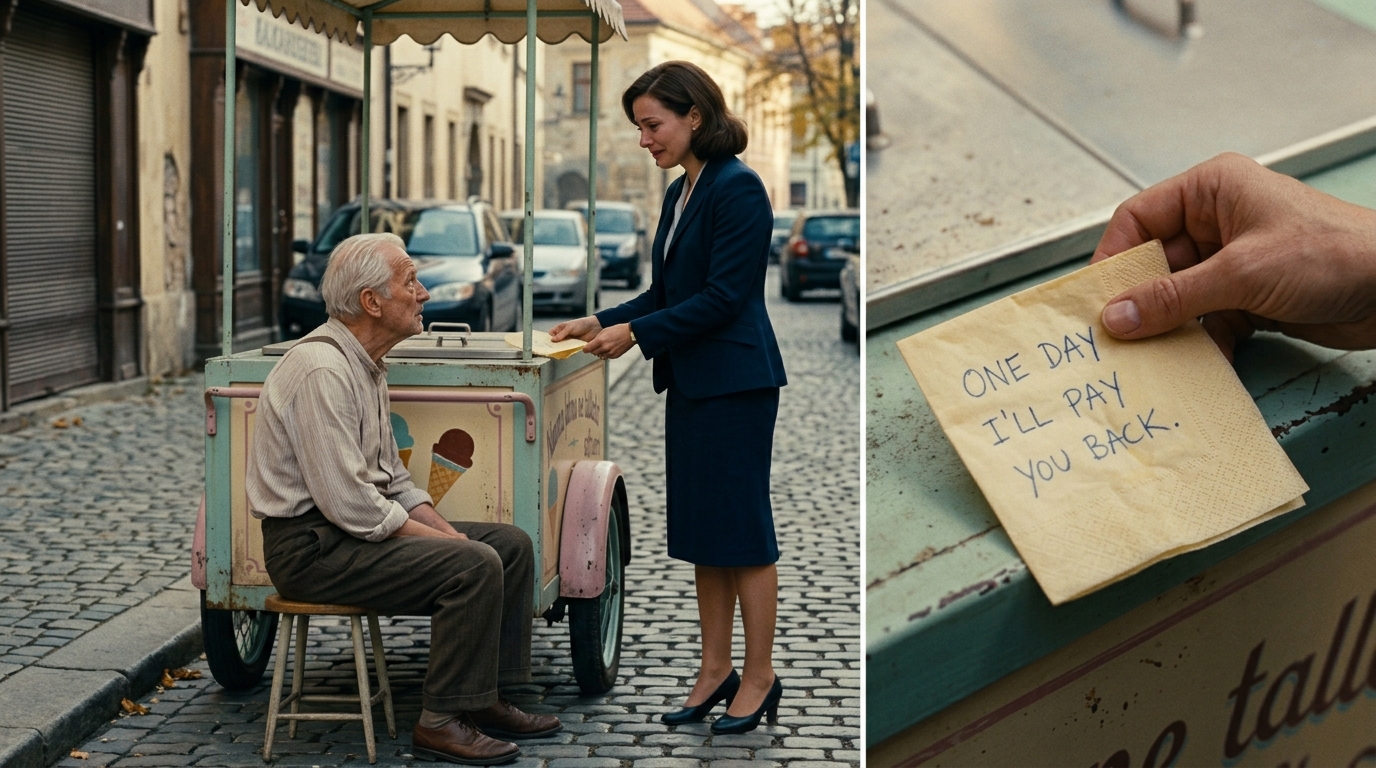
The Promise on the Napkin
The ice cream seller forgot the little girl by the next day.
She never forgot him.
It was one of those summer afternoons when the heat made the whole town shimmer. Cobblestones burned under tired shoes. Tourists crowded the square with cameras and paper fans. Children tugged at their parents’ sleeves, pointing toward pastel carts and colorful umbrellas.
Near the corner of Bellamy Street, an ice cream cart stood beneath a faded striped canopy.
The young vendor behind it was named Tomas Bell.
He was twenty-six then, with sun-browned arms, tired eyes, and a smile he gave freely because it cost nothing.
At least, that was what he believed.
The little girl stood in front of his cart for nearly ten minutes.
She did not ask for anything.
She only looked.
Her hair was dusty. Her dress had been washed so many times the flowers on it had nearly disappeared. Her shoes were too small, one toe pushing through the front. She stood with both hands clasped behind her back, as if afraid touching the cart might make someone chase her away.
Tomas noticed the way she swallowed.
The way her eyes followed each cone he handed to another child.
The way her fingers lifted once, then fell back to her side.
A child who wanted something but had already been taught not to ask.
He leaned forward.
“Do you like vanilla?”
She startled.
Then nodded quickly.
He reached for the biggest cone he had left.
Tall swirl.
Extra cream.
A little dusting of sugar flakes on top because children liked beautiful things even when life refused to give them many.
He handed it to her.
“Here you go, little one.”
She stared at it.
Then at him.
“I don’t have money.”
“I know.”
Her eyes widened.
He smiled.
“It’s a gift.”
For a moment, she did not take it.
Not because she didn’t want it.
Because kindness can frighten children who rarely receive it without conditions.
Then she accepted the cone with both hands.
Like it was treasure.
Like it was proof.
“What’s your name?” Tomas asked.
“Clara,” she whispered.
“Well, Clara, eat it before the sun steals it.”
She took one careful bite.
Her whole face changed.
Not with simple happiness.
With wonder.
As if, for one brief second, the world had become gentle enough to trust.
Then she reached into her dress pocket and pulled out a napkin.
Old.
Folded.
Already used once before.
She placed it on the counter and took a tiny pencil from behind her ear.
Tomas watched, amused, as she wrote slowly.
Her letters were crooked.
Uneven.
Serious.
When she finished, she folded the napkin and pushed it toward him.
“One day,” she said, “I’ll pay you back.”
Tomas chuckled softly.
Not mockingly.
The way adults laugh when children make promises too big for their small hands.
“All right,” he said. “I’ll wait.”
Clara nodded as if the matter had been legally settled.
Then she ran down the street, holding the cone carefully, looking back once to smile.
Tomas watched her go.
Then he glanced into his cart.
Empty.
That had been his last cone.
He closed early that day.
He told himself it didn’t matter.
He had planned to save one for himself after the shift, but dinner could wait.
Rent could wait.
Everything could wait.
A child had smiled.
That was enough for one hot afternoon.
By the next morning, tourists returned, the square filled, and Tomas forgot the little girl’s face.
But Clara kept the memory like a candle cupped against wind.
The Cart Nobody Stopped For
Years passed the way years do when no one is watching closely.
At first, Tomas did well.
His cart became a small fixture of the town.
Children recognized the striped canopy before they could read. Couples bought cones after dinner. Old men teased him for using too much sugar. Mothers thanked him for wiping sticky hands with extra napkins.
He married once.
Lost his wife to illness.
Had no children.
Worked anyway.
Summer after summer.
Then the town changed.
A chain dessert shop opened near the square.
Then another.
Bright signs.
Discounts.
Plastic seats.
Online coupons.
Flavors with names Tomas could barely pronounce.
Children stopped pointing at his cart.
Parents walked past with branded cups and loyalty cards.
Tourists took photos of the old vendor because he looked “authentic,” but they bought their ice cream elsewhere.
Tomas repaired the wheels of his cart with secondhand parts.
Then patched the canopy.
Then sold his wife’s old jewelry to pay supplier debt.
Then borrowed against the cart itself.
By the time autumn came, Bellamy Street had grown colder than he remembered.
One evening, Tomas sat beside the cart with his hands folded over his cane.
He was seventy-two.
His back hurt.
His fingers ached in the mornings.
The striped canopy sagged above him like a tired flag.
His friend Mateo, who owned the tiny newspaper kiosk nearby, came over with two paper cups of coffee.
“You look like a man waiting for bad news,” Mateo said.
Tomas took the coffee.
“I already got it.”
Mateo sat on the curb beside him.
“The bank?”
Tomas nodded.
“I went bankrupt.”
Mateo said nothing.
Good friends sometimes know silence is kinder than surprise.
Tomas looked at the cart.
“I’ll lose it by Friday.”
“The cart?”
“The cart. The storage room. The apartment if I miss another payment.”
Mateo exhaled.
“Tomas…”
“I’ll end up on the streets,” Tomas said quietly.
He tried to laugh.
It failed.
“A funny thing, no? I spent my life selling sweetness. Now I can’t afford bread.”
Mateo looked away.
Neither man noticed the black car passing slowly two streets away.
Inside it, a woman in a dark blue suit had her phone pressed to her ear.
Her name was Clara Vale.
She was forty-one years old now.
Founder of a food logistics company.
Owner of three bakeries, two restaurants, and a charitable kitchen that served children after school.
People called her powerful.
Disciplined.
Elegant.
Self-made.
They did not know that once, she had stood barefoot in front of an ice cream cart with nothing in her pocket but a pencil and hunger.
She had come back to town for a business meeting.
A local acquisition.
Nothing emotional.
Nothing personal.
That was what she told herself.
Then she heard Mateo’s voice through the open car window.
“Tomas, you can’t sleep outside at your age.”
And then Tomas answered:
“I went bankrupt. I’ll end up on the streets.”
Clara froze.
The phone slipped slightly from her ear.
Her assistant on the line said, “Ms. Vale? Are you still there?”
Clara looked out the window.
Same cobblestones.
Same corner.
Same old cart.
Older now.
Faded.
Nearly invisible beside the modern shop signs.
“He went bankrupt?” she whispered.
“Who?” her assistant asked.
Clara did not answer.
Something in her chest tightened.
Not pity.
Not nostalgia.
A debt waking up.
She opened her handbag and reached into the inner pocket.
There it was.
The napkin.
Old.
Yellowed.
Carefully folded inside a plastic sleeve.
She had kept it through foster homes.
Through shelters.
Through her first job.
Through nights when she studied under streetlights because she could not afford electricity.
Through every apartment, every office, every boardroom where people assumed she had always belonged somewhere clean.
She looked at the crooked line written by a hungry child.
One day I’ll pay you back.
Her voice changed.
“I’m coming,” she said.
Her assistant paused.
“To the meeting?”
“No.”
Clara looked at the old ice cream cart.
“Today I repay his kindness.”
The Woman in the Blue Suit
Twenty minutes later, a black car stopped near the corner of Bellamy Street.
Tomas barely looked up.
Wealthy people had learned to pass him with polite indifference.
Sometimes they glanced at the cart the way people glance at old buildings scheduled to be torn down.
With mild sadness.
No responsibility.
Then expensive heels clicked against the stones.
A woman stepped into view.
Dark blue jacket.
White blouse.
Hair swept neatly back.
A leather handbag on her arm.
She looked like someone who belonged in boardrooms, not beside a failing street cart.
Tomas tried to stand from embarrassment.
“Good afternoon, madam.”
The woman gently raised one hand.
“Please don’t get up.”
He gave a tired smile.
“I’m afraid I don’t have much left today. The freezer broke this morning.”
“I didn’t come for ice cream.”
Tomas nodded slowly.
Many people did not come for ice cream anymore.
The woman opened her handbag and removed something small.
She placed it on the cart counter.
A napkin.
Old.
Yellowed.
Folded with care.
Tomas stared at it.
Confused.
Then he opened it.
Inside was a tiny dried sugar flake, preserved like a relic.
And one faded line in uneven child handwriting:
One day I’ll pay you back.
His hands began to tremble.
The square blurred around him.
He looked up at the woman.
She smiled through sudden tears.
“Do you remember the little girl who couldn’t afford ice cream?”
Tomas’s face went pale.
For a moment, the years seemed to fall from him.
Hot afternoon.
Dusty hair.
Faded dress.
A child holding a cone with both hands.
“Clara,” he whispered.
She nodded.
“I thought you forgot.”
“I did,” he said, voice breaking. “And then I didn’t.”
His fingers touched the napkin carefully.
“As soon as I saw this, I remembered.”
Clara’s eyes filled more deeply.
“You gave me your last cone that day.”
Tomas looked down.
“It was only ice cream.”
“No,” she said.
Her voice sharpened with emotion.
“No, it wasn’t.”
He looked back up.
She swallowed.
“You closed early because you had no money left for your own dinner.”
Tomas became very still.
“How did you know that?”
Clara smiled sadly.
“I followed you.”
His brows lifted.
“I was a child,” she said. “I didn’t understand much. But I knew you gave me something you needed.”
She looked toward the alley behind the square.
“You walked to the bakery and asked if they had day-old bread. The baker said no. You said it was fine. Then you sat on the steps and drank water from a public fountain.”
Tomas closed his eyes.
He had forgotten that part.
Or tried to.
Clara had not.
“I ate that cone so slowly,” she whispered. “I thought if I took small bites, the kindness would last longer.”
Tomas covered his mouth.
Mateo stood nearby, silent, holding his cap against his chest.
Clara reached across the cart and gently placed her hand over Tomas’s.
“I never got to pay you back because life took me away from this town. But I kept the napkin.”
“Why?”
“Because on that day, I was ready to believe no one saw me.”
Her voice broke.
“You saw me.”
The old man’s eyes filled.
“I was just a fool with an ice cream cart.”
“No,” Clara said. “You were the first adult who gave me something without asking what I could give back.”
For a long moment, neither spoke.
Then Tomas forced a small laugh.
“Well,” he said, wiping his eyes, “you brought the napkin. Debt settled.”
Clara looked at the broken cart.
At the sagging canopy.
At the old man trying to make generosity small because receiving kindness frightened him too.
“No,” she said.
Tomas looked at her.
Clara’s face became calm.
The kind of calm that had closed deals, rebuilt kitchens, and made powerful men nervous.
“That was only the receipt.”
The Offer He Tried to Refuse
Clara’s assistant arrived with a folder ten minutes later.
So did a lawyer.
And then a mechanic.
And then two men from a catering company Clara owned.
Tomas watched in bewilderment as the quiet corner of Bellamy Street filled with people who seemed to know exactly what to do.
“What is happening?” he asked.
Clara stood beside the cart, reading through papers.
“I bought your debt.”
Tomas blinked.
“You what?”
“The bank note. The supplier balance. The storage lien. The apartment arrears.”
His mouth opened.
No sound came.
Clara looked up.
“You owe nothing now.”
Tomas gripped the edge of the cart.
“No. No, I can’t accept that.”
“You already did.”
“I did not.”
“You gave me your last cone. This is less dramatic.”
He almost laughed, but panic overtook it.
“Madam—Clara—I cannot repay this.”
She stepped closer.
“You’re not supposed to.”
“Then it’s charity.”
“No,” she said. “It’s interest.”
Mateo chuckled softly.
Tomas glared at him.
“This isn’t funny.”
“No,” Mateo said. “It is beautiful. There is a difference.”
Tomas shook his head.
“I’m an old man. The cart is finished. You should not waste money on ruins.”
Clara’s expression softened.
“I know a little about ruins.”
He looked at her then.
Really looked.
Behind the polished suit and the powerful posture, he saw the little girl again.
Not hungry now.
But still carrying the memory of hunger.
“What happened to you?” he asked quietly.
Clara looked toward the square.
“I survived.”
“That is not an answer.”
“It is the first one.”
He waited.
So she told him.
Not everything.
Enough.
Her mother died the winter after the ice cream cone.
Her father was gone long before that.
She spent years moving between relatives, shelters, kitchens, and cheap rooms.
She worked after school.
Washed dishes.
Cleaned guesthouses.
Packed bread at dawn.
Studied at night.
Food became her life because hunger had been her first teacher.
“I built my company because I never wanted children to stand outside windows wishing someone would notice,” she said.
Tomas listened with tears in his eyes.
“You did all that?”
“I had help.”
“From who?”
She smiled.
“People who handed me things when they could have looked away.”
The mechanic inspected the cart and shook his head.
“It can be repaired,” he said. “But it deserves better.”
Tomas frowned.
“My cart is listening.”
Clara laughed.
The sound surprised them both.
Then she opened the folder.
“I have a proposal.”
Tomas groaned.
“Business people always say that before destroying a man’s peace.”
“You have no peace. You have bankruptcy papers.”
Mateo laughed again.
Tomas pointed at him.
“You are enjoying this too much.”
Clara placed a rendering on the counter.
It showed the old ice cream cart restored beautifully.
Same pastel colors.
Same striped canopy.
But stronger.
Cleaner.
With a small golden sign on the side:
Tomas & Clara’s
The Last Cone
Tomas stared.
“What is this?”
“A new company.”
He shook his head immediately.
“No.”
“You haven’t heard it.”
“No.”
“We restore the cart. Then open a small shop here on Bellamy Street. Old recipes. Simple flavors. Fair prices. Free cones for children every afternoon between three and four.”
Tomas’s lips parted.
Clara continued.
“The business will be funded by my foundation. You will be founder emeritus.”
“I don’t know what that means.”
“It means you sit in a chair and tell children stories while younger people do the heavy lifting.”
“I can still scoop.”
“Good. Then you may scoop.”
He stared at the sign again.
“The Last Cone.”
Clara touched the napkin.
“That’s what you gave me.”
Tomas’s voice trembled.
“It was just vanilla.”
“It was not just vanilla.”
He looked away.
“I don’t want my name on a shop.”
“Too late. It’s already on the rendering.”
“You are very bossy.”
“I became successful.”
“That does not make it better.”
“It makes it funded.”
Mateo slapped his knee laughing.
Tomas tried to look annoyed.
He failed.
Then he looked down at the napkin again.
“One day I’ll pay you back.”
His voice was soft.
“I never thought children remember.”
Clara answered, “They remember everything that keeps them alive.”
The Shop With Free Cones
The reopening happened in spring.
Bellamy Street had never looked so alive.
The old cart stood outside the new shop, restored but not erased. The canopy still had a slight tilt. The wheels still creaked faintly. Tomas insisted some things should sound familiar.
Inside the shop, the walls were painted cream and pale blue.
Old photographs hung near the counter.
Tomas as a young vendor.
The original cart.
The square in summer.
And in a small frame beside the register—
The napkin.
One day I’ll pay you back.
Children lined up before the doors opened.
Some came with parents.
Some came from the school nearby.
Some came alone and looked at the menu too long.
Tomas noticed those children first.
He always had.
At three o’clock, Clara stood beside him as the first free cone was served.
A little boy with serious eyes stepped forward.
“How much?” he asked.
Tomas leaned on his cane.
“For you? Today? Free.”
The boy narrowed his eyes.
“Why?”
Tomas glanced at Clara.
Then back at the child.
“Because once, someone should have asked me that too.”
The boy did not understand.
Not fully.
But he accepted the cone.
With both hands.
Clara had to turn away for a moment.
The shop became a success faster than anyone expected.
Tourists came for the story.
Locals came for the flavors.
Children came for the free hour.
But the free hour was never advertised as charity.
Tomas insisted on that.
“No child should feel like a poor thing for wanting ice cream,” he said.
So the sign simply read:
Children’s Hour: 3–4 PM
Every day.
No questions.
The foundation covered the cost.
The community covered the rest.
People began leaving prepaid cone cards on the wall.
For someone having a hard day.
For a kid who needs strawberry.
For the child I used to be.
For my sister, who loved vanilla.
For anyone hungry.
Tomas read every card.
Sometimes he cried.
Sometimes he pretended not to.
Clara visited every Friday.
At first, she said it was to review operations.
Tomas told her she was lying.
Eventually, she admitted she liked sitting near the front window and watching children choose flavors like the decision mattered.
Because it did.
One evening, after closing, Tomas found Clara standing beside the framed napkin.
“You know,” he said, “you paid me back too much.”
She smiled.
“No such thing.”
“You saved my cart. My home. My dignity. Then you put my name on a shop. That is excessive.”
“You gave me your dinner.”
“It was one dinner.”
She turned to him.
“I was a child, Tomas. One dinner can become a whole belief.”
He grew quiet.
She looked back at the napkin.
“I used to think kindness meant someone would rescue me forever. But that wasn’t it. You gave me one good thing, and it made me believe I might find another. Then another. Then maybe become one.”
Tomas sat slowly.
His knees hurt more in the evenings now.
“I should have done more.”
Clara shook her head.
“You did what you could.”
“It wasn’t enough.”
“It was enough for that day.”
He looked at her.
She said softly, “Sometimes that is all a child needs to reach the next one.”
For a while, they sat in silence.
Outside, the cobblestones glowed under streetlamps.
The square was quieter now.
Kinder, somehow.
Or maybe memory had changed its light.
The Last Cone, Again
Tomas worked at the shop for three more years.
Not every day.
Clara and the staff scolded him when he tried.
He sat by the window most afternoons, greeting children like old customers and complaining that modern sprinkles were “too confident.”
He became famous in a small, warm way.
People came to shake his hand.
Reporters asked for interviews.
He hated microphones but loved telling children, “Always eat before it melts. Life is hard enough without wasted ice cream.”
On his seventy-fifth birthday, Clara hosted a party at the shop.
No champagne.
No speeches from officials.
Just children, neighbors, Mateo, staff, and one enormous vanilla cake shaped like the old cart.
Tomas said it looked nothing like the cart.
Then ate two slices.
At the end of the party, Clara handed him a small box.
Inside was a gold-plated ice cream scoop engraved with one sentence:
Kindness always remembers.
Tomas held it for a long time.
Then said, “You are still very dramatic.”
Clara smiled.
“You taught me.”
He shook his head.
“I taught you nothing.”
“You taught me to give before asking who deserves it.”
His eyes filled.
“That was your own heart.”
“Maybe,” she said. “But you fed it first.”
The following winter was hard on him.
His heart weakened.
His walks became shorter.
His chair by the window became his usual place.
Still, every afternoon at three, he insisted on being present for Children’s Hour.
Even if he only sat wrapped in a blanket, watching.
One cold day, a little girl came in alone.
Dusty hair.
Thin coat.
Hands tucked into sleeves.
She stood by the counter and stared at the vanilla machine.
Clara saw her first.
Then Tomas.
Their eyes met.
No words were needed.
Clara prepared the cone herself.
Tall swirl.
Extra cream.
A dusting of sugar flakes.
She handed it to Tomas.
His hand trembled as he offered it to the girl.
“Here you go, little one,” he said.
The girl looked down.
“I don’t have money.”
Tomas smiled.
“I know.”
Her eyes lifted.
“It’s a gift.”
She took it carefully.
Then whispered, “Thank you.”
Clara stood behind the counter, tears filling her eyes.
The girl took one bite.
Her face changed.
Wonder.
Exactly as Clara’s had, decades earlier.
Tomas leaned back in his chair, exhausted but smiling.
After the girl left, Clara sat beside him.
“You okay?”
He nodded.
“Now I am.”
That night, Tomas passed away in his sleep.
Peacefully.
In his apartment above the shop.
The old cart key on his bedside table.
The framed photograph of the first Children’s Hour beside him.
And the napkin copy Clara had made tucked into the drawer near his bed.
The funeral filled the square.
Children left paper cones on the steps.
Parents brought flowers.
Former customers shared stories.
Mateo cried so loudly everyone pretended not to hear because he would have been embarrassed.
Clara spoke last.
She stood beside the restored cart, wearing a dark blue coat, her voice steady until the end.
“When I was a hungry little girl, Tomas Bell gave me his last cone. He forgot by the next day. I remembered for the rest of my life.”
She looked at the children gathered near the front.
“He taught me that small kindness is never small to the person who needs it.”
Her voice broke.
“So today, we do not say goodbye by closing his cart.”
She turned toward the shop.
“We keep it open.”
And they did.
Years later, the shop still stood on Bellamy Street.
Tomas & Clara’s
The Last Cone
Children’s Hour continued every afternoon.
No questions.
No shame.
No child turned away.
The old napkin remained framed near the register, its faded pencil line nearly unreadable now.
But everyone knew what it said.
One day I’ll pay you back.
And beneath it, Clara added a second line after Tomas died:
He never asked her to.
That was why she did.