The Boy With the Green Duffel Bag
The boy did not walk into the bank looking for money.
He walked in carrying more of it than most adults would ever touch in their lives.
At first, no one noticed him.
He was small.
Eight years old.
Maybe nine if someone was being generous.
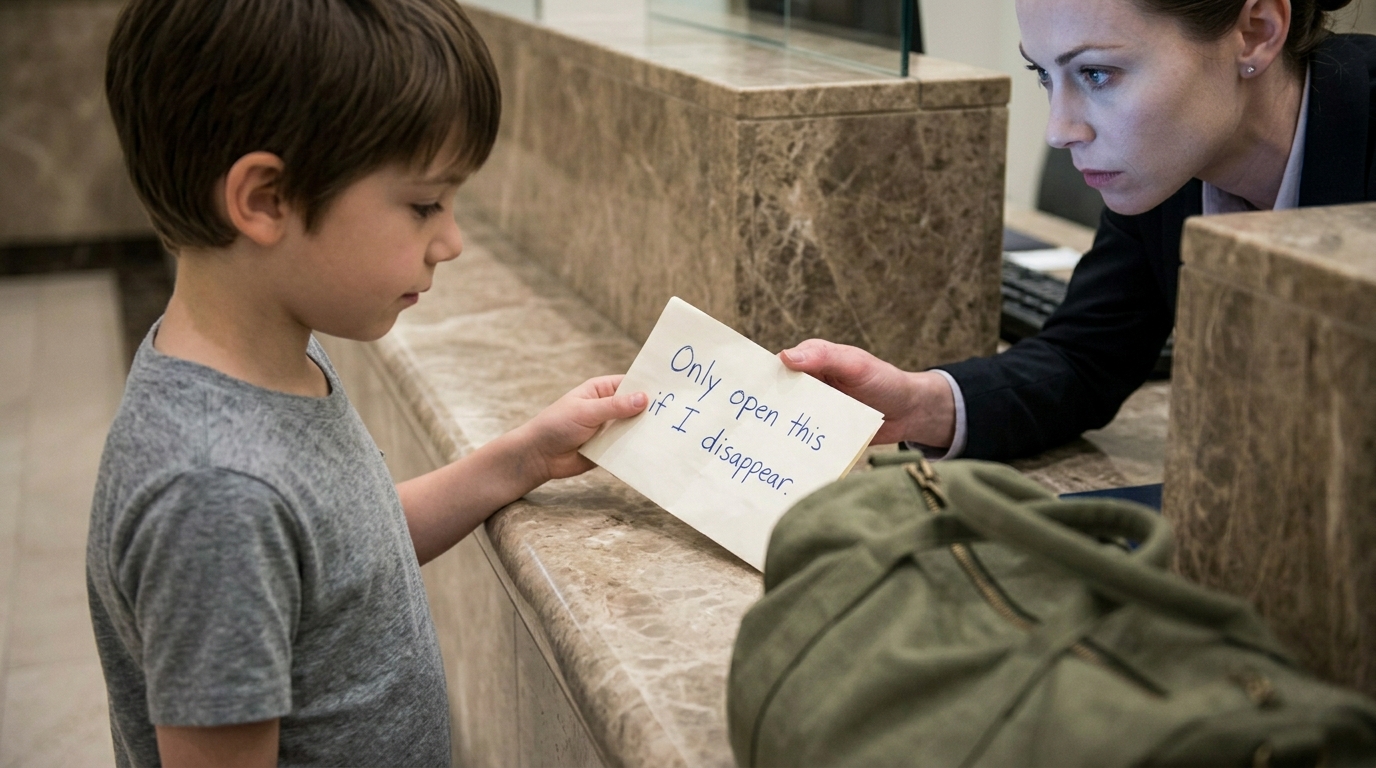
He wore a plain gray T-shirt, sneakers with one loose lace, and a green duffel bag so heavy he had to drag it across the marble floor in short, determined pulls.
The bank lobby was busy that morning.
Polished shoes crossed the floor.
Luxury watches flashed beneath cuffed sleeves.
A businessman argued quietly into his phone.
An elderly woman filled out a deposit slip.
A young couple sat near the loan office, holding hands too tightly.
No one looked twice at the boy until he reached the counter.
He stood on his toes.
Still too short.
The teller looked down and smiled the way adults smile when they think a child is about to ask something harmless.
“Hello there, sweetie. Are you with someone?”
The boy shook his head.
“No, ma’am. I’m on my own.”
Her smile tightened slightly.
“What can I help you with?”
He lifted the green duffel bag with both hands and dropped it onto the counter.
The thud echoed across the lobby.
Several heads turned.
The boy took a breath.
“I’d like to open a savings account.”
The teller blinked.
Then gave a small laugh.
Not cruel.
Just confused.
“Well, we might need a parent or guardian for that.”
The boy unzipped the bag.
The teller leaned closer.
And forgot how to breathe.
Inside were stacks of hundred-dollar bills.
Neatly bundled.
Tightly wrapped.
Layered from bottom to top.
Not a few bills.
Not birthday money.
Not a child’s piggy bank emptied into a bag.
A fortune.
The teller’s professional smile vanished.
“Oh my God,” she whispered. “Where did this money come from?”
The lobby changed.
The businessman stopped talking.
The elderly woman turned.
The security guard near the entrance straightened.
The boy looked down into the bag as if it were something he had been told was important but still did not fully understand.
“My mom hid it,” he said softly.
The teller’s throat moved.
“What do you mean, honey?”
“She said if she didn’t return by Friday, I had to bring it here and open an account where my uncle couldn’t touch it.”
The teller went pale.
Because it was Friday.
And because the word uncle made the money feel less like a deposit and more like evidence.
She lowered her voice.
“What’s your mother’s name?”
The boy reached into his pocket and pulled out a folded note.
The paper was wrinkled, as if he had been holding it too tightly for too long.
On the outside, written in shaky handwriting, were seven words:
Only open this if I disappear.
The teller looked at the boy.
Then at the bag.
Then at the note.
“What’s your name?” she asked.
“Noah.”
“Noah what?”
“Noah Bennett.”
The name struck someone behind her.
The branch manager, Margaret Ellis, had just stepped out of her office.
She stopped mid-step.
Bennett.
Everyone in the bank knew that name.
Not because of the boy.
Because of his uncle.
Victor Bennett.
Real estate developer.
Local donor.
Board member.
A man with money, influence, and a smile so polished people often forgot to ask where the shine came from.
Margaret walked toward the counter slowly.
“Noah,” she said gently, “is your mother Emily Bennett?”
The boy nodded.
“She told me to ask for someone named Margaret.”
The teller turned.
Margaret’s face had gone white.
Noah held out the note.
“My mom said you would know what to do.”
Margaret took it with trembling fingers.
For one moment, she did not open it.
She stared at the handwriting as if recognizing a ghost.
Then she unfolded the note.
And as she read, the blood drained from her face.
Noah stood on the other side of the marble counter, clutching the strap of the green duffel bag.
He looked very small.
Very tired.
And suddenly very afraid.
Margaret lifted her eyes.
“Lock the front doors,” she said.
The security guard froze.
“Ma’am?”
Her voice sharpened.
“Now.”
The Note Emily Left Behind
The teller’s name was Claire.
She had worked at First Crown Bank for eleven years and had seen people cry at counters for all kinds of reasons.
Foreclosure.
Divorce.
Death.
Debt.
But she had never seen her manager look at a piece of paper the way Margaret Ellis looked at that note.
Not shocked.
Not merely frightened.
Haunted.
Margaret guided Noah away from the counter and into her office. Claire carried the duffel bag with both hands, though it took effort. The security guard stayed near the door, one hand close to his radio.
Noah sat in the chair across from Margaret’s desk.
His feet did not touch the floor.
That detail nearly broke Claire.
A child had just carried a bag full of cash into a bank because the adults in his life had failed so completely that his mother trusted instructions more than protection.
Margaret closed the office blinds.
Then read the note aloud, voice unsteady.
Margaret,
If Noah is standing in front of you with this bag, then I did not make it back by Friday.
Do not call Victor.
Do not let anyone from his office know he is here.
The money is not stolen. It is my father’s cash reserve from the Riverside properties. Victor has been hiding it from probate, threatening me, and trying to force me to sign guardianship papers over Noah.
I found the ledgers.
I found the account numbers.
I found what he did to Daniel.
If I disappear, protect my son first.
The key is inside the dinosaur.
Emily
Noah looked up.
“Mom said I shouldn’t open it unless she didn’t come home.”
Margaret lowered the paper.
“When did you last see your mother?”
“Wednesday night.”
Claire covered her mouth.
Margaret leaned forward carefully.
“What happened Wednesday night?”
Noah looked at the duffel bag.
“She made pancakes for dinner. Then she gave me the bag and said we were playing a very serious grown-up game.”
His voice stayed flat in the way children’s voices do when they have been trying not to cry for too long.
“She told me if she was back by Friday morning, I should forget everything. But if she wasn’t back, I had to take bus 14, get off at the big clock, come here, ask for Margaret, and not talk to Uncle Victor.”
Margaret closed her eyes briefly.
Emily had planned every step.
That meant she had known danger was close.
Claire whispered, “Who is Daniel?”
Noah looked at her.
“My dad.”
Margaret’s expression tightened.
Daniel Bennett had died two years earlier in a warehouse accident.
At least, that was what everyone believed.
He had been Emily’s husband.
Victor’s younger brother.
The quiet one.
The one who never liked cameras.
The one people said was too soft for the Bennett family business.
“What did your mother mean,” Margaret asked slowly, “when she wrote that she found what Victor did to Daniel?”
Noah’s lower lip trembled.
“I don’t know.”
Margaret looked at the last line again.
The key is inside the dinosaur.
“Noah,” she said, “do you know what dinosaur your mother meant?”
For the first time, his eyes changed.
He reached into his backpack and pulled out a small green plastic dinosaur.
A T. rex with one cracked leg.
The kind of toy a child keeps long after one birthday because someone important gave it to him.
“My dad gave me this,” Noah said. “Mom told me never to lose it.”
Margaret took it gently.
The dinosaur had a seam along its belly.
A tiny screw held the plastic together.
Claire found a small screwdriver in the supply drawer.
No one spoke while Margaret opened it.
Inside was a folded slip of paper and a tiny silver key.
Noah stood from the chair.
“What is that?”
Margaret unfolded the paper.
It was a safe deposit box number.
First Crown Bank.
Box 417.
Margaret’s hand shook.
That box belonged to Daniel Bennett.
It had been dormant since his death.
Victor had tried to access it three times.
Each time, Margaret had refused because Daniel’s signature authorization was required.
Now the key sat in her palm.
Emily had found the one thing Victor had been unable to reach.
Margaret stood.
“Claire, call legal.”
Claire nodded.
“And child protective services?”
Margaret looked at Noah.
Not yet.
Not before she knew who could be trusted.
“Call the state attorney’s office. Ask for Agent Hale. Use the private line.”
Claire’s eyes widened.
“Margaret…”
“Do it.”
Before Claire could move, the branch phone rang.
Margaret looked at the caller ID.
Victor Bennett.
Noah went very still.
Margaret did not answer.
The phone rang again.
Then her cell phone buzzed.
Unknown number.
Then the teller line.
Then the security desk.
The branch filled with ringing.
Victor was looking for the boy.
And he already knew Noah had reached the bank.
The Man Who Wanted the Bag
Victor Bennett arrived twelve minutes later.
He did not come alone.
A black SUV stopped outside the locked glass doors. Victor stepped out in a tailored charcoal suit, followed by two men who looked like lawyers until one adjusted his jacket and revealed the outline of a shoulder holster.
The security guard swallowed.
“He’s here.”
Noah was sitting on the floor behind Margaret’s desk now, clutching the dinosaur shell in both hands.
Claire stood near the file cabinet, pale but steady.
Margaret looked through the blinds.
Victor Bennett smiled at the locked door.
Then knocked.
Not hard.
Not angrily.
Politely.
That made it worse.
The guard spoke through the intercom.
“We’re temporarily closed, sir.”
Victor’s smile widened.
“I can see my nephew inside.”
Noah curled smaller.
Margaret stepped toward the intercom.
“Mr. Bennett, this is not a good time.”
“Margaret,” he said warmly. “Open the door.”
“No.”
The warmth left his eyes before it left his voice.
“My sister-in-law is missing. My nephew is confused. You are interfering in a family emergency.”
Margaret looked at the green duffel bag on her office floor.
“Then the police can help sort it out.”
Victor’s face hardened slightly.
“I am the one who called the police.”
Claire looked at Margaret.
That was the trap.
If local officers arrived first, Victor would present himself as the responsible guardian, claim the boy had run away with family money, and take both Noah and the bag before anyone understood what they were seeing.
Margaret pressed the intercom.
“Noah is safe.”
Victor leaned closer to the glass.
His voice lowered.
“Emily is not.”
The words landed in the office like a threat.
Noah made a small sound.
Margaret’s hand tightened.
“What did you say?”
Victor smiled again.
“I said my sister-in-law is not well. She has been unstable since Daniel died. Paranoid. Erratic. Filling a child’s head with stories.”
Margaret looked at Noah.
His face had gone gray.
Victor continued.
“She likely stole that money from the estate. If you help conceal it, you become part of the crime.”
Claire whispered, “Agent Hale is on the way.”
Margaret nodded once.
Then she turned back to the glass.
“Mr. Bennett, unless you have a court order, you are not entering this branch.”
Victor’s smile finally vanished.
“I sit on this bank’s advisory board.”
“And I manage this branch.”
“You will lose your job.”
“Maybe.”
He stared at her.
Margaret stared back.
Some lines are crossed loudly.
Others happen in silence.
This was one of those.
Victor lifted his phone and made a call.
Within minutes, two police cars pulled up.
Margaret’s heart sank.
Local officers.
Not Agent Hale.
Victor turned toward them with visible relief.
He began speaking before they reached the door.
The officers listened.
Nodded.
Looked toward the bank.
One approached the intercom.
“Ma’am, open the door.”
Margaret asked, “Do you have a warrant?”
“We have a report of a runaway minor and stolen funds.”
Noah started crying silently.
Claire knelt beside him.
“You’re okay,” she whispered, though her own voice shook.
The officer repeated, “Open the door.”
Before Margaret could answer, another vehicle pulled up behind the police cars.
Dark blue.
Unmarked.
A woman in a navy coat stepped out.
Agent Rachel Hale.
State attorney’s office.
She walked past Victor without acknowledging him and showed her badge to the officers.
Whatever she said made their posture change immediately.
Victor’s expression went flat.
Agent Hale looked through the glass at Margaret.
Margaret unlocked the door.
Victor stepped forward.
Agent Hale held up one hand.
“Not you.”
He laughed.
“This is my nephew.”
“Then you can wait while we verify that.”
His jaw tightened.
“You have no authority to keep me from my family.”
Agent Hale looked at him calmly.
“Mr. Bennett, your sister-in-law left a signed statement naming you as a threat. Until we establish the facts, you are not going near that child.”
For the first time, Victor looked truly angry.
Not polished anger.
Real anger.
The kind that came from losing control.
Then Noah appeared behind Margaret, clutching the broken dinosaur.
He looked through the glass and whispered:
“Where is my mom?”
Victor’s face changed instantly.
Soft.
Concerned.
Rehearsed.
“Noah, buddy. Come here. Your mom is sick. We need to find her together.”
Noah stepped back.
He had heard that tone before.
Children always know which softness has teeth.
Box 417
Safe deposit box 417 had not been opened in two years.
Margaret signed the access log with Agent Hale standing beside her and Noah waiting in the private viewing room with Claire.
Victor had been kept outside the secure area.
He was not happy about it.
Everyone knew.
The key from the dinosaur fit.
The box slid out.
Heavy.
Margaret carried it to the viewing table.
Agent Hale turned on a small body camera.
“Opening box 417 at First Crown Bank. Present are Branch Manager Margaret Ellis and Agent Rachel Hale.”
Margaret lifted the lid.
Inside were papers.
A flash drive.
A small black notebook.
A sealed envelope addressed to Emily.
And a photograph.
Daniel Bennett stood beside a warehouse loading dock, holding Noah as a toddler. Emily stood next to him, laughing at something outside the frame.
On the back, Daniel had written:
If they say it was an accident, ask who moved the cameras.
Agent Hale exhaled.
Margaret opened the notebook.
Numbers.
Dates.
Property names.
Cash reserves.
Names of shell companies.
Payments marked with initials.
V.B.
Victor Bennett.
Then came the flash drive.
Agent Hale connected it to an evidence laptop.
The first file was a video.
Warehouse security footage.
Two years old.
The night Daniel died.
The official report said a faulty lift collapsed while Daniel was alone inspecting inventory.
But the footage showed something else.
Daniel entering the warehouse office.
Victor following.
An argument.
No audio, but the body language was unmistakable.
Daniel held a folder.
Victor tried to grab it.
Daniel shoved him back.
Then two men entered.
The same two men now waiting outside the bank with Victor.
The video cut.
Then resumed from another camera.
Daniel on the warehouse floor.
One of the men near the lift controls.
Victor walking away.
The lift dropped.
Margaret turned from the screen.
Agent Hale’s face had hardened.
“That’s enough for probable cause.”
“There’s more,” Margaret whispered.
The next file was audio.
Daniel’s voice.
Low.
Urgent.
“Emily, if you find this, do not trust Victor. He’s been hiding cash from the Riverside properties, using estate funds to pay off inspectors, and moving money through charitable housing accounts. I confronted him tonight. If anything happens to me, take Noah and go to Margaret Ellis. She won’t fold for him.”
Margaret closed her eyes.
Daniel had trusted her.
And Emily had remembered.
The audio continued.
“My father’s reserve money is still hidden in the basement wall. Victor doesn’t know I moved the ledger key into Noah’s dinosaur. I know it sounds ridiculous, but he never looks at anything that belongs to the boy.”
A soft laugh.
Then silence.
Then Daniel’s voice again.
“I love you. I love Noah. Don’t let my brother raise him.”
Noah was brought into the viewing room only after the video stopped.
No child needed to see that.
But he saw the photograph.
He touched his father’s face with one finger.
“Dad knew about the dinosaur?”
Margaret knelt beside him.
“Yes.”
Noah looked at the safe deposit box.
“Did he know Mom would disappear?”
Agent Hale answered carefully.
“He knew she might need help one day.”
Noah’s chin trembled.
“Can you find her?”
Agent Hale’s face softened.
“We are going to try very hard.”
Then Margaret opened the envelope addressed to Emily.
Inside was one more note.
Different handwriting.
Emily’s.
She must have added it after Daniel’s death.
Margaret read silently first.
Then aloud.
If this box is open, Victor either found me or forced me to run.
The cash in the green bag is not all of it. It is bait.
The real ledger is with the woman Victor thinks is dead.
Ask Aunt Clara about the lake house.
Margaret stared at the note.
“Aunt Clara?”
Noah wiped his face.
“My grandma’s sister. Uncle Victor said she died before I was born.”
Agent Hale looked at Margaret.
“Did she?”
Margaret slowly shook her head.
“No. Clara Bennett didn’t die.”
Her voice dropped.
“She disappeared after accusing Victor of stealing from his father.”
Noah whispered, “Where is the lake house?”
Margaret looked toward the front of the bank, where Victor was still waiting.
Then back at Agent Hale.
“I know exactly where it is.”
The Woman Victor Couldn’t Kill
Clara Bennett was seventy-one years old and very much alive.
She lived under the name Clara Moore in a lakeside cabin forty miles outside town, surrounded by pine trees, rusted wind chimes, and warning signs that made it clear visitors were not welcome.
Agent Hale found her before sunset.
Margaret went with her.
So did Noah.
He refused to stay behind.
“I did what Mom said,” he told them. “I’m part of it.”
No one argued.
The cabin door opened before they knocked.
An old woman stood there holding a shotgun.
Her silver hair was braided down her back. Her eyes were sharp enough to cut wire.
Then she saw Noah.
The shotgun lowered.
“My God,” she whispered. “You have Daniel’s face.”
Noah clutched the dinosaur pieces in his jacket pocket.
“Are you Aunt Clara?”
Her eyes filled.
“I was.”
Agent Hale showed her badge.
Clara laughed bitterly.
“Only took the law twenty years.”
Margaret stepped forward.
“Emily sent us.”
Clara’s face changed.
“Where is she?”
No one answered quickly enough.
The old woman stepped back.
“Come in.”
The lake house smelled of wood smoke, coffee, and old paper.
Files filled the kitchen table.
Ledgers.
Property records.
Photographs.
Newspaper clippings.
Victor Bennett had been stealing from his own family since before Daniel was old enough to work in the business.
His father hid cash reserves from taxes.
Victor hid them from everyone.
After the father died, Clara discovered the first missing account.
When she confronted Victor, he had her declared unstable through a friendly doctor and tried to force a conservatorship.
She ran before the papers went through.
Everyone was told she had drowned.
No body.
No funeral.
Just another Bennett disappearance made official by men with signatures.
“Daniel found me three years ago,” Clara said. “He said he needed help proving Victor killed the company from the inside.”
Noah sat very still.
Clara looked at him.
“Your father was a brave man.”
Noah’s eyes filled.
“My mom says that too.”
“Your mother is brave as well.”
“Is,” Noah whispered.
Not was.
Is.
Clara nodded.
“Yes. Is.”
Agent Hale leaned forward.
“Emily wrote that the cash was bait. What did she mean?”
Clara walked to the pantry and removed a loose floorboard.
Beneath it was a metal case.
Inside were the real ledgers.
Not copies.
Originals.
Names.
Payments.
Bribes.
Property fraud.
Insurance fraud.
And a handwritten list of law enforcement contacts Victor had paid over the years.
Agent Hale’s jaw tightened as she read.
“This is enough to take down half the county.”
Clara nodded.
“That’s why Emily didn’t bring it to the local police.”
Margaret asked, “Where is Emily?”
Clara’s eyes lowered.
“She came here Tuesday night.”
Noah sat up.
“She was here?”
Clara nodded.
“She brought the ledgers. Said Victor had found out she removed the cash reserve from the basement wall. She planned to lure him into making a move while Noah took the bag to the bank.”
Noah’s voice shook.
“She used me as bait?”
Clara crouched in front of him.
“No, baby. She trusted you with the safest part.”
“But she didn’t come back.”
“No.”
Clara looked at Agent Hale.
“She left here Wednesday morning to meet a reporter at the old ferry dock. She never arrived.”
The room went cold.
Before anyone could speak, headlights swept across the cabin windows.
Clara stood immediately.
“No one followed you?”
Agent Hale reached for her sidearm.
Margaret grabbed Noah and pulled him away from the window.
Outside, a vehicle door slammed.
Then Victor Bennett’s voice carried through the trees.
“Clara,” he called. “Enough.”
Noah began shaking.
Clara lifted the shotgun again.
Agent Hale whispered into her radio.
But Clara did not look afraid.
She looked tired.
Tired of hiding.
Tired of being declared dead by a man who kept failing to bury the truth properly.
Victor’s voice came again.
“Send out the boy, and we can all stop pretending this family can survive more scandal.”
Noah whispered, “He knows I’m here.”
Clara looked at him.
Then at the ledgers.
Then at Agent Hale.
“No,” she said. “He knows the truth is.”
The Dock Behind the Pines
Victor did not know Agent Hale had called for backup.
He also did not know Clara had installed cameras after the first time his men found the lake house.
That was how men like Victor failed.
They mistook survival for weakness.
They thought people who ran were only afraid, never prepared.
Agent Hale kept Victor talking through the door.
“Mr. Bennett, this is Agent Rachel Hale. Step away from the cabin.”
A pause.
Then Victor laughed.
“Rachel Hale. Of course Margaret called the state.”
“Hands visible.”
“You don’t understand what you’re holding.”
“That seems to be a theme today.”
Victor’s voice hardened.
“My sister-in-law stole a substantial amount of estate cash. My nephew is being manipulated by a mentally unstable fugitive.”
Clara shouted, “Still using that word, Victor?”
Silence.
Then he said, “Hello, Clara.”
Noah stood behind Margaret, trembling but listening.
Victor continued.
“You should have stayed dead.”
Clara smiled grimly.
Agent Hale’s body camera was recording.
So were the cabin cameras.
Victor had just given them a gift.
Sirens sounded in the distance.
Victor heard them too.
A shadow moved past the window.
Then another.
His men were circling.
Clara whispered, “Back door leads to the dock.”
Agent Hale shook her head.
“No one leaves alone.”
“I’m not leaving,” Clara said.
She handed the metal case to Margaret.
Then looked at Noah.
“Your mother may still be alive.”
Noah’s eyes widened.
“What?”
Clara’s voice was urgent now.
“When Emily disappeared, I checked the ferry dock cameras. One had been cut. But the bait shop camera caught a van. Same company Victor used years ago.”
“Where would they take her?” Agent Hale asked.
Clara looked toward the dark lake.
“There’s an old boathouse past the pines. Used to belong to the Bennetts before Victor sold it on paper. He keeps problems there when he needs time.”
Noah’s face crumpled.
“My mom?”
Agent Hale spoke into her radio immediately.
“Possible hostage location. Old Bennett boathouse east side of Lake Marrow. Move now.”
Victor’s men reached the back porch at the same time the first state police vehicle tore through the gravel road.
Chaos broke open.
Shouts.
Flashlights.
Commands.
A man running.
Another dropping to the ground.
Victor tried to reach his SUV but found Margaret standing on the porch with her phone raised.
Recording.
He stopped.
For the first time all day, he looked at Noah.
Not as a nephew.
Not as a child.
As the one piece of the plan he could not control.
“Noah,” he said softly. “Your mother is confused. I can take you to her.”
Noah stepped forward before anyone could stop him.
He stood behind the porch railing, small and shaking.
Then he said, “My mom told me not to trust you.”
Victor’s face twitched.
Noah reached into his pocket and lifted the broken dinosaur.
“And Dad did too.”
State police arrested Victor Bennett under the porch light.
But Noah did not watch long.
Because across the radio came a burst of static.
Then a voice.
“We found a woman. Alive. Repeat, alive.”
Noah stopped breathing.
Agent Hale turned toward him.
“Is it my mom?” he whispered.
The radio crackled again.
“Female adult. Injured but conscious. Says her name is Emily Bennett.”
Noah made a sound that was not quite a sob and not quite a laugh.
Then he ran.
Not toward Victor.
Not toward the money.
Toward the lake road where the ambulance lights were already beginning to glow red through the trees.
The Account No One Could Touch
Emily Bennett survived.
Barely.
She had been held in the old boathouse for two nights while Victor’s men tried to force her to reveal where the ledgers were hidden.
She told them the truth.
That Noah had them.
They did not believe her.
Because men like Victor could not imagine trusting an eight-year-old with something valuable.
That was why she had done it.
The green duffel bag had been bait.
The cash was real, but incomplete.
Enough to bring Victor running.
Enough to expose who responded.
Enough to force the bank, the state attorney, Clara, and the evidence into the same room before Victor could quietly erase them one by one.
Emily had been beaten, dehydrated, and exhausted.
But when Noah reached the ambulance, she pushed aside the oxygen mask and held out her arms.
He climbed onto the stretcher and collapsed against her.
“I did it,” he cried. “I brought the bag.”
Emily held him with shaking hands.
“I knew you would.”
“I opened the note.”
“You were supposed to.”
“I was scared.”
“Me too.”
That was the moment Margaret turned away.
So did Agent Hale.
Some reunions were too sacred for witnesses, even when everyone had helped make them possible.
The investigation destroyed Victor Bennett’s empire.
The warehouse footage reopened Daniel’s death case.
The ledgers exposed fraud across multiple counties.
The cash reserves revealed hidden estate assets that should have passed to Emily and Noah after Daniel died.
Several officers were suspended.
Two officials resigned.
Victor’s lawyers tried to paint Emily as unstable, Clara as bitter, Margaret as overreaching, and Noah as a manipulated child.
Then the bank footage was played.
An eight-year-old boy lifting a duffel bag onto the counter.
A teller asking where the money came from.
Noah saying:
“My mom hid it. She said if she didn’t return by Friday, I had to bring it here and open an account where my uncle couldn’t touch it.”
The jury watched that clip in silence.
Victor was convicted on financial crimes first.
Then kidnapping.
Then conspiracy connected to Daniel’s death.
The murder charge took longer, but the warehouse footage and testimony from one of his men finally finished what Daniel had started.
Victor Bennett received life in prison.
At sentencing, he looked at Noah once.
Only once.
Noah did not look away.
Emily squeezed his hand.
Margaret left First Crown Bank six months later.
Not because she was fired.
Because she was offered a position overseeing financial abuse investigations for vulnerable families.
Claire became branch manager.
On her first day, she placed a small sign near the counter.
If you are afraid someone is controlling your money, ask for Margaret’s folder.
Most people never knew what it meant.
The ones who needed it did.
As for the green duffel bag, it became evidence for nearly a year.
When it was finally returned, Emily asked Noah what he wanted to do with it.
He looked at the faded fabric.
The broken zipper.
The bag that had once felt heavier than his whole body.
“Can we keep it?”
Emily nodded.
“Of course.”
He placed the green dinosaur inside.
Not broken anymore.
Margaret had found someone to repair the cracked leg and seam.
Years later, when people asked Noah what he remembered most about that Friday, they expected him to say the money.
The police.
His uncle outside the bank.
The safe deposit box.
The lake house.
But he always remembered the teller first.
Claire’s smile.
The way she called him sweetie before she saw the cash.
Then the way she stopped smiling when she understood he was not playing.
He remembered Margaret locking the doors.
He remembered adults finally doing what his mother promised they would do if he was brave enough to follow the instructions.
And he remembered the account.
The one they opened weeks later after the legal dust settled.
Not in Victor’s name.
Not under the Bennett estate.
In Noah’s name.
Protected.
Transparent.
Untouchable.
The first deposit was not the cash from the duffel bag.
That stayed frozen until trial ended.
The first deposit was one dollar from Emily.
She slid it across the counter and smiled.
“Every fortune should begin with something clean.”
Noah added the second dollar from his own pocket.
Margaret, visiting that day, added the third.
Claire added the fourth.
Even Aunt Clara added one, though she grumbled that banks were “just fancy drawers with paperwork.”
Noah kept the receipt.
Not because of the money.
Because for the first time, the adults around him had built something his uncle could not reach.
The boy had not walked into the bank seeking cash.
He came carrying fear, instructions, a dinosaur, and a note written by a mother who refused to disappear quietly.
And because he was brave enough to lift that heavy green bag onto the marble counter, the truth finally had somewhere safe to be deposited.