The Locket on the Glass Counter
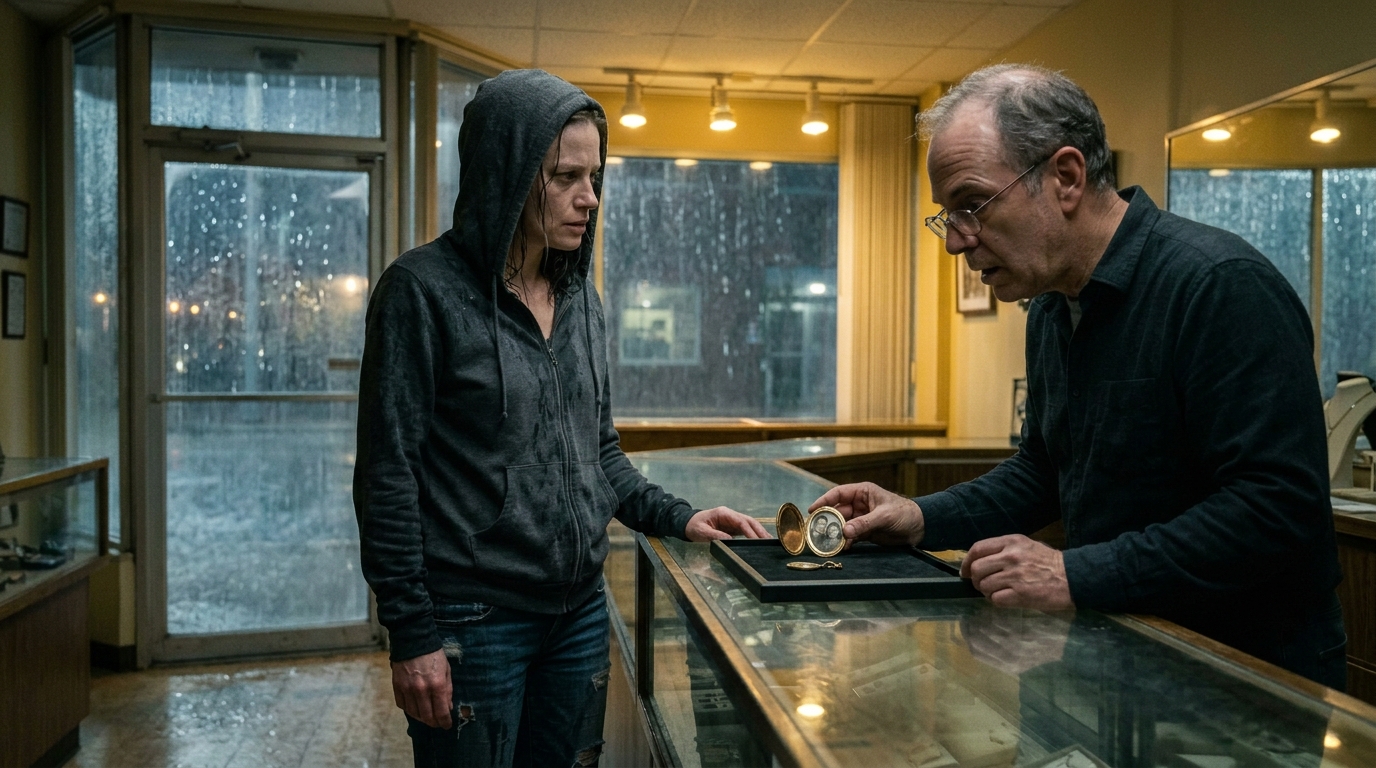
The woman looked as if the rain had been chasing her for days.
Her gray hoodie was soaked through. Water dripped from the ends of her sleeves onto the floor of my shop. Her jeans were torn at one knee, her shoes nearly split at the soles, and her face carried the kind of exhaustion that does not come from one bad night.
It comes from running out of choices.
My jewelry shop was small, old, and warm from the yellow lamps above the display cases. Outside, rain beat against the windows hard enough to blur the streetlights. Most people avoided pawn counters on evenings like that unless desperation had already made the decision for them.
She stood in front of me without speaking at first.
Then she reached into her hoodie pocket and placed a gold necklace on the glass.
A locket.
Aged.
Elegant.
Familiar in a way my mind refused to accept.
“How much can you give me for this necklace?” she asked.
Her voice was quiet.
Not weak.
Just empty.
I barely looked at her at first.
That is a shame I still carry.
In my line of work, you learn to protect yourself from stories. Stolen rings. Inherited watches. Wedding bands sold after divorces. Pendants pawned by people who promised they would buy them back and never did.
Desperation had many faces.
I thought hers was just another one.
I picked up the necklace.
“It’s old,” I said.
She nodded.
“Gold is worn near the clasp.”
She said nothing.
“I can offer fifty. Nothing more.”
Her face tightened.
Only for a second.
Then she whispered, “All right. It’s a deal.”
That should have been it.
A small sale.
A desperate woman.
Another quiet tragedy under warm lights while the city drowned outside.
I opened the register, counted the cash, and slid it toward her.
She took it with both hands.
Then I opened the locket.
And the world stopped.
Inside was a tiny photograph.
A man.
A young girl.
The girl was laughing, missing one front tooth, wearing a yellow sweater and holding up a crooked paper crown.
The man beside her was younger then.
Less gray.
Less hollow.
Me.
Below the photograph, etched into the inner rim in fading letters, were the words:
For my daughter Clara.
My hand froze.
The rain outside seemed to fall away into silence.
I knew that inscription.
I had chosen every word.
I had bought that locket twenty-one years earlier for Clara’s tenth birthday, after she told me she wanted “a necklace that could keep a secret.”
I told her she was too young for gold.
She told me secrets did not wait for grown-ups.
So I bought it anyway.
She wore it almost every day until the night she disappeared.
My throat closed.
I looked up.
But the woman had already taken the cash.
Already turned toward the door.
Already stepped back into the rain.
I rushed out from behind the counter so fast my knee hit the display case.
“Wait!”
She did not stop.
I pushed open the shop door.
Cold rain struck my face.
“That necklace,” I shouted. “It belongs to my daughter. My missing daughter!”
The woman stopped beneath the streetlamp.
Her shoulders tensed.
For a moment, she did not turn.
When she finally did, water streamed down her face.
But her eyes were not confused.
They were afraid.
Not of me exactly.
Of what my words meant.
“If Clara is your daughter,” she said, “then why did she make me promise never to return this to you?”
The locket felt suddenly heavy in my fist.
Because with one sentence, this stranger had not only brought my daughter back from the dead.
She had told me Clara had been alive long enough to hate me.
The Promise Clara Made
“My daughter vanished twelve years ago,” I said.
The woman looked down the street as if expecting someone to appear from the rain.
“Then lower your voice.”
That frightened me more than if she had screamed.
I stepped closer.
“Where is she?”
The woman’s face tightened.
“I shouldn’t have come.”
“You came to my shop with her locket.”
“I didn’t know it was yours.”
“You knew her name.”
She flinched.
I saw it.
Not guilt.
Pain.
“What is your name?” I asked.
She hesitated.
“Elena.”
The name meant nothing to me.
Not then.
But she said it like someone who had learned not to give the real answer too quickly.
I held up the locket.
“When did Clara give this to you?”
Elena looked at it, and her whole expression changed.
For one second, the rain, the street, the cold, and the fear all disappeared.
She looked at the locket like it was a person.
“Three weeks before she died,” she whispered.
The words hit me so hard I almost stepped backward.
“No.”
“I’m sorry.”
“No,” I said again. “No body was ever found.”
Her eyes filled.
“There was a body. Just not one anyone reported.”
The rain kept falling between us.
Cars hissed along the street.
Somewhere behind me, the bell above my shop door swung softly.
I could not move.
My daughter had been missing for twelve years.
For twelve years, I had imagined every possibility except the one standing in front of me.
That she had lived.
That she had died.
That she had believed I was the reason she never came home.
Elena looked past me toward the shop.
“Can we not do this outside?”
I brought her in.
She stood near the door, dripping onto the floor, refusing to sit. Her fingers kept closing around the fifty dollars I had given her, as if she wanted to return it but needed it too badly.
I placed the locket on the counter between us.
“Tell me everything.”
She shook her head.
“I don’t know everything.”
“Tell me what you know.”
She looked at the locket.
Then at me.
“I met Clara eight years ago.”
Eight.
My hand gripped the edge of the counter.
That meant Clara had been alive four years after she disappeared.
Elena continued.
“We were both staying at a women’s shelter near the train station. She used a different name then.”
“What name?”
“Lina.”
Clara’s middle name was Caroline.
But when she was little, she could not pronounce it and called herself Lina for nearly a year.
No one outside the family knew that.
Elena saw my face and nodded sadly.
“That was her.”
My chest hurt.
“What happened to her?”
“She was sick by the time I met her. Not at first glance. She hid it well. But she coughed blood some mornings. She got dizzy. She had scars on her wrists and a burn near her shoulder.”
I closed my eyes.
Clara hated hospitals.
Even as a child, she cried at the smell of antiseptic.
“She never stayed anywhere long,” Elena said. “She said moving kept people alive.”
“People?”
Elena looked away.
“She had a child.”
For a moment, my brain refused the words.
Then they entered all at once.
“A child?”
Elena nodded.
“A little boy. Thomas.”
My grandson.
The word formed somewhere inside me but did not reach my mouth.
“Where is he?”
Elena’s eyes filled.
“With me.”
The shop tilted.
I reached for the counter again.
“You have my grandson?”
“He’s sick. That’s why I sold the locket.”
She lifted the crumpled bills.
“He needs antibiotics. I didn’t have enough.”
I stared at the money.
Fifty dollars.
I had offered fifty dollars for the last thing my daughter left behind while my grandson needed medicine somewhere in the rain.
Shame burned through me.
“Where is he?”
Elena stepped back.
“No.”
“Elena.”
“No. I promised her.”
“You promised Clara what?”
Her voice broke.
“To keep him away from you.”
The words were not loud.
They did not need to be.
They struck deep enough.
I whispered, “Why?”
Elena swallowed hard.
“Because Clara said you signed the papers.”
“What papers?”
“The ones that gave them the right to take her baby.”
I went still.
No sound entered the shop after that.
Not rain.
Not traffic.
Not breath.
Because I had never signed any papers.
And if Clara believed I had, then someone had spent twelve years making sure my daughter died afraid of her own father.
The Papers I Never Signed
Clara disappeared three months after her mother died.
That was when everything in our family had already begun to crack.
My wife, Marianne, had been sick for two years. Cancer did not take her quickly. It took her in pieces. By the end, Clara was eighteen and furious at the world for making her grow up in hospital rooms.
After Marianne’s funeral, Clara and I fought constantly.
Not because we hated each other.
Because grief had taken our shared language and left us with blame.
Then Clara met Julian Voss.
A musician.
Older by six years.
No money.
No family.
No future I could see.
I told her he was using her.
She told me I sounded like every cruel father in every story she hated.
I said things I wish I could burn out of time.
She left the house that night.
Two weeks later, she came back.
Pregnant.
I remember standing in the kitchen, staring at her, unable to speak.
She mistook my silence for disgust.
Maybe it was.
Maybe it was fear.
Maybe fathers do not deserve forgiveness for the difference if their daughters cannot feel it.
Then she vanished.
Her room was empty.
Her phone gone.
Her locket gone.
Julian disappeared the same week.
The police told me young women sometimes ran from controlling families.
My second wife, Vivian, told me Clara needed time.
Vivian.
I had married her too quickly after Marianne’s death.
That was another shame.
She had been Marianne’s hospice coordinator, kind when the house was drowning. She knew medications, doctors, paperwork, grief. She knew when to speak softly and when to take over.
After Clara vanished, Vivian became the person who handled everything.
Police contacts.
Private investigators.
Legal forms.
Financial records.
She told me Clara had called once from a blocked number and said she never wanted to hear from me again.
I begged for the number.
Vivian said there was no trace.
I believed her because grief had made me weak and she had made herself necessary.
Now Elena stood in my shop telling me Clara believed I had signed away her child.
“What papers?” I asked again.
Elena opened her worn bag and pulled out a folded envelope.
“This was in Clara’s things.”
She placed it on the counter.
The paper inside was old and soft from being opened too often.
A copy of a legal consent form.
Emergency guardianship transfer.
Infant male child.
Mother: Clara Hale.
Authorized family representative: Robert Hale.
My signature appeared at the bottom.
Or what was meant to be my signature.
I stared at it.
The R was wrong.
Too round.
My signature always cut sharply downward.
Clara would not have known that if she saw only photocopies.
But Vivian would.
I whispered, “I didn’t sign this.”
Elena closed her eyes.
“I believe you.”
“Did Clara?”
“She wanted to.”
The sentence nearly ended me.
“She wanted to,” Elena repeated softly. “But she was scared. She said if you didn’t sign it, then someone close to you did. And if someone close to you did, coming back would lead them straight to Thomas.”
I looked at the name on the document.
Authorized witness: Vivian Hale.
My wife.
My second wife.
The woman who had stood beside me at every missing-person interview.
The woman who lit candles on Clara’s birthday.
The woman who told me hope was becoming unhealthy.
I picked up the locket.
My hand shook.
“Where is Vivian now?” Elena asked.
“Home.”
Elena went pale.
“She’s still with you?”
I looked at her.
Something in her fear told me the answer mattered more than I understood.
“Yes.”
Elena backed toward the door.
“Then I need to go.”
“No. Wait.”
“You don’t understand. Clara said Vivian had people.”
“People?”
Elena’s voice dropped.
“The kind who make women disappear and paperwork look clean.”
My phone buzzed on the counter.
Vivian.
The screen lit up with her name.
I stared at it.
Then answered.
Her voice came through warm and smooth.
“Robert, are you still at the shop?”
I did not speak.
A pause.
Then she said, “Who is with you?”
Elena’s eyes widened.
I looked toward the front window.
Across the rain-soaked street, a black car idled beneath a broken streetlamp.
Its headlights were off.
But someone inside was watching.
Vivian’s voice softened.
“Robert?”
My blood turned cold.
She already knew.
The Woman Who Kept My Daughter Lost
I ended the call without answering.
Elena grabbed the locket.
Not to steal it.
To protect it.
“We have to leave,” she said.
“Where is Thomas?”
She hesitated.
I stepped closer.
“If Vivian knows you’re here, then he’s not safe either.”
That reached her.
Her face crumpled.
“He’s in a room above the old pharmacy.”
We left through the back.
I had not used that exit in years.
It opened into a narrow service alley smelling of rain, cardboard, and old brick. Elena moved quickly, head down, hood up, one hand gripping the locket inside her pocket.
I followed her through side streets I had spent decades pretending did not exist.
The old pharmacy stood six blocks away, closed years earlier and divided into cheap rooms above shuttered windows.
The staircase inside was dark.
The air smelled of damp plaster and boiled cabbage.
At the top, Elena unlocked a peeling green door.
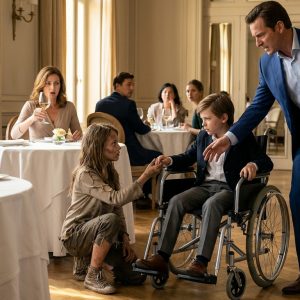
A boy lay on a mattress near the radiator.
Small.
Too thin.
Hair dark with sweat.
Cheeks flushed with fever.
My grandson.
Thomas.
He was seven years old.
The same age Clara had been when I first let her help polish silver at the shop counter.
He opened his eyes when we entered.
“Elena?”
“I’m here,” she whispered, rushing to him.
His gaze shifted to me.
Suspicious.
Tired.
Too adult.
“Who’s that?”
Elena sat beside him and touched his forehead.
“A man who knew your mother.”
He looked at me more carefully.
“My real mother?”
The words broke something open in my chest.
“Yes,” I said.
“What was her favorite color?”
I blinked.
Elena looked at me with warning.
A test.
Children who have been promised too many rescuers learn to ask questions only truth can answer.
“Yellow,” I said. “But not bright yellow. The soft kind. She said bright yellow was too loud.”
Thomas stared at me.
Then his lower lip trembled.
“She told me that.”
I had to turn away.
Elena opened her hand.
The fifty dollars lay inside.
“I need to get medicine.”
“No,” I said. “We need a doctor.”
She shook her head.
“No hospitals.”
“Elena—”
“No hospitals.”
Thomas coughed hard.
The sound was wet.
Dangerous.
I took out my phone.
Elena grabbed my wrist.
“If you call emergency services, they’ll ask names.”
“Good.”
“No. You don’t understand. Clara tried that once. After Thomas was born. Someone came before the ambulance.”
I froze.
“What happened?”
Elena looked at the boy.
“Not now.”
But Thomas whispered, “Mama said the lady with the pearl earrings sent them.”
Vivian wore pearl earrings every day.
Even to breakfast.
Especially to breakfast.
I called the only doctor I trusted from before Vivian entered my life.
Dr. Samuel Price.
Old friend.
Retired pediatrician.
Still angry enough at the world to answer late calls.
He arrived twenty-five minutes later with a medical bag and no questions until he saw the boy.
Then he asked all of them at once.
Thomas had pneumonia.
Not yet catastrophic.
Close enough to become so by morning.
Dr. Price treated him there first, then arranged a private clinic under his supervision with no paperwork sent through the usual channels until we were ready.
While Thomas slept, Elena told me the rest.
Clara had lived under false names for years.
She believed Vivian had arranged the guardianship scheme to gain control of the Hale family trust.
I had created that trust after Marianne’s death.
It held the shop, the apartment building above it, and the family savings.
If Clara had a child, the trust passed through her bloodline.
If Clara was declared estranged, unstable, or deceased without a recognized heir, Vivian could petition as surviving spouse.
Vivian had not only stolen my daughter.
She had tried to erase my grandson before he could inherit anything.
“Clara found out too late,” Elena said. “She was already sick. She made me promise to keep Thomas hidden.”
“And the locket?”
“She said it was proof. But also danger.”
“What proof?”
Elena opened the locket again.
I had already seen the photograph.
But not the back.
Inside the tiny frame, behind the old picture, was a folded strip of paper so thin it looked like backing.
Elena removed it with trembling fingers.
A bank deposit receipt.
A name.
An account.
Vivian Hale.
A transfer from a company I recognized immediately.
Northbridge Recovery Services.
The private investigation firm Vivian had hired to find Clara.
The firm that had never found anything.
Because they had not been paid to find her.
They had been paid to keep her away.
The Account Behind the Search
I did not confront Vivian that night.
That was the hardest thing I have ever done.
Every instinct screamed at me to drive home, throw the forged papers in her face, and demand the truth.
But Clara had spent years running from my second wife.
Elena had survived by hiding.
Thomas was sick because fear had kept him from hospitals.
I would not waste the first real proof we had by giving Vivian time to destroy the rest.
Instead, I called my lawyer.
Not the family lawyer.
Vivian had chosen him.
I called Marianne’s brother, Daniel, who had hated Vivian from the beginning and never pretended otherwise.
He arrived at the clinic before dawn.
When he saw Thomas asleep under a blanket, he sat down hard in the hallway and wept without making a sound.
Then he went to work.
By noon, we had the bank records.
By evening, we had three forged documents.
By midnight, we had a pattern.
Vivian had been paying Northbridge Recovery Services for twelve years.
Not to locate Clara.
To monitor her.
Every time Clara moved, a payment followed.
Every time she tried to contact someone from her old life, a report was filed.
Every time she approached a hospital, shelter, or legal clinic, someone connected to Northbridge appeared.
Sometimes as help.
Sometimes as threat.
Sometimes as a social worker with a badge no one verified.
Elena watched the documents spread across the clinic table.
“She was right,” she whispered.
I looked at her.
“Clara?”
“She said the search was the cage.”
I closed my eyes.
All those years.
All those invoices.
All those updates Vivian brought me with sad eyes.
“We checked every lead, Robert.”
“Nothing yet, Robert.”
“You have to prepare yourself, Robert.”
She had turned my love into a leash.
At 9:00 the next morning, Daniel filed an emergency petition in probate court.
At 9:15, he sent the forged guardianship papers to a federal investigator he knew through an old fraud case.
At 9:30, he contacted the police with evidence of identity fraud, coercion, and conspiracy.
At 9:42, Vivian called me.
I answered this time.
“Robert,” she said, voice tight. “Where are you?”
“With Clara’s son.”
Silence.
Not surprise.
Calculation.
Then she sighed.
“Oh, Robert.”
Those two words told me everything.
No shock.
No denial.
Only disappointment that I had finally become inconvenient.
“She poisoned you against me,” Vivian said.
“She’s dead.”
Another pause.
Shorter.
Colder.
“Then she can’t defend the lies she told.”
My hand tightened around the phone.
“You forged my signature.”
“I protected you.”
“You stole my daughter.”
“She left.”
“You made sure she couldn’t come home.”
Vivian’s voice hardened.
“Clara was reckless. Pregnant by that musician, threatening to ruin everything Marianne built. She would have handed your legacy to a man who played piano for tips.”
“My legacy was her.”
“She was going to destroy you.”
“No,” I said. “You did.”
For the first time, Vivian lost control.
“If you bring that child into this, you will regret it.”
I looked through the clinic window.
Thomas slept under a blue blanket.
Elena sat beside him, one hand resting protectively on his shoulder.
“No,” I said softly. “I already regret not finding him sooner.”
Then I hung up.
Vivian was arrested two days later.
Not dramatically.
Not in the shop.
Not at home.
At the airport.
She had a suitcase full of cash, a new passport, and a velvet pouch containing several pieces of Marianne’s jewelry.
Including Clara’s baby bracelet.
She had kept it.
That detail nearly made me sick.
Some people collect trophies from the lives they ruin.
The Boy Clara Saved
The trial lasted four months.
The newspapers called it the Locket Case.
I hated that.
It made the story sound small.
As if everything began with gold on a glass counter.
It began long before that.
With grief.
With paperwork.
With a woman who learned where our family was broken and slipped herself into every crack.
Vivian was charged with fraud, forgery, conspiracy, witness intimidation, unlawful coercion, and crimes connected to the attempted illegal guardianship transfer of Thomas.
Northbridge Recovery Services collapsed under investigation.
Two former employees testified that Vivian paid them to locate Clara, intercept messages, intimidate shelter workers, and block medical registration attempts under Clara’s real name.
One investigator admitted he watched Clara outside a clinic three months before she died.
He said she was carrying Thomas.
He said she looked directly at him.
Then ran.
I listened from the courtroom gallery and felt my heart break in a new way.
She had been so close to help.
So close.
Elena testified too.
She wore a navy sweater Daniel bought her and held the locket in both hands while she spoke.
She told the court how Clara coughed blood into towels.
How she refused hospitals.
How she taught Thomas to answer to different names.
How she made Elena promise that if anything happened, the child would stay hidden unless the locket proved the truth.
Vivian’s lawyer tried to make Elena look unreliable.
Homeless.
Desperate.
A woman who sold jewelry for cash.
Elena looked at the jury and said, “Yes. I sold it because his grandson needed medicine. If that makes me desperate, then I was desperate. But desperate people can still tell the truth.”
That was the moment the jury believed her.
Thomas did not testify.
I refused to allow it.
He had lost enough before I even knew he existed.
Vivian was convicted on all major counts.
At sentencing, the judge asked if she wished to speak.
She stood in a gray suit and looked at me.
“You would have lost everything without me.”
I thought of Clara.
Of Marianne.
Of Thomas coughing in a cold room.
Of Elena selling the only proof she had because a child needed antibiotics.
Then I answered, though no one had asked me.
“I did lose everything with you.”
Vivian received thirty-one years.
When they led her away, she did not look at Thomas.
Not once.
That told me she had never seen him as a child.
Only a threat that had survived.
Thomas came to live with me six weeks later.
Not immediately.
Trust cannot be handed over like keys.
Elena stayed too.
At first as his guardian.
Then as family.
There are bonds law does not create but should learn to respect.
The first night Thomas slept in Clara’s old room, he placed the locket under his pillow.
I asked if he wanted a safer place for it.
He shook his head.
“Mama said it knows the way home.”
I turned away before he saw my face.
We buried Clara properly in spring.
A small service.
No reporters.
No speeches from people who had not looked hard enough.
Elena placed wildflowers on the grave.
Thomas placed a drawing.
I placed the locket in my palm one last time, then kept it.
Not because I could not let go.
Because Thomas asked me to.
“She gave it back,” he said. “So you should keep it until I’m big.”
I nodded.
“All right.”
Years later, people would ask whether I hated Vivian.
The answer is yes.
But hate was not the hardest part.
The hardest part was forgiving the man I had been when Clara needed me to look closer.
To question faster.
To believe my daughter more than my grief.
I cannot undo that.
I can only tell Thomas the truth when he asks.
And he asks often.
“What was my mom like?”
“She hated peas.”
“Really?”
“Passionately.”
“Was she brave?”
“Very.”
“Was she scared?”
“Yes.”
“Can both be true?”
I look at him then.
At Clara’s eyes in his face.
At the boy who survived because two women loved him fiercely in different ways.
“Yes,” I tell him. “Both can be true.”
The shop still stands on the same rainy street.
The locket is no longer for sale.
It hangs in a small frame behind the counter, open to the old photograph of me and Clara when she was ten.
Below it, I added another photograph.
Clara holding baby Thomas.
Elena found it later in the lining of an old coat.
On the back, in Clara’s handwriting, were seven words:
If he ever knows, tell him I tried.
I know now.
Thomas knows too.
And every time rain taps against the shop windows, I remember the night a drenched woman walked in with nothing left to sell except the truth.
I offered her fifty dollars.
She gave me back my family.