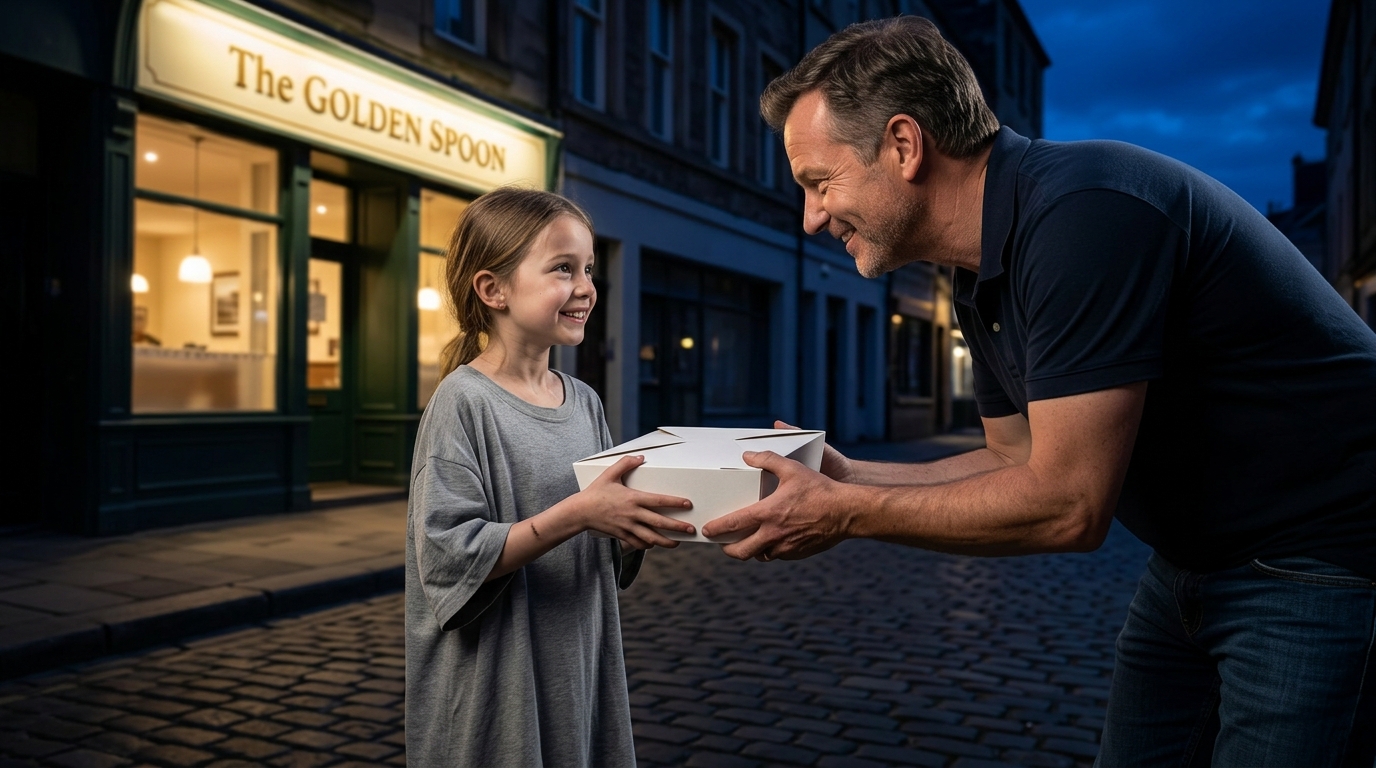
The Girl Who Didn’t Eat
He thought he was giving food to one hungry child.
That was all.
One takeout box.
One warm meal.
One small act outside a restaurant where golden light spilled onto the cobblestones and people inside laughed over wine they barely finished.
Thomas Avery had almost walked past her.
Almost.
She stood near the alley beside the restaurant, half-hidden beneath the awning, wearing an oversized gray dress that looked like it belonged to someone much older. Her shoes were cracked. Her hair was tied back with a piece of string. Her arms were too thin.
But it was her eyes that stopped him.
They were not begging eyes.
That would have been easier.
They were waiting eyes.
Quiet.
Careful.
The eyes of a child who had learned that asking too directly made adults uncomfortable.
Thomas had just left his own restaurant, Maison Vale, after a late meeting with his executive chef. The kitchen had already closed. The dining room glowed behind tall windows, all velvet chairs and polished silverware.
He carried a takeout box meant for himself.
Rice.
Chicken.
Vegetables.
Still warm.
He stopped in front of the little girl.
“Are you hungry?”
She looked up quickly, startled.
Then nodded once.
Not greedily.
Not eagerly.
Like admitting it cost her something.
Thomas held out the box.
“Here.”
She accepted it with both hands.
As if it were fragile.
As if it were treasure.
“Thank you, sir,” she whispered.
“You’re welcome.”
That should have been the end.
He should have walked to his car.
She should have sat on the curb, opened the box, and eaten like a starving child would.
But she didn’t.
She clutched the meal to her chest, turned, and ran.
Fast.
Too fast.
Thomas stood under the warm restaurant light, watching her disappear into the midnight blue of the side street.
Something tightened inside him.
Concern first.
Then curiosity.
Then a feeling he could not name.
A child that hungry did not run away from food unless someone hungrier was waiting.
So he followed.
Not too close.
He moved past shuttered bakeries, damp stone walls, trash bins, and narrow alleys where the city’s beauty ended as soon as the tourists stopped looking. The girl never slowed. She cut through a side passage, crossed a small courtyard, and reached a peeling blue door at the back of an old building.
She looked once over her shoulder.
Thomas stepped into shadow.
She slipped inside.
He hesitated.
He knew he should leave.
A respectable man did not follow a child into the dark.
But the worry in his chest had become heavier than caution.
He moved closer.
Through the cracked doorway, he saw the room.
Small.
Bare.
Cold.
A mattress on the floor.
A broken chair.
A pan blackened from too many fires.
And children.
Several of them.
Thin.
Small.
Waiting.
The little girl opened the takeout box, and the younger ones rushed forward with wide eyes.
“Did you bring food?” one boy asked.
She smiled.
A bright smile.
Too bright.
“Yes. Quietly. Mama is resting.”
She poured the rice into the pan and began dividing it carefully, stretching one meal into five portions with the seriousness of someone performing a sacred duty.
A frail older woman sat against the far wall, wrapped in a blanket.
Her face was pale.
Her eyes were wet.
The girl lifted the first portion and brought it to her.
“You eat, Mama,” she said softly. “I already had lunch at school.”
Thomas froze outside the door.
Because he knew immediately—
That was a lie.
He had seen hunger in boardrooms, hospitals, courtrooms, and war zones.
But child hunger had a special kind of silence.
It lived in the hands.
The careful swallowing.
The smile held too long.
The way the girl looked at the food and then forced herself to look away.
The older woman took the bowl with trembling fingers.
Tears pooled in her eyes.
Then she whispered the words that made Thomas’s throat close.
“You said the same thing yesterday.”
The little girl kept smiling.
“I wasn’t hungry yesterday either.”
One of the younger boys looked at her.
“Yes, you were.”
She shook her head quickly.
“No. Eat before it gets cold.”
Thomas stepped back from the doorway.
His hands were shaking.
He had offered one meal to one child.
And found a room full of hunger that had learned to share lies more carefully than food.
The Room Behind the Peeling Door
Thomas did not enter immediately.
He stood in the alley with his back against the cold wall, listening to the soft sounds inside.
Spoons scraping.
Children whispering.
The older woman coughing into a cloth.
The girl telling them to eat slowly while not taking a single bite herself.
He had built restaurants for thirty years.
He knew the sound of fine dining.
Forks touching porcelain.
Wine poured into crystal.
Guests complaining that sauce was too warm, too cool, too rich, too plain.
But this sound was different.
This was food becoming survival.
Finally, he knocked gently on the doorframe.
Everything inside stopped.
The little girl spun around.
Fear erased her smile.
The younger children froze with food halfway to their mouths.
The older woman tried to sit straighter, but her body betrayed her.
Thomas raised both hands.
“I’m sorry,” he said softly. “I didn’t mean to frighten you.”
The girl stepped in front of the pan.
Small body.
Huge courage.
“We didn’t steal it.”
“I know.”
“You gave it to me.”
“I know.”
“You said I could have it.”
“I did.”
Her voice trembled.
“Then why did you follow me?”
Thomas looked at the children.
Then at the woman.
Then back at her.
“Because you looked hungry.”
The girl swallowed.
“I’m not.”
The older woman closed her eyes.
The lie hurt her more than the hunger.
Thomas crouched slightly so he was not towering over the child.
“What’s your name?”
The girl hesitated.
“Ellie.”
“How old are you, Ellie?”
“Ten.”
She said it too quickly.
The boy behind her muttered, “Nine.”
Ellie shot him a look.
Thomas almost smiled.
Almost.
“And this is your family?”
Ellie nodded.
“My brothers. And Mama.”
The older woman tried to speak.
“Sir, we’re sorry. She shouldn’t have—”
Thomas shook his head.
“Please don’t apologize.”
He looked around the room again.
There were no toys.
No proper bedding.
No refrigerator.
No heat except a small electric plate plugged into a dangerous-looking socket.
Near the mattress was a plastic pharmacy bag with two bottles inside.
Both nearly empty.
The woman followed his gaze and pulled the blanket higher.
Thomas asked gently, “Are you sick?”
Ellie answered before her mother could.
“She just needs rest.”
The older woman gave a tired smile.
“Her name is Grace. I’m her mother, Anna.”
Thomas looked at the girl.
“Grace?”
The child’s cheeks flushed.
“Ellie is easier.”
“For who?”
She looked down.
“For people at school.”
That answer told him more than he wanted to know.
Thomas stepped fully into the room.
The children watched him as if he might take the food back.
Instead, he removed his coat and placed it around the shoulders of the smallest boy, who was shivering.
Ellie’s eyes widened.
“You don’t have to do that.”
“I know.”
“Then why?”
Thomas looked at the empty takeout box.
“Because one meal isn’t enough.”
Anna began to cry silently.
Grace noticed and rushed to her.
“Mama, don’t. Please. I brought food.”
“I know, baby.”
“I did good.”
Anna pulled her close with one weak arm.
“You always do good.”
Thomas turned away for a moment.
Some scenes deserved privacy.
Even in poverty.
Especially there.
He pulled out his phone and dialed the restaurant.
His manager answered on the third ring.
“Mr. Avery?”
“Send four full meals to the back alley behind Rue Montrose. Now. Soup, bread, chicken, vegetables, fruit, bottled water.”
A pause.
“At this hour?”
Thomas’s voice cooled.
“Yes. At this hour.”
“Of course, sir.”
He ended the call.
Grace stared at him.
“More food?”
“Yes.”
“For us?”
“Yes.”
Her eyes filled.
But instead of smiling, she looked afraid.
“We can’t pay.”
“I didn’t ask you to.”
Her shoulders tensed.
People had offered help before.
Thomas could see it.
Help with conditions.
Help with judgment.
Help that became a story someone else told at dinner.
He softened his voice.
“No one is taking anything from you.”
Anna looked at him then.
Really looked.
And something changed in her face.
Recognition flickered there.
Not of him.
Of his name, maybe.
“Your restaurant,” she whispered. “Maison Vale.”
Thomas nodded.
“Yes.”
She looked away quickly.
Too quickly.
He noticed.
“Have you been there before?”
Anna shook her head.
Grace answered.
“Mama used to cook.”
Anna whispered, “Grace.”
But the child had already spoken.
Thomas turned back.
“Where?”
Anna lowered her eyes.
For several seconds, she said nothing.
Then she whispered—
“Maison Vale.”
The Woman Who Cooked the Signature Dish
Thomas had spent twenty years building Maison Vale into one of the most respected restaurants in the city.
But he had not been in the kitchen every day for the last five.
Expansion had changed things.
Investors.
New locations.
Managers.
Consultants.
Menus shaped by people who used words like concept and luxury experience while forgetting food began with hunger.
He still visited.
Still tasted.
Still signed.
But he had trusted others with operations.
Now he stood in a cold room behind a peeling door, staring at a sick woman who claimed she once cooked in his restaurant.
“What was your position?” he asked.
Anna looked ashamed.
“Prep cook. Then line cook. Mostly sauces.”
Thomas stepped closer.
“When?”
“Three years ago.”
Three years.
The same year Maison Vale introduced its most profitable dish.
Braised chicken with saffron rice and citrus broth.
Critics called it elegant comfort.
Guests asked for it by name.
The restaurant called it The Golden Table.
Thomas remembered the first time he tasted it.
He had asked the head chef where the recipe came from.
“Team development,” the chef said.
Thomas believed him.
Now he looked at Anna.
“What did you cook?”
Grace answered again.
“Mama made the golden chicken.”
Anna closed her eyes.
Thomas went still.
“What did you say?”
Grace looked nervous now.
“The one with yellow rice. She used to make it when we had chicken. Before.”
Before.
A word children used when life had split into two parts.
Thomas looked at Anna.
“That recipe was yours?”
Anna shook her head weakly.
“It doesn’t matter.”
“It matters.”
“No, sir. Not anymore.”
“It matters.”
Her eyes filled with tears.
“I made it for staff meal once. Chef Laurent tasted it. The next week, he asked me to write it down. He said maybe they would use it for a family dinner special. Then it appeared on the menu.”
Thomas’s jaw tightened.
“Were you credited?”
She laughed softly.
Not with humor.
“No.”
“Paid?”
“No.”
“Then why did you leave?”
The room became quieter.
Grace’s face changed.
The boys stopped eating.
Anna looked at her children, then back at Thomas.
“I was accused of stealing.”
Thomas already knew what was coming.
Still, he asked.
“Stealing what?”
“Cash from the office.”
Grace shook her head hard.
“She didn’t.”
Thomas looked at the child.
“How do you know?”
“Because Mama cried when she lost the job. Not when they yelled at her. When they said she couldn’t cook anymore.”
Anna wiped her eyes.
“I begged them to check the cameras.”
“Who accused you?”
“Chef Laurent. And the manager, Mr. Bell.”
Thomas’s hand closed around his phone.
Victor Bell.
Current regional manager.
The man who had answered the phone minutes earlier.
“What happened after?”
Anna’s voice became smaller.
“They said if I fought it, they would report me. I had no lawyer. No savings. My husband had died that winter. I took the children and left.”
“Were charges filed?”
“No. They said I should be grateful they were merciful.”
Merciful.
Thomas felt something cold settle inside him.
Powerful men loved that word when they decided not to destroy someone completely.
As if restraint after cruelty were kindness.
A knock came at the door.
Grace flinched.
Thomas turned.
One of his restaurant drivers stood outside with bags of food, face pale as he took in the room.
“Mr. Avery?”
“Bring it in.”
The children stared as containers were placed on the table.
Soup.
Bread.
Chicken.
Fruit.
Milk.
More food than they had probably seen together in weeks.
Grace did not move.
Thomas looked at her.
“It’s okay.”
She looked at Anna.
Anna nodded through tears.
Only then did Grace take a piece of bread.
But she did not eat it.
She handed it to her youngest brother.
Thomas saw.
So did Anna.
The driver lingered near the door.
Thomas asked quietly, “Is Mr. Bell at the restaurant?”
“Yes, sir.”
“Tell him I’m coming back.”
The driver nodded.
Thomas’s voice lowered.
“And tell him not to leave.”
The driver disappeared into the alley.
Anna reached for his sleeve.
“Please don’t make trouble for yourself.”
Thomas looked at the room.
At the children.
At the stolen recipe feeding wealthy guests while its creator’s family starved in the dark.
“I’m not making trouble,” he said.
“I’m correcting theft.”
The Manager Who Buried Her Name
Thomas returned to Maison Vale with Grace beside him.
She refused at first.
Then insisted on coming when she realized he was going to confront the people who had ruined her mother.
“I want to hear them say it,” she said.
“Say what?”
“That she didn’t steal.”
Thomas did not argue.
Some children needed proof more than protection.
He wrapped her in his coat and walked with her through the back entrance.
The kitchen went silent when he entered.
Cooks froze.
Dishwashers stepped aside.
Chef Laurent looked up from the plating station and went pale.
Victor Bell arrived from the office seconds later, tie crooked, smile too large.
“Mr. Avery,” he said. “I heard there was some confusion.”
Thomas looked at him.
“Was there?”
Victor’s eyes flicked to Grace.
Then away.
“Who is this?”
Grace lifted her chin.
“Anna’s daughter.”
Chef Laurent dropped a spoon.
That tiny sound echoed across the kitchen.
Thomas turned to him.
“You remember Anna?”
The chef wiped his hands on a towel.
“There were many employees.”
Grace spoke before Thomas could.
“She made the golden chicken.”
No one moved.
Victor laughed nervously.
“I’m not sure what this is about.”
Thomas walked to the office.
“Then let’s find out.”
Inside, he logged into the old security archive.
Victor stepped forward quickly.
“I’m afraid those files were purged during system migration.”
Thomas looked at him.
“Were they?”
Victor stopped.
Thomas had built this company before Victor learned to fake authority. He knew which systems backed up automatically. He knew which servers stored deleted footage. He knew which people lied by explaining too much.
He called the head of IT.
“Restore kitchen and office footage from March 17 three years ago.”
Victor’s face drained.
Chef Laurent stood in the doorway.
Sweat gathered near his hairline.
Grace stood beside Thomas, too small for the room, too brave for the men in it.
The footage loaded.
Kitchen.
Anna in a white apron, younger, healthier, stirring a pot.
Chef Laurent tasting sauce.
His expression changing.
Then asking for her notebook.
Another clip.
Office.
Victor Bell opening a cash drawer.
Removing money.
Placing it into an envelope.
Then turning toward the camera before covering it with a file folder.
But not fast enough.
Final clip.
Anna standing in the office, crying.
Victor pointing toward the door.
Chef Laurent beside him, holding her recipe notebook.
Thomas paused the video.
The office was silent.
Grace whispered, “You lied.”
No one answered.
She said it again.
Louder.
“You lied.”
Chef Laurent’s shoulders sagged.
Victor tried one last performance.
“Mr. Avery, this was years ago. The situation was complicated. Anna had attendance issues, and we made a management decision—”
Thomas turned the screen toward him.
“You stole cash.”
Victor’s mouth closed.
Thomas looked at Laurent.
“You stole her recipe.”
The chef looked down.
Thomas’s voice hardened.
“And together, you stole her life.”
Victor said, “That’s dramatic.”
Grace moved before Thomas could stop her.
She stepped directly in front of Victor.
“My brothers were hungry,” she said. “My mom was sick. We slept in a room with no heat. Because you didn’t want people to know she made the food everyone loved.”
Victor did not look at her.
That was his final failure.
Thomas picked up the phone.
“Security.”
Victor’s head snapped up.
“Wait.”
“No.”
“Thomas, think about the brand.”
Thomas looked at the kitchen beyond the office.
At the staff pretending not to listen.
At the pots, knives, flames, plates, and the invisible hands behind every dish wealthy people praised.
“The brand should have thought about Anna.”
Within twenty minutes, Victor Bell was escorted out.
Chef Laurent was suspended pending investigation.
Corporate legal was called.
So were the police.
The stolen wages, false accusation, and altered records opened a wider investigation than Thomas expected.
Anna had not been the only one.
There were others.
Dishwashers denied overtime.
Cooks threatened over immigration status.
Servers forced to give up tips.
Staff meals billed to charity accounts but never served.
Thomas sat in his office past midnight, reading documents that made his own restaurant feel unfamiliar.
Grace fell asleep on the leather chair beside the desk, still wrapped in his coat.
When Anna arrived, carried in a taxi Thomas had sent, she entered the office shaking.
Grace woke and ran to her.
Anna held her daughter tightly.
Thomas stood.
“I am sorry,” he said.
Anna looked at the screen.
At the frozen image of herself in the old kitchen.
At the notebook in Laurent’s hand.
Her face crumpled.
“I told them I didn’t steal.”
“I know.”
“No one believed me.”
“I know.”
Grace turned to him.
“Can you say it?”
Thomas understood.
He stepped closer to Anna.
Clearly.
Fully.
“You did not steal.”
Anna covered her mouth.
Grace cried then.
Not quietly.
Not politely.
Like a child who had been carrying her mother’s innocence on her back for three years and could finally set it down.
The Table With Her Name
The story did not stay private.
It couldn’t.
Not after Victor’s arrest.
Not after staff began speaking.
Not after Thomas announced the closure of Maison Vale for one week to conduct a full internal investigation.
Critics called it a scandal.
Business papers called it a leadership failure.
Former employees called it overdue.
Thomas called it shame.
The Golden Table was removed from the menu immediately.
Then restored one month later under its true name.
Anna’s Chicken.
The menu description was simple:
Created by Anna Moreau. Served with credit, compensation, and gratitude.
Anna refused at first.
“I don’t want people pitying me.”
Thomas said, “Then don’t let them. Let them respect you.”
She stared at him.
“I don’t know how to be respected anymore.”
Grace, sitting beside her, said, “We can learn.”
That settled it.
Anna received back pay, damages, royalties for the dish, and a formal apology from the company. Thomas also created an employee protection fund, independent complaint channels, and a profit-sharing program for recipes developed by kitchen staff.
But none of that mattered to Grace as much as the lunch card.
Thomas noticed it one afternoon.
She stared at a school form on Anna’s table.
Meal account balance.
Overdue.
Grace had been telling her mother she ate lunch at school because she was ashamed to admit she had been giving her food away.
Thomas did not simply pay the balance.
He funded lunch accounts for every child in her school with unpaid meal debt.
Anonymously at first.
Grace found out anyway.
She crossed her arms when she confronted him.
“You said no pity.”
“That wasn’t pity.”
“What was it?”
“Debt repayment.”
She considered that.
“For the takeout box?”
“For the lie you told your mother so everyone else could eat.”
Grace looked away.
“I didn’t want her to worry.”
“I know.”
“She already worries too much.”
“I know.”
Then she whispered, “I was hungry.”
Thomas knelt so they were eye level.
“You don’t have to pretend with me.”
Her chin trembled.
“I don’t know how to stop.”
He nodded.
“Then we’ll start with lunch.”
Healing for Anna’s family came slowly.
Anna’s health improved once she received proper treatment.
The children moved from the bare room behind the peeling door into a small apartment above the restaurant, warm and bright, with real beds and a kitchen where Anna could cook only when she wanted to.
Grace still saved food in napkins.
Still gave her brothers the best pieces.
Still said she wasn’t hungry when she was.
But now adults noticed.
And gently handed the food back.
Three months after that night, Maison Vale reopened fully.
No grand celebrity party.
No champagne tower.
No influencers.
Thomas invited the staff first.
Then former employees.
Then the families of everyone who worked in the kitchen.
At the center of the dining room was one long table.
A brass plaque had been placed at the head.
ANNA’S TABLE
No one who feeds others should go hungry.
Anna cried when she saw it.
Grace pretended not to.
Then cried harder than everyone.
Thomas watched her sit at the table with her brothers, a full plate in front of her.
For a moment, she only looked at it.
Then she glanced toward Anna.
Anna smiled.
“Eat, baby.”
Grace picked up her fork.
This time, she did not pass the first bite to anyone else.
She ate.
And the room, full of cooks, servers, dishwashers, drivers, and children who knew what hunger looked like, pretended not to notice her tears.
That was kindness too.
Years later, people would ask Thomas why he followed the girl.
He never had a clean answer.
Because she ran too fast.
Because she didn’t open the box.
Because hunger carried in the hands has a different shape when it is being carried for others.
But the truth was simpler.
He followed because something in him understood that one meal was not the end of the story.
It was the door.
Behind it was a child who lied about lunch so her mother would eat.
A family pushed into darkness by men who stole more than money.
A recipe that fed the rich while its creator starved.
And a restaurant that had to learn the difference between serving food and honoring the people who make it.
That night, Thomas Avery believed he was offering one hungry child a meal.
Instead, she gave him back the truth.
And the truth changed every table he owned.