The Last Bread by the Fire
She was hungry too.
Anyone could have seen it if they had looked closely enough.
In the way her hands trembled when she tore the bread apart.
In the way she swallowed even when there was nothing in her mouth.
In the way she smiled at the boys as if hunger were something she had outgrown.
Her name was Mara Whitfield.
Though most people on that street called her nothing at all.
Not because they didn’t know her.
Because the poor are often reduced to what they lack.
The woman in the stained apron.
The widow near the alley.
The one who sleeps behind the old bakery.
The one who feeds strays when she can barely feed herself.
That evening, the city was turning gold at the edges, but the street where Mara knelt beside the small fire stayed gray. Smoke curled from broken wood inside a rusted metal drum. The smell of damp cardboard, dust, and old cooking oil hung in the air.
Three boys sat on the curb in front of her.
They were filthy.
Thin.
Exhausted.
Their clothes hung from their bodies like fabric had given up trying to fit.
The oldest looked about twelve. Sharp eyes. Split lip. A torn brown jacket too large at the shoulders.
The middle boy was maybe nine, with dark curls and a cough he tried to hide by turning away.
The youngest could not have been more than six.
He held his food with both hands, terrified it might disappear.
Mara had found them behind the market just after sunset, digging through a crate of spoiled vegetables.
They had run at first.
Children without homes learn that adults usually mean trouble.
But hunger is stronger than fear when the stomach has been empty long enough.
So they followed her.
Not all at once.
The youngest first.
Then the middle one.
Then the oldest, pretending he was only keeping watch.
Mara had one loaf of bread.
A small tin of beans.
Half a onion.
And one dented plate.
It was supposed to be her meal for two days.
She made it their dinner in ten minutes.
“Slow down,” she told them gently as they ate.
They did not.
They couldn’t.
They tore into the bread as if someone might change their mind and take it back. Beans smeared across their fingers. Steam rose from the plate. The youngest burned his tongue and kept eating anyway.
Mara laughed softly.
Not because it was funny.
Because if she didn’t laugh, she might cry.
The oldest boy noticed.
His name was Elias.
He had introduced himself only after Mara gave them food.
That told her something.
Trust came after bread.
He watched her hands.
Watched how she kept pushing pieces toward them.
Watched how her own portion grew smaller, then vanished completely.
“You didn’t eat,” he said.
Mara waved him off.
“I ate earlier.”
It was a lie.
A kind one.
The worst kind, because children who know hunger can always hear it.
Elias looked at the empty plate in her hands.
“You gave us all of it.”
She smiled.
“Good. Then I won’t have leftovers to carry.”
The middle boy, Jonah, slowed down.
The youngest, Caleb, looked between them with beans on his chin.
Mara reached out and wiped his face with the edge of a yellow cloth.
It had once been part of a kitchen towel.
Now it was faded, torn, and soft from years of use.
She wrapped the last piece of bread in it and pressed it into Caleb’s hands.
“For later,” she said.
Caleb stared at her.
“But there won’t be later for you.”
Mara’s smile faltered.
Only for a second.
Then she touched his cheek.
“Children first.”
Elias looked away.
His eyes were bright.
Not with childish tears.
With the kind of anger hunger teaches early.
“You shouldn’t have to,” he whispered.
“No,” Mara said. “I shouldn’t.”
That surprised him.
Most adults lied about suffering to make children comfortable.
Mara didn’t.
She simply added, “But tonight, I can.”
The boys ate until there was nothing left.
No crumbs.
No beans.
No onion.
The plate in Mara’s hands shone empty in the firelight.
She pretended to be full.
The boys pretended to believe her.
That was the small mercy they gave one another.
Then engines roared at the end of the street.
The sound did not belong there.
Not among broken windows, leaning buildings, and people who carried their lives in plastic bags.
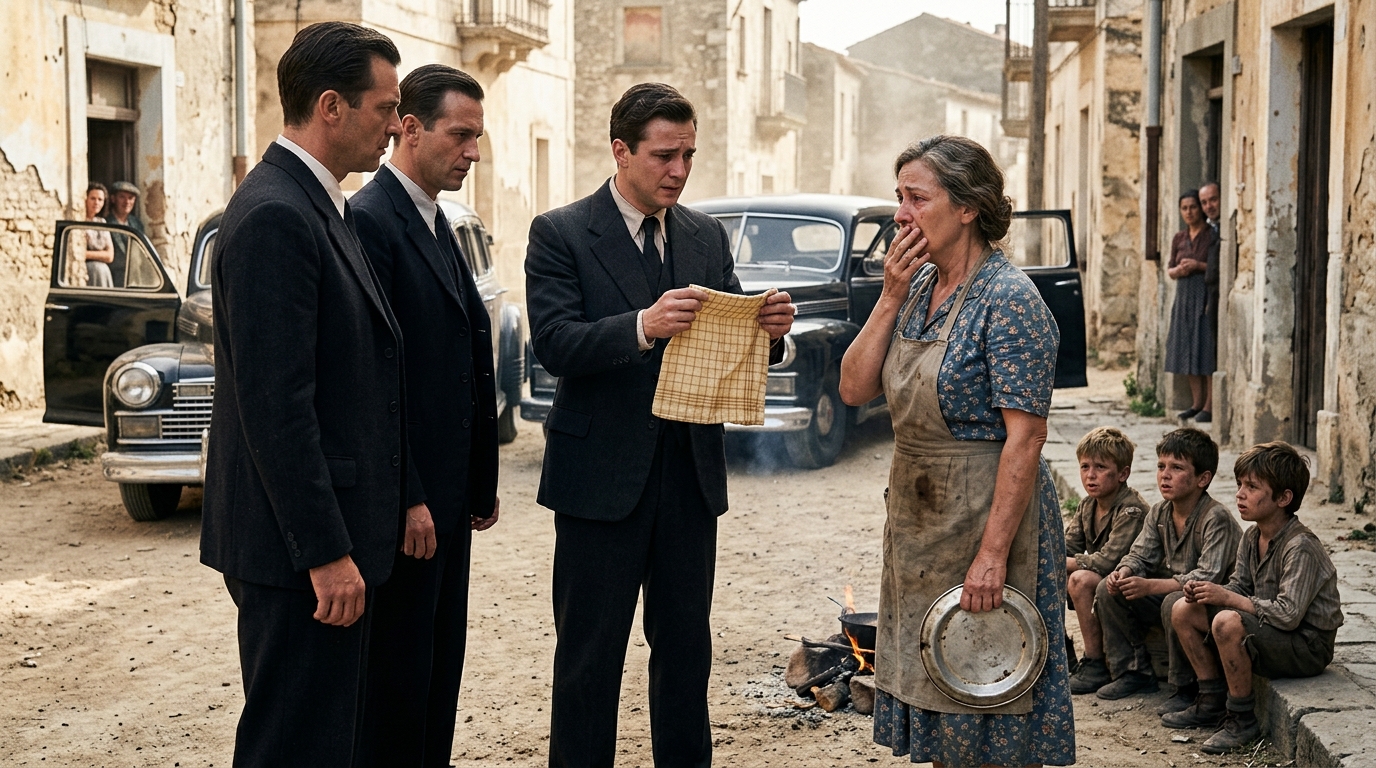
Two black vintage cars rolled into the dust and stopped behind her.
Beautiful cars.
Polished.
Expensive.
Impossible.
The street went still.
Mara froze with the empty plate in her hands.
The boys stopped eating.
Even little Caleb lowered the bread cloth in his lap.
The doors opened.
Three tall men in dark suits stepped out.
They moved together.
Shoulder to shoulder.
Silent.
Powerful.
Not hurried.
Men who did not need to hurry because the world usually moved for them.
Mara rose slowly.
The empty plate was still in her grip.
Fear passed across her face before she could hide it.
People like her knew luxury rarely came to streets like this unless it wanted something.
The men stopped in front of her.
For a moment, none of them spoke.
The man in the center looked down at the plate.
Then up at her face.
His expression broke.
“You already did,” he said.
Mara frowned.
“What?”
His voice trembled.
“You fed us with your last meal.”
The plate slipped from her fingers and struck the dirt.
She looked from his face to the man on his right.
Then to the man on his left.
Something in their eyes pulled at a memory buried beneath years of hunger, loss, and survival.
The youngest of the three men reached inside his jacket.
His hands shook as he drew out a folded yellowed cloth.
Old.
Faded.
Soft.
Mara stopped breathing.
He held it up.
“Do you remember,” he whispered, “what you wrapped the bread in that day?”
The Cloth That Survived
Mara could not speak.
The cloth hung between them like a piece of time refusing to die.
Yellow.
Frayed.
Burn-marked near one corner.
She knew that cloth.
Not because it was valuable.
Because poverty makes every small possession memorable.
She had owned only three cloths then.
One for washing.
One for wrapping food.
One for cold nights when her hands hurt.
That yellow cloth had been the softest.
She had wrapped bread in it for the smallest boy.
Caleb.
The name returned before the face did.
Then the others.
Elias.
Jonah.
Caleb.
Three boys by a fire.
Three empty stomachs.
Three pairs of eyes watching her pretend not to be hungry.
Mara lifted one trembling hand toward the cloth but stopped before touching it.
As if it might vanish.
“You kept it?” she whispered.
The youngest man smiled through tears.
“All these years.”
His voice had changed.
Deepened.
Polished by education, age, and pain.
But the eyes were the same.
Caleb’s eyes.
The little boy who had asked what would be left for her.
Mara staggered backward.
The man in the center stepped forward quickly, then stopped himself, afraid of frightening her.
“It’s us,” he said. “Elias. Jonah. Caleb.”
Her lips parted.
“No.”
Elias smiled sadly.
“You said that then too.”
Mara stared at him.
The oldest boy.
The guarded one.
The one who pretended he didn’t need anyone.
He was now a man in a tailored black suit, with silver at his temples and a watch that could have bought the entire block.
Jonah stood beside him, broad-shouldered, quiet, tears already running down his face.
Caleb still held the cloth like a sacred thing.
Mara covered her mouth.
The street blurred.
“I thought you died,” she whispered.
Elias’s expression darkened with memory.
“We almost did.”
That sentence settled over them.
Not dramatically.
Truthfully.
The night Mara fed them had not saved their lives forever.
No single meal could do that.
But it gave them enough strength to keep moving.
Enough warmth to survive one more night.
Enough proof that the world had not gone completely empty.
Jonah spoke for the first time.
“You told us where the mission church was.”
Mara remembered.
St. Agnes.
Three blocks over.
A red door.
Soup on Thursdays.
Blankets if supplies hadn’t run out.
“I walked you halfway,” she said slowly.
Caleb nodded.
“Then you gave me the cloth.”
“You were cold.”
“I was scared.”
“You were six.”
He laughed softly, wiping his face.
“I kept telling people I was seven.”
“You weren’t.”
“I know.”
For a moment, they all stood in the dust between past and present.
Then the trunks of the cars opened.
Two men in suits began unloading bags.
Food.
Blankets.
Medical kits.
Wooden crates.
Winter coats.
Shoes.
Gift boxes.
And bundles of cash sealed in bank paper.
Mara stared.
“What is this?”
Elias looked around the street.
“At first, not enough.”
He turned back to her.
“But it’s a start.”
Mara shook her head.
“I don’t understand.”
Jonah stepped closer.
“We’ve been looking for you for twelve years.”
“Twelve?”
“Longer, really,” Caleb said. “But seriously for twelve.”
Mara’s legs weakened.
Elias guided her gently to a wooden crate.
She sat.
The men stood in front of her like boys again, waiting to be recognized.
“I don’t understand,” she repeated.
Elias crouched so his eyes were level with hers.
“You fed us when no one else would look at us.”
“That was one meal.”
“No,” Jonah said. “That was the first time someone treated us like we might still become people.”
Mara looked at the cloth.
Then at the food.
Then at the cars.
“What happened to you?”
The brothers exchanged a glance.
The kind that held too much history to enter easily.
Elias answered.
“We reached St. Agnes that night. A volunteer there took us in. Not forever. But long enough.”
Jonah added, “A social worker found our aunt in Chicago.”
Caleb smiled faintly.
“She was terrifying.”
“She saved us,” Elias said.
“She made us go to school,” Jonah added.
Caleb looked at Mara.
“And Elias wouldn’t stop talking about the woman with the yellow cloth.”
Mara laughed once.
A broken sound.
“I had no name?”
“You told us Mara.”
“I did?”
Elias nodded.
“You said, ‘My name is Mara, but tonight you can call me boss because I’m in charge of this fire.’”
For the first time, Mara remembered that too.
And she laughed properly.
Just for a second.
Then she cried.
The kind of crying that bends the body because it has waited too many years to be allowed out.
Caleb knelt in the dirt and placed the yellow cloth in her hands.
“I wanted to return it,” he said.
Mara held it to her chest.
“You came all this way for an old cloth?”
Elias shook his head.
“No.”
His voice thickened.
“We came back for you.”
The Boys Who Became Men
People on the street began gathering.
Slowly at first.
Then in clusters.
A mother holding a baby.
An old man with a shopping cart.
Two teenagers from the corner.
A woman from the shelter doorway.
They did not come close enough to interrupt, but hunger recognizes food before pride can refuse it.
Jonah noticed first.
He turned to one of the men unloading the cars.
“Start distributing.”
Mara looked up sharply.
“No, wait. You can’t just hand out cash in the street. People will fight.”
Elias smiled.
“There she is.”
“What?”
“The boss of the fire.”
Mara wiped her face with the cloth.
“If you want to help, do it right.”
Jonah nodded immediately.
“Tell us.”
Mara stared at him.
He meant it.
This wealthy man in an expensive suit was standing in front of her asking how to help the people she knew.
Not telling.
Not performing.
Asking.
She looked toward the gathering crowd.
“Food first. No cash where desperate people can see it. Shoes by size. Medicine with someone who knows what they’re doing. Blankets after sunset. And nobody takes pictures of anyone crying.”
Elias turned to his team.
“You heard her.”
No one argued.
Within minutes, the street transformed.
Tables appeared from one of the cars.
Crates opened.
Food was passed out in order.
A nurse stepped from the second car and began checking children for fever, infection, and dehydration.
Shoes were lined along the curb.
Blankets stacked beside the fire.
Mara watched it happen in stunned silence.
Then she stood.
She could not help herself.
She began directing.
“You. The little one needs socks first.”
“Don’t give him hard fruit; his teeth hurt.”
“She won’t ask for two blankets, but give her two.”
“Put the soup away from the smoke.”
“Who brought canned beans without can openers?”
Caleb laughed.
Jonah whispered, “She hasn’t changed.”
Elias looked at Mara with something close to reverence.
“No,” he said. “She hasn’t.”
When the first rush settled, Elias brought her a bowl of stew.
Warm.
Thick.
Full of meat and potatoes.
She stared at it.
“I’m not hungry.”
All three brothers looked at her.
Mara sighed.
“I am hungry.”
Caleb sat beside her.
“Then eat.”
“I don’t like being watched.”
“Neither did we.”
That silenced her.
She took the spoon.
Her hand trembled.
Not from age.
Not only from hunger.
From being given something without having to earn it through suffering.
She took one bite.
Then another.
Tears slipped down her face again.
Jonah sat on the curb nearby, watching the children eat.
He looked almost haunted.
Mara noticed.
“What happened to you after Chicago?”
He rubbed his hands together.
“Our aunt took us in. She had one bedroom and three jobs.”
“Good woman?”
“The best,” Elias said.
“She died five years ago,” Caleb added softly.
Mara bowed her head.
“I’m sorry.”
“She wanted to meet you,” Jonah said.
Mara looked at him.
“She knew about me?”
Caleb laughed softly.
“We all knew about you.”
Elias reached into his coat and pulled out a small leather notebook.
The yellow cloth was not the only thing he had kept.
He opened the notebook and showed her the first page.
In a child’s handwriting, uneven and faded, were the words:
Find Mara. Bring bread.
Mara touched the page.
“You wrote that?”
Elias nodded.
“The night after we got to St. Agnes. I thought if I wrote it down, I wouldn’t forget.”
“And you didn’t.”
“No.”
He turned the pages.
Business notes.
Addresses.
Names.
Old searches.
Mission records.
Shelter lists.
Every possible spelling of her name.
Mara.
Maira.
Moira.
Mary.
Woman with yellow cloth.
Woman near old bakery.
Woman who fed three brothers.
Her breath caught.
“You really looked.”
“For years.”
“Why?”
Elias closed the notebook.
“Because every good thing we built started with that meal.”
Mara shook her head.
“You built it. Not me.”
Jonah leaned forward.
“Do you know what happened the next morning?”
She looked at him.
He continued.
“Caleb got sick. Fever. Bad. The church called a clinic because you told them he had been coughing.”
Mara remembered the cough.
Jonah’s hidden fear.
Caleb’s burning forehead near the fire.
“If you hadn’t noticed,” Elias said, “he might not have lived.”
Caleb looked down.
“I don’t remember that part.”
“I do,” Jonah said.
Mara swallowed hard.
“And you?”
Elias smiled.
“Construction first. Then real estate. Then logistics.”
Jonah added, “We own the food distribution company that supplies half the shelters in the state.”
Mara stared at them.
Caleb grinned.
“And I run the foundation.”
“What foundation?”
Elias looked around the street.
Then back at her.
“The Yellow Cloth Foundation.”
Mara froze.
No one spoke.
Caleb unfolded the cloth again, carefully.
“It’s our symbol,” he said. “Every emergency meal kit has a yellow cloth inside.”
Mara’s lips trembled.
“You named a foundation after a rag?”
Elias’s eyes filled.
“No,” he said. “After the woman who wrapped bread in it when she had nothing else.”
The Truth They Came to Repay
As evening deepened, the street filled with light.
Portable lamps were set up.
More cars arrived.
Not luxury cars this time.
Vans.
Food trucks.
Medical outreach workers.
Shelter coordinators.
People with clipboards who listened to Mara before making decisions.
She kept looking at Elias, Jonah, and Caleb as if they might disappear.
They did not.
They stayed.
They served food.
Carried crates.
Helped children try on shoes.
Jonah repaired the handle of an old woman’s cart.
Caleb sat on the curb with two boys and showed them how to open meal packs without spilling soup.
Elias took calls near the car, voice low, arranging hotel rooms, shelter beds, medical transport.
Mara watched them move through the street with a strange ache in her chest.
They had become powerful men.
But they still bent down when children spoke.
That told her more than the cars.
More than the suits.
More than the money.
Later, Elias returned to her with another envelope.
Mara immediately shook her head.
“No.”
He smiled faintly.
“You don’t know what it is.”
“I know what envelopes mean when rich men bring them.”
Jonah snorted.
“She got you.”
Elias sat beside her on an overturned crate.
“This is not a handout.”
“That’s what people say before handing something out.”
“It’s a deed.”
Mara stared at him.
He placed the envelope on her lap.
“The old bakery building. We bought it.”
Her breath stopped.
The old bakery had been empty for years.
Its windows boarded.
Its ovens cold.
Its sign half-fallen.
Mara had slept behind it more times than she could count.
“Why?”
Caleb crouched in front of her.
“Because you used to say nobody should eat alone if there’s a roof nearby.”
“I said that?”
“You were bossy,” Jonah said.
“I was hungry.”
“Both can be true.”
Elias opened the folder.
“We want to turn it into a community kitchen. Meals, showers, laundry, job support, medical visits twice a week. No cameras. No speeches. No donor tours.”
Mara stared at the papers.
Her name was printed on one line.
Director: Mara Whitfield.
She shook her head.
“No. No, I can’t direct anything.”
Caleb lifted an eyebrow.
“You directed this entire street in fifteen minutes.”
“That’s different.”
“How?”
“These people know me.”
Elias’s voice softened.
“Exactly.”
Mara looked away.
The old defenses rose automatically.
“I’m too old.”
“You’re fifty-eight,” Jonah said.
“I look seventy.”
“You look tired.”
“I have no degree.”
“You have trust.”
“I have nothing.”
Elias leaned closer.
“No, Mara. You had nothing that night. And you still gave.”
She closed her eyes.
Those words entered somewhere deep.
A place she had kept locked because remembering kindness was sometimes more painful than remembering cruelty.
“I was not always like this,” she whispered.
The brothers went quiet.
Mara had not planned to say it.
But the evening, the fire, the cloth, the full stomach, the impossible return of three boys she thought life had swallowed—
It loosened the story.
“I had a son,” she said.
Caleb’s expression changed.
Elias lowered his head slightly.
Jonah became very still.
“He was seven. Fever took him. I was working two jobs. I kept telling myself I would take him to the doctor after payday.”
Her voice broke.
“There was no after payday.”
The street noise softened around her.
No one interrupted.
“After he died, I started feeding children when I could. Not because I was good. Because I could not feed him.”
Caleb reached for her hand.
This time, she let him.
Mara looked at the three of them.
“That night, when I saw you boys behind the market, I thought…”
She stopped.
Elias finished gently.
“You thought of him.”
She nodded.
“I thought if someone had fed my boy when I couldn’t, maybe…”
Her voice dissolved.
Jonah wiped his face.
Caleb held her hand tighter.
Elias looked at the yellow cloth.
“You did feed him,” he said.
Mara looked up.
“No.”
“Yes,” he said. “Not the one you lost. But three others.”
That broke her.
Not loudly.
Not dramatically.
She bent over the cloth and cried into it while the three brothers surrounded her, no longer powerful men arriving in black cars, but hungry boys by a fire, finally able to return the warmth she had given them.
The Kitchen With the Yellow Door
The old bakery reopened six months later.
They painted the door yellow.
Mara argued against it.
Too bright, she said.
Too cheerful.
Too easy to stain.
The brothers ignored her.
The sign above the entrance read:
The Yellow Door Kitchen
No One Eats Alone
Mara cried the first time she saw it, then yelled at Caleb because the delivery crates were blocking the sidewalk.
“Emotional but still terrifying,” Jonah whispered.
“She’s perfect,” Elias said.
The kitchen became what the street had needed for years.
Hot meals every morning and evening.
Clean socks.
Showers.
A laundry room.
Medical volunteers.
A small children’s corner with books, crayons, and no questions asked.
Mara insisted the tables be round.
“People talk better when nobody sits at the head,” she said.
She insisted the food smell good.
“Survival meals don’t have to taste like punishment.”
She insisted every child leave with something wrapped in yellow cloth.
Not plastic.
Not paper.
Cloth.
Something soft.
Something reusable.
Something that said the meal was not an accident.
The brothers came every Friday.
No cameras.
No press.
No speeches.
Elias washed dishes badly.
Jonah repaired things that were not broken.
Caleb sat with the children and let them climb all over his expensive coat.
The first winter, a boy named Micah hid bread in his sleeves.
Mara saw him.
She did not scold him.
She brought him a yellow cloth and said, “Wrap it properly. Sleeves are for arms.”
Micah stared at her.
Then smiled.
That night, Mara went into the pantry and cried for ten minutes.
Not from sadness exactly.
From the strange, painful math of kindness.
How one meal could become three men.
How three men could become a kitchen.
How a kitchen could become a door.
How a door could become a place where hungry children stopped apologizing for needing food.
On the anniversary of the night by the fire, the brothers asked Mara to sit down after dinner.
She hated ceremonies.
So naturally, they created one anyway.
The room was full.
Children.
Volunteers.
Neighbors.
People who had once slept under bridges and now served soup to others.
Elias stood first.
“Twelve years ago,” he said, “a woman gave us her last meal.”
Mara covered her face.
“Don’t start.”
Everyone laughed.
He continued anyway.
“She gave us bread, beans, directions to safety, and a yellow cloth.”
Jonah stood next.
“She also yelled at us for eating too fast.”
More laughter.
Caleb stood last, holding the original cloth in a frame.
Mara went still.
The cloth had been carefully preserved, faded and frayed, with one burned corner and old fold lines still visible.
Caleb’s voice trembled.
“We kept this because it proved that someone saw us when we thought we had disappeared.”
He looked at Mara.
“You were hungry too. We know that now. You gave anyway.”
Mara shook her head, crying.
“I only did what anyone should do.”
Elias smiled.
“But not everyone did.”
That silence was gentle.
Honest.
Then they hung the framed cloth near the entrance, beside the yellow door.
Below it was a small plaque:
The first meal was wrapped in this cloth.
The next ones are for everyone.
Mara stood beneath it for a long time after the room emptied.
Caleb came to stand beside her.
“Do you hate it?”
“Yes.”
He grinned.
“You love it.”
“Yes.”
He leaned his head briefly against her shoulder like the six-year-old boy he had once been.
She did not move away.
Outside, the city was cold again.
It always was.
But inside the kitchen, soup simmered on the stove, bread cooled on metal racks, and yellow cloths were folded in neat stacks for morning.
Mara looked around the room.
For years, she had believed her life ended with what she lost.
Her son.
Her home.
Her place in the world.
But somehow, one night on a curb, with an empty plate in her hands and hunger twisting inside her, she had given away the last thing she had.
And it had come back.
Not as charity.
Not as pity.
As three grown men standing in the dust with tears in their eyes.
As food for a whole street.
As a yellow door that opened every morning.
As proof that kindness, once given, does not always vanish into the dark.
Sometimes it grows up.
Finds you.
And brings bread back.