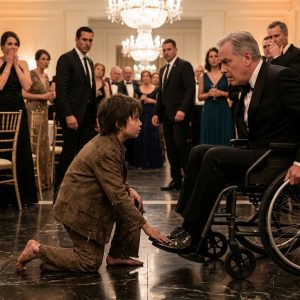
The Boy Who Ruined the Perfect Family Portrait
The atrium was too bright for a lie that dark.
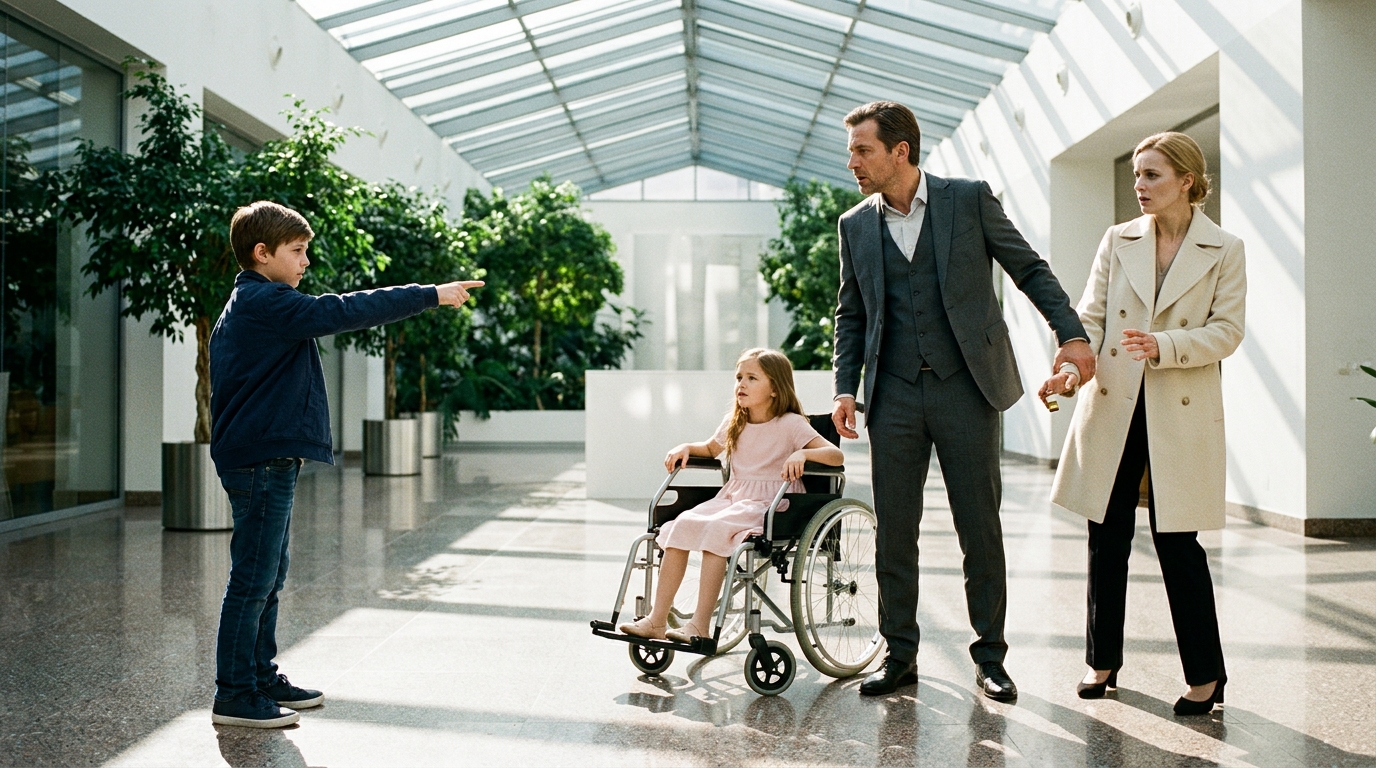
Sunlight poured through the glass ceiling of Westbridge Children’s Medical Center, spilling across the polished marble in wide, golden sheets. Everything gleamed beneath it—the white walls, the hanging gardens, the crystal donor plaques, the silent grand piano in the corner no child ever seemed to touch.
It was supposed to be a beautiful afternoon.
A public one.
A generous one.
The kind of day wealthy people loved because it allowed them to feel human while cameras were pointed at them.
My name is Adrian Vale, and that afternoon, I was standing behind my daughter’s wheelchair with one hand resting on the handle, pretending I knew how to breathe.
Sophie was eight years old.
She wore a pale blue dress, white socks, and small silver shoes she had not been able to use properly in almost a year. Her legs rested beneath a soft blanket embroidered with tiny stars. Her hair had been brushed into two neat ribbons by my fiancée, Vanessa, who stood to my right with one hand gently placed on Sophie’s shoulder.
To everyone watching, we looked like a family.
A widowed father.
A brave little girl.
A devoted woman who had stepped into a broken home and held it together with grace.
That was the image Vanessa loved most.
She had helped organize the charity luncheon. She had chosen the photographer. She had insisted Sophie attend, even though I had worried the noise would overwhelm her.
“She needs to be seen, Adrian,” Vanessa had whispered that morning, fastening her pearl earrings in my bedroom mirror. “People need to understand what she’s fighting.”
I had believed her.
God help me.
I had believed almost everything.
The diagnosis had come eleven months earlier after Sophie collapsed at school during recess. One moment she was running across the playground. The next, her teacher called me in a voice so shaky I knew before she said the words that my life had already changed.
The doctors called it functional motor paralysis triggered by neurological trauma.
A rare case.
A complicated case.
A heartbreaking case.
No clear cause.
No reliable timeline.
Maybe she would walk again.
Maybe she wouldn’t.
My late wife, Clara, had been gone three years by then. Cancer took her quietly, cruelly, leaving behind a daughter who still asked why heaven didn’t have visiting hours.
Vanessa arrived in our lives six months later.
At first, I thought she was a blessing.
She was elegant. Patient. Warm in all the ways grief had made me cold. She remembered Sophie’s medications, therapy schedule, favorite stuffed rabbit, and the precise way she liked her pancakes cut.
People praised her constantly.
“You’re lucky,” they told me. “Not every woman would love a child like her own.”
I used to nod.
I used to feel grateful.
That afternoon in the atrium, Vanessa looked perfect. Cream-colored coat. Soft waves of auburn hair. Diamond engagement ring catching the sunlight whenever she moved.
She leaned down toward Sophie and smiled.
“You’re doing wonderfully, sweetheart.”
Sophie smiled back, but it was small.
Tired.
Too tired.
That had become normal too.
I hated that I had accepted it.
A photographer lifted his camera.
“Everyone look this way, please.”
Vanessa moved closer to Sophie.
I adjusted my grip on the wheelchair.
A board member from the hospital placed a hand over his heart, already preparing to talk about resilience, generosity, and hope.
Then a boy’s voice cut through the atrium.
“She’s not really paralyzed.”
The sentence landed so sharply that for one second, no one seemed to understand it.
The photographer lowered his camera.
A woman holding champagne turned.
Two nurses near the registration table froze.
The boy stood on the far left side of the atrium, half-hidden behind a marble column. He looked maybe thirteen. Thin. Dark-haired. Wearing a gray hoodie two sizes too large and sneakers with split soles.
His face was pale.
But his eyes were steady.
Too steady.
Someone near him whispered, “Security.”
The boy didn’t move.
He raised one trembling finger and pointed straight past me.
Not at Sophie.
At Vanessa.
“Your fiancée is the reason she’s still like this.”
The atrium lost its sound.
Not gradually.
All at once.
I felt my hand tighten around the wheelchair handle.
Vanessa inhaled.
It was small.
Quiet.
But I heard it because I knew her breathing. I had slept beside it. Trusted it. Mistaken it for safety.
I looked down at Sophie.
Her eyes were wide, not with understanding, but fear. Children don’t always understand accusations. But they understand adults changing shape in front of them.
I turned to Vanessa.
“What is he saying?”
Her lips parted.
Nothing came out.
Not immediately.
That was the first thing that scared me.
Vanessa was never speechless. She could explain anything. She could soften anything. She could turn blame into concern with a single practiced look.
But in that moment, under all that sunlight, something drained from her face so fast it felt like I was watching a mask dissolve.
“What is he saying?” I asked again.
This time my voice was lower.
Harder.
The boy didn’t shout. He didn’t run. He didn’t perform for the people now pulling out their phones.
He simply stared at Vanessa with the awful calm of someone who had already decided silence was more dangerous than truth.
“She gives her something,” he said. “Before therapy. Before appointments. Before anyone tests her.”
Vanessa took one step back.
Then another.
“Adrian,” she whispered. “He’s unstable.”
I looked at the boy.
His clothes were dirty. His hands were raw. He looked like someone who had slept wherever the world allowed him to.
But his voice did not sound unstable.
It sounded certain.
“Who are you?” I asked.
His eyes flicked to Sophie.
For the first time, his expression changed.
Pain passed through it.
“My name is Caleb,” he said. “And she did this before.”
Vanessa turned slightly toward the exit.
Not enough for anyone else to notice.
Enough for me.
I stepped forward, still keeping one hand on Sophie’s wheelchair.
“Vanessa.”
She stopped.
At least, her body stopped.
Her eyes didn’t.
They scanned the atrium—the exits, the donors, the security desk, the cameras, the people watching.
Then something near her sleeve shifted.
A flash of glass.
A faint glimmer against the pale fabric of her coat.
I looked down.
Half-concealed inside her cuff was a tiny vial.
Clear liquid.
Silver cap.
No label.
For a moment, my mind refused to connect the object to anything real.
Then Sophie whispered behind me.
“Daddy?”
I turned.
Her small hand was gripping the blanket over her knees.
“My legs feel sleepy again.”
That was when the atrium seemed to darken without the light changing at all.
Because suddenly, I understood one thing with absolute clarity.
Whatever was in Vanessa’s sleeve had already touched my daughter.
And I had been standing close enough to stop it for months.
The Medicine Hidden in Her Sleeve
“Show me your hand,” I said.
Vanessa blinked.
“What?”
“Your hand.”
She gave a fragile laugh, the kind meant to make everyone else feel embarrassed for doubting her.
“Adrian, you’re frightening Sophie.”
But Sophie was already frightened.
Not of me.
Of her.
That was what I saw next, and it nearly broke something inside my chest.
My daughter had turned her face away from Vanessa. Just slightly. Just enough.
How many times had she done that before?
How many times had I missed it?
“Open your hand,” I said.
Vanessa’s expression hardened at the edges.
“Don’t humiliate me in public.”
The words were soft, but the threat beneath them was not.
I had heard that tone once before, though I hadn’t recognized it then. It was the tone she used with nurses who asked too many questions. With therapists who suggested alternate treatment plans. With household staff who made small mistakes and resigned two weeks later without explanation.
Control disguised as composure.
“Adrian,” she said, stepping closer now, voice trembling beautifully. “A strange boy just accused me of poisoning your daughter in front of half the hospital board, and you’re choosing to believe him?”
The crowd shifted.
That was a clever sentence.
She knew it.
I knew it.
It made me sound cruel before I had even answered.
But Caleb spoke again.
“Ask her why Sophie gets worse after the blue bag.”
My skin went cold.
The blue bag.
Sophie’s medical kit.
Vanessa had insisted on managing it because she said I was too overwhelmed. It went everywhere with Sophie. Therapy. School. Appointments. Even family dinners.
“What blue bag?” one of the board members murmured.
Vanessa turned on Caleb so quickly that her elegance cracked.
“You need to leave.”
Caleb didn’t.
He only looked at me.
“She keeps the vial in the inside pocket,” he said. “Not always. Only when she thinks someone might check the bag.”
Vanessa lunged toward him.
It happened fast.
Too fast.
One second she was beside Sophie.
The next she was moving across the marble, hand outstretched, coat swinging open.
Security stepped forward, but I moved first.
I caught Vanessa by the wrist.
The vial slipped from her sleeve.
It hit the marble.
A tiny sound.
Barely more than a click.
But it echoed through me like a gunshot.
Everyone looked down.
Vanessa stopped breathing.
I bent slowly and picked it up.
Clear liquid.
No label.
No prescription mark.
No explanation.
“What is this?” I asked.
She stared at it, then at me.
For the first time since I had known her, Vanessa looked truly ugly.
Not because her features changed.
Because the kindness left them.
“It’s for emergencies,” she said.
“What emergencies?”
“Sophie has spasms.”
“She hasn’t been prescribed this.”
“You don’t know every detail.”
“I’m her father.”
“And yet I’m the one who takes care of her,” she snapped.
There it was.
The sentence beneath every soft smile.
The resentment beneath every sacrifice.
A nurse stepped forward cautiously.
“Mr. Vale, may I see the vial?”
Vanessa turned sharply.
“No.”
That one word told the room more than any confession could have.
The nurse froze.
Caleb took another step forward.
“She used to say that too,” he said.
Vanessa’s face twitched.
“Stop talking.”
“My sister couldn’t walk for nine months.”
The atrium went silent again.
Caleb swallowed, but his voice stayed steady.
“She said it was trauma. She said my sister’s body forgot how. She said doctors didn’t understand because the illness was rare.”
I looked at Vanessa.
Her eyes were locked on Caleb now.
Not confused.
Not offended.
Recognizing.
“You know him,” I said.
“No, I don’t.”
Caleb reached into his hoodie pocket and pulled out a folded photograph.
His hands shook as he opened it.
He held it toward me.
I took it without looking away from Vanessa.
Only when I lowered my eyes did the world tilt.
The photo showed a younger Vanessa standing outside a beach house beside a little girl in a wheelchair. The child had dark curls, a pink cast on one wrist, and the same hollow exhaustion I had seen in Sophie for months.
Beside them stood Caleb, smaller then.
Angrier.
Alive with warning.
Vanessa wore a different hairstyle in the picture, darker and shorter. But it was her. The same smile. The same careful hand resting on the wheelchair handle.
The same pose.
Protector.
Caretaker.
Prison guard.
“She called herself Vivian then,” Caleb said quietly.
My hand went numb around the photograph.
Vanessa stepped back.
“This is insane,” she whispered. “You’re being manipulated by a homeless child.”
Caleb flinched at the word homeless.
But he didn’t retreat.
“My mother died trying to prove it,” he said.
The sentence tore through the atrium.
Vanessa moved.
Not backward this time.
Toward the exit.
I grabbed her arm again.
She twisted violently.
“Let go of me.”
The woman I loved disappeared completely in that second. What remained was cold, furious, and cornered.
Sophie began crying.
Not loudly.
That made it worse.
“Daddy, I don’t feel good.”
I released Vanessa and turned to my daughter.
Her face had gone pale. Her eyes were unfocused. Her fingers trembled on the blanket.
The nurse rushed to her side.
“What did she receive today?” the nurse asked.
Vanessa said nothing.
“What did she receive today?” the nurse repeated, louder now.
I looked at the vial in my hand.
Then at the blue medical bag hanging from the back of Sophie’s wheelchair.
I had carried that bag dozens of times.
Never checked it.
Never questioned it.
The nurse unzipped it carefully.
Inside were the usual things—tissues, wipes, a water bottle, prescribed supplements, therapy notes.
Then she reached into the inner pocket.
And pulled out three more vials.
All unlabeled.
All identical.
Vanessa stopped moving.
For one terrible second, the entire atrium held her still with its attention.
Then Caleb whispered the words that made my blood turn to ice.
“She already gave her one before you arrived.”
The Diagnosis That Made No Sense
The emergency room swallowed us whole.
Everything became white curtains, rolling beds, urgent voices, soft rubber soles squeaking against tile. Sophie was lifted from her wheelchair onto a hospital bed while I stood beside her, answering questions I should have known the answers to.
When was her last dose?
What medication?
Who administered it?
How long had symptoms worsened after each treatment?
I had no answers.
Only guilt.
Vanessa had been detained by hospital security until police arrived. She did not cry when they took her into a private room. She did not ask about Sophie.
That was the detail I kept returning to.
Not once.
Not one time.
Caleb sat outside the exam room with a blanket over his shoulders and a carton of juice untouched in his hands. A social worker had tried to speak with him, but he would only answer if he could see the hallway leading to Vanessa’s room.
“She talks her way out,” he told them.
They thought he was traumatized.
I knew he was experienced.
A toxicology screen was ordered. A neurologist was called. The vials were secured as evidence.
I paced beside Sophie’s bed while she drifted in and out of sleep.
Her small shoes sat on the floor below the bed.
Silver.
Unused.
I could not stop looking at them.
“How did I not see it?” I whispered.
The nurse beside me was older, with tired eyes and a voice made gentle by years of watching families break.
“People don’t look for monsters in the person packing the lunchbox,” she said.
That nearly ended me.
Because Vanessa had packed lunches.
She had braided hair.
She had kissed scraped knees.
She had sat beside Sophie through night terrors and whispered songs from Clara’s old playlist.
She had become indispensable.
That was the trick.
Monsters don’t always enter through windows.
Sometimes we hand them keys because they look like help.
Two hours later, Dr. Elaine Porter arrived from pediatric neurology. She had silver hair, sharp eyes, and the kind of calm that came from not needing people to like her.
She reviewed Sophie’s chart in silence.
Then she asked me one question.
“Who insisted on the original diagnosis?”
I opened my mouth.
Closed it.
Vanessa.
It had been Vanessa from the beginning.
She found the specialist. She arranged the second opinion. She kept folders, binders, medical journals printed and highlighted in neat yellow lines. She told me the first doctors were dismissive. She told me I had to fight harder. She told me Sophie needed someone relentless.
And she had been relentless.
Just not for the reason I thought.
“Vanessa did,” I said.
Dr. Porter nodded once.
“Did your daughter’s symptoms fluctuate?”
“Yes.”
“When?”
I thought back.
I did not want to.
But memory began rearranging itself with cruel precision.
The mornings after Vanessa stayed overnight in Sophie’s room.
The afternoons after therapy sessions Vanessa attended alone.
The evenings before major evaluations.
The sudden setbacks whenever a doctor mentioned improvement.
“She got worse before appointments,” I said slowly.
Dr. Porter’s expression did not change.
But something in the room did.
“What was in those vials?” I asked.
“We’ll wait for confirmation.”
“Doctor.”
She looked at Sophie.
Then back at me.
“I suspect a neuromuscular suppressant. Possibly combined with sedatives. Enough to mimic weakness, fatigue, and impaired motor control without causing immediate collapse.”
My knees nearly gave out.
“She was drugging her.”
Dr. Porter did not soften it.
“Yes.”
The word was clean.
Clinical.
Devastating.
“And the paralysis?”
“If we’re right, Sophie may not be paralyzed at all.”
The room blurred.
I gripped the edge of the bed.
The sound that came out of me was not crying. Not exactly. It was something too broken to have a name.
For eleven months, I had mourned a future that may have been stolen artificially.
I had watched Sophie stare at other children running.
I had watched her ask if her legs were mad at her.
I had watched her apologize for needing help.
And the woman responsible had stood beside us, accepting sympathy like applause.
Dr. Porter placed a hand on the bed rail.
“But long-term exposure can create real damage,” she said quietly. “We need to act quickly.”
There it was.
Hope with a blade inside it.
A detective arrived an hour later.
His name was Mark Ellis. He had the posture of a man who had seen too much and the eyes of someone who still let it matter.
He asked for my statement.
I told him everything.
The diagnosis.
The charity event.
The boy.
The vial.
The photograph.
The medical bag.
When I finished, Detective Ellis looked through the glass toward the hallway where Caleb sat alone.
“That boy has filed three reports in two states,” he said.
My head snapped up.
“You knew about him?”
“Not me personally. But his name is in the system.”
“Why didn’t anyone stop her?”
His jaw tightened.
“Because people like Vanessa rarely leave simple evidence. They leave confusion. Contradictory doctors. Emotional witnesses. Families too exhausted to fight.”
I thought of Caleb’s sister.
“Is she alive?”
Detective Ellis hesitated.
“Yes.”
That should have comforted me.
It didn’t.
“But she never fully recovered,” he added.
I closed my eyes.
A silence passed between us.
Then the detective slid a tablet across the table.
“Do you recognize this?”
On the screen was a document bearing my digital signature.
A medical conservatorship authorization.
My stomach turned.
“I’ve never seen this.”
“It was submitted this morning.”
“What does it do?”
Detective Ellis studied me before answering.
“It gives Vanessa emergency authority over Sophie’s medical and financial care if you are deemed emotionally unstable or medically negligent.”
For a second, I did not understand.
Then I did.
The charity event.
The cameras.
The public image.
The strange boy being discredited as unstable.
The medicine in Vanessa’s sleeve.
She had not been caught off guard.
She had been preparing for a final move.
My phone buzzed.
A message from my estate attorney.
Adrian, urgent. Vanessa came by yesterday with amended trust paperwork. Please call me immediately.
I stared at the screen.
The room narrowed.
Because suddenly this was no longer only about making Sophie sick.
It was about what Vanessa planned to take once Sophie was officially declared broken.
And the signature on that document meant the trap had already begun to close.
The Contract My Fiancée Needed Me to Sign
My father built Vale Industries from a two-room warehouse and a temper no competitor survived.
When he died, he left behind factories, patents, land, and a family trust worth more money than I liked discussing. Most of it was protected. Untouchable. Designed to pass to Sophie when she turned twenty-five.
Unless she became permanently disabled.
That clause had made sense when lawyers explained it years ago. It was meant to protect her. If Sophie ever needed lifelong care, the trust could be opened early for medical housing, specialists, adaptive technology, and full-time support.
I remembered signing the papers after Clara died.
I remembered not reading every line because grief had turned my brain into wet cement.
Vanessa had read them.
That was what I understood now.
Not recently.
Not casually.
Carefully.
Detective Ellis drove me to my attorney’s office while another officer stayed at the hospital. Sophie was stable but sedated, and Dr. Porter had promised me she would not leave the medical team’s sight.
Caleb came too.
No one invited him.
No one stopped him.
He sat beside me in the back of the unmarked car, staring out the window.
“How did you find us?” I asked.
He didn’t answer at first.
Then he said, “She likes rich men with hurt children.”
The sentence struck me so hard I had to turn away.
“She finds families already cracked,” he continued. “Then she becomes the only person holding them together.”
I thought of Vanessa arriving after Clara’s death.
The casseroles.
The handwritten notes.
The quiet understanding.
The way she never pushed too soon, only appeared whenever I was drowning.
“She studied me,” I said.
Caleb nodded.
“She studies everyone.”
My attorney, Harold Finch, looked as though he had aged ten years by the time we arrived. He met us in a conference room lined with law books no one had opened in decades.
“I didn’t process anything,” he said immediately. “Something felt wrong.”
He spread papers across the table.
Amended caregiving authorization.
Permanent disability disbursement request.
Emergency financial access petition.
My forged initials appeared on three pages.
My full signature on the last.
“It’s a good forgery,” Harold admitted. “But not perfect.”
“How much?” I asked.
He looked at me.
“Initial release would be twelve million.”
Caleb made a sound beside me.
Not surprise.
Recognition.
“And after that?” I asked.
“If Sophie was declared permanently incapacitated and Vanessa became her legal medical conservator, she could petition for full access.”
“How much?”
Harold swallowed.
“Eighty-seven million, including projected asset transfers.”
I sat down.
Not because I wanted to.
Because my legs stopped agreeing with me.
Eighty-seven million dollars.
That was the value Vanessa had placed on my daughter’s suffering.
I thought of Sophie’s tiny hands gripping the blanket.
My legs feel sleepy again.
Rage came slowly.
Not hot.
Cold.
Useful.
“What do we need?” I asked.
Harold blinked.
“For what?”
“To destroy her.”
Detective Ellis leaned forward.
“We need proof of intent. Not just possession. Not just medical harm. We need the bridge between the drugs, the diagnosis, and the money.”
Harold tapped the papers.
“She was careful. Everything here could be framed as preparation for Sophie’s care.”
Caleb reached into his hoodie pocket.
I turned.
He pulled out a cracked phone.
Old.
Taped at the corner.
“I have something,” he said.
Detective Ellis straightened.
Caleb placed the phone on the table but kept his hand over it.
“My mother recorded Vivian before she died,” he said.
Vanessa.
Vivian.
Whatever name she had worn while ruining Caleb’s family.
“She sent it to herself from a hidden account,” he continued. “I found it after the funeral. I didn’t know what it meant then.”
His fingers trembled.
For the first time, Caleb looked thirteen.
Not like a witness.
Not like a hunter.
Like a child carrying something too heavy because every adult had failed first.
Detective Ellis said softly, “You don’t have to play it here.”
Caleb looked at me.
“Yes,” he said. “I do.”
He unlocked the phone.
Tapped a file.
A woman’s voice filled the room. Older. Frightened. Caleb’s mother.
“Vivian, I know what you’re doing to Hannah. I tested the bottle. I know.”
Then Vanessa’s voice.
Younger, but unmistakable.
Smooth.
Almost bored.
“You don’t know anything you can prove.”
Caleb’s mother began crying.
“She’s a child.”
Vanessa laughed.
Not loudly.
That made it worse.
“She’s an asset with a pulse.”
The room went still.
My hand closed into a fist.
Vanessa continued on the recording.
“People like your husband sign anything when they’re scared. Medical care. Trust access. Caregiver authority. It’s not my fault grief makes rich people stupid.”
Harold whispered, “My God.”
Caleb stared at the table.
His face had gone blank in the way people go blank when feeling everything would kill them.
The recording continued.
Caleb’s mother threatened police.
Vanessa sighed.
“Go ahead. By the time anyone believes you, the money will be gone, and your daughter will still be sitting in that chair.”
The audio ended.
No one spoke.
Detective Ellis picked up the phone carefully.
“This changes everything.”
“No,” I said.
Everyone looked at me.
I stood slowly.
“This confirms everything.”
My phone rang again.
Unknown number.
I almost ignored it.
Then Detective Ellis nodded for me to answer on speaker.
I did.
For one second, there was only breathing.
Then Vanessa’s voice slid through the room.
“Adrian.”
My blood went cold.
“Where are you?”
She laughed softly.
“You really should have stayed at the hospital.”
Detective Ellis motioned for everyone to stay silent.
My hand tightened around the phone.
“What did you do?”
Vanessa’s voice softened into something almost tender.
“You still don’t understand, do you? Sophie was never the only insurance policy.”
Then the line clicked dead.
For half a second, no one moved.
Then Detective Ellis grabbed his radio.
I was already running.
Because there was only one place Vanessa would go if she had planned for everything.
And my daughter was still there.
The First Step My Daughter Took Back
The hospital was in lockdown when we arrived.
Police cruisers crowded the entrance. Nurses rushed through corridors. A security guard near the elevators had blood on his collar from a split lip.
Vanessa had not escaped custody.
That was the first thing Detective Ellis learned.
She had done something worse.
She had activated someone else.
An accomplice.
A fake transfer order had been submitted under Dr. Porter’s name. Two men in private medical transport uniforms had arrived with a stretcher, claiming Sophie needed to be moved for specialized imaging.
They knew the floor.
They knew the room.
They knew my daughter’s full name.
But Dr. Porter had been faster.
She blocked the transfer, demanded verification, and when one of the men tried to force the bed through the hallway, security intervened.
Both men fled.
One was caught in the parking garage.
The other disappeared.
Sophie was safe.
Barely.
I found her in a secured pediatric room with two officers outside the door. She looked so small beneath the hospital blanket that all the rage in me cracked open into something more painful.
“Daddy?”
I crossed the room and took her hand.
“I’m here.”
“Where’s Vanessa?”
I couldn’t answer immediately.
Because children ask simple questions that adults have ruined with complicated truths.
“She can’t hurt you anymore,” I said.
Sophie looked at me for a long moment.
Then whispered, “She said you’d be mad if I got better.”
The words nearly took me apart.
“What?”
“She said walking would make you sad because Mommy couldn’t see it.”
Clara.
Vanessa had used Clara.
She had reached into my daughter’s grief and twisted it into obedience.
I pressed Sophie’s hand to my forehead.
“No, sweetheart,” I said, my voice breaking. “No. Your mom would want you to run so fast the angels had to chase you.”
Sophie’s lip trembled.
Then she cried.
For the first time in months, she cried like a child instead of apologizing for being one.
The next weeks became a blur of doctors, police, court orders, toxicology reports, and headlines.
Vanessa’s real name was not Vanessa Marlowe.
It was Vivian Cross.
Before that, Vivian Bell.
Before that, Vivienne Hart.
Four states.
Three wealthy families.
Two children with long-term mobility damage.
One dead mother whose warnings had been dismissed as grief-induced paranoia.
And Sophie.
My Sophie.
Her test results confirmed repeated exposure to a compound that impaired muscle control and caused profound fatigue. Dr. Porter said recovery was possible, but not guaranteed. The body heals on its own timeline, she warned me.
So we waited.
We did real therapy.
Honest therapy.
Painful therapy.
There were no cameras.
No charity luncheons.
No elegant woman accepting praise beside a wheelchair.
Only Sophie sweating through small movements while I knelt beside her, counting every inch like a prayer.
Caleb stayed in town through the trial.
Harold arranged housing. I arranged private investigators for his sister’s case. Detective Ellis reopened files that had been sleeping under dust and shame.
Vanessa’s trial lasted seventeen days.
She wore navy suits and minimal makeup. She looked calm in every photograph. Commentators called her poised. Analysts called her manipulative. I called her nothing.
Names felt too human for what she had done.
Caleb testified first.
He did not cry.
That somehow made the courtroom cry for him.
Then his sister testified by video, her voice quiet, her hands folded in her lap. She spoke about the months she believed her own body had betrayed her. She spoke about Vivian brushing her hair while whispering that no one loved difficult children.
I watched the jurors change during that testimony.
Not dramatically.
Permanently.
Then Dr. Porter explained Sophie’s results.
Harold explained the trust.
Detective Ellis played Caleb’s recording.
And finally, they played the hospital atrium footage.
The sunlight.
The wheelchair.
The boy pointing.
Vanessa stepping back.
The vial slipping from her sleeve.
On screen, I watched myself realize the truth again.
It was strange seeing the exact second my life split open.
Vanessa never looked at the footage.
Not once.
When the verdict came, Sophie was not in the courtroom. I wouldn’t let her be.
Guilty.
Medical child abuse.
Attempted kidnapping.
Fraud.
Forgery.
Conspiracy.
Multiple counts across multiple jurisdictions.
The judge sentenced Vanessa to forty-eight years.
She showed no remorse.
But as officers led her away, she turned and looked at Caleb.
That was her mistake.
Because he smiled.
Not with joy.
With release.
Outside the courthouse, reporters shouted questions.
“How does it feel, Mr. Vale?”
“Do you believe justice was served?”
“Can your daughter walk again?”
I ignored all of them.
Because justice is not a microphone moment.
Justice is what happens after everyone stops watching.
Three months later, Sophie stood in our backyard between two parallel therapy bars I had installed under the oak tree Clara loved.
The afternoon sun was soft.
Golden.
Kind.
Caleb sat on the porch steps, pretending not to watch too closely.
Dr. Porter stood nearby with her arms crossed, wearing the smallest smile I had ever seen.
I knelt at the end of the bars.
Sophie gripped them tightly.
Her legs trembled.
“Daddy,” she whispered, scared.
“I’m right here.”
“What if I fall?”
“Then I catch you.”
She looked at me.
Really looked.
Then she took one step.
Tiny.
Uneven.
Shaking.
But hers.
Everyone went silent.
Sophie took another.
Then another.
Her face changed slowly, as if some locked room inside her had opened and light was spilling in.
“I’m doing it,” she whispered.
I could not speak.
She reached the end of the bars and collapsed into my arms, laughing and crying at the same time.
I held her so tightly I could feel her heartbeat against mine.
Behind us, Caleb wiped his face with his sleeve and looked away.
That night, after Sophie fell asleep, I found him standing in the atrium of our house, staring at the old family photo of Clara, Sophie, and me.
“You saved her,” I said.
He shook his head.
“No,” he replied. “I just pointed.”
Maybe that was true.
Maybe all he did was point at a lie in a room full of people too comfortable to see it.
But sometimes that is the bravest thing anyone can do.
The next morning, Sophie asked if Caleb could stay for breakfast.
He did.
Then for lunch.
Then for another week.
Then longer.
Grief had taken people from all of us.
Vanessa had tried to turn that grief into money.
But she had failed to understand something simple.
Broken families are still families.
And sometimes, the child nobody believes becomes the only reason another child gets to stand again.
Six months after the atrium, Sophie walked into the same medical center holding my hand.
No wheelchair.
No blanket.
No silver shoes left unused.
Caleb walked on her other side.
When we passed beneath the glass ceiling, sunlight poured over the marble just like before.
Bright.
Unforgiving.
Beautiful.
Sophie stopped in the middle of the atrium and looked up.
“Daddy,” she said softly. “It doesn’t look scary anymore.”
I looked at the place where Vanessa’s vial had once hit the floor.
Then at my daughter standing in the light.
“No,” I said, squeezing her hand. “It doesn’t.”
And for the first time in nearly a year, I believed it.