I was the man who laughed first.
That is the part I have never been able to forgive.
The lobby of the Saint Aurelia Hotel glowed that evening with everything money can buy and nothing it can protect.
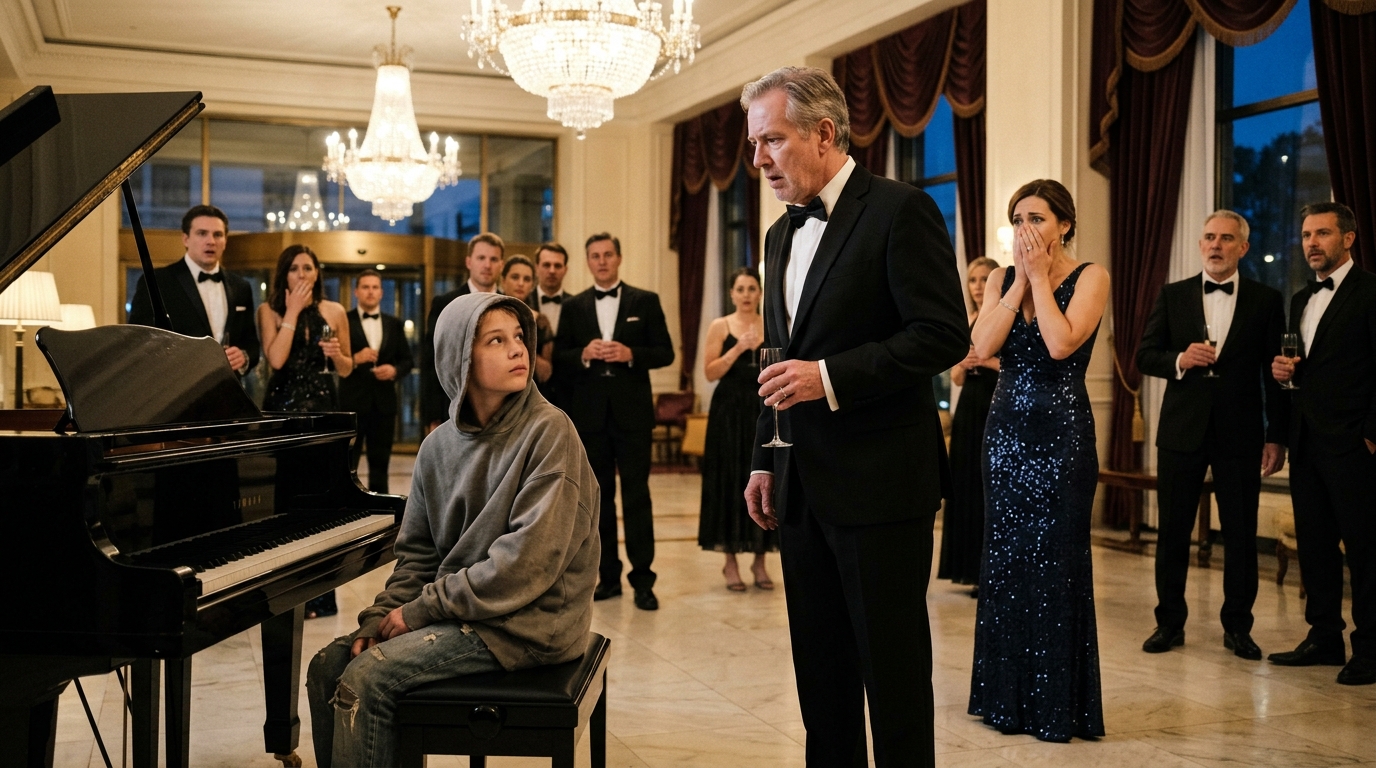
Crystal chandeliers shimmered over marble floors. Soft piano music drifted through the air. Women in silk gowns lifted champagne flutes beneath golden light, while men in tuxedos spoke in low voices about mergers, estates, and countries they visited only when the weather suited them.
Then the boy appeared near the entrance.
He was small.
Thin.
Maybe twelve.
His clothes were torn at the sleeves. His shoes were split near the toes. He stood beside the grand piano with his eyes lowered, as though even looking at the room might get him thrown out.
Guests noticed him immediately.
Not with concern.
With curiosity.
The way people notice a stain on an expensive tablecloth.
My wife, Catherine, leaned toward me and whispered, “Security should remove him.”
I should have agreed.
Or better, I should have walked over and asked if he was hungry.
Instead, I lifted my glass.
I was drunk enough to be cruel and powerful enough to mistake cruelty for charm.
“Play a song, kid,” I called out. “If you move me, maybe tonight you won’t have to sleep on the streets.”
A few guests laughed.
Softly.
Politely.
The boy did not.
He looked at me once, then turned toward the piano bench.
No one stopped him.
The lobby seemed to pause as he sat down. His hands hovered over the keys. They were dirty. Small. Scarred across the knuckles in a way no child’s hands should be.
Then he began to play.
The first notes were soft.
Almost hesitant.
But the melody that followed cut through the room like a memory sharpened into sound.
The laughter vanished.
Conversations died.
A woman near the staircase lowered her phone.
My smile faded before I understood why.
The tune deepened, slow and aching, each phrase more familiar than the last. My glass trembled in my hand. The chandeliers seemed suddenly too bright. The air too thin.
No.
That was impossible.
No one knew that melody.
No one.
I took a step forward.
The boy kept playing, eyes lowered.
My throat closed.
“That tune…” I whispered.
Catherine’s hand tightened around my arm.
I barely felt it.
“That tune was never made public.”
The final note rang through the lobby and dissolved into silence.
The boy lifted his eyes.
They were gray.
My daughter’s eyes had been gray.
I stared at him, unable to breathe.
“Only my missing child knew that melody,” I said.
The boy’s face did not change.
No fear.
No confusion.
Only a sadness too old for him.
“Then ask your wife,” he said softly, “why my mother died with your family ring.”
The lobby went completely still.
I turned toward Catherine.
For the first time in all the years I had known her, my wife looked terrified.
The Song My Daughter Took With Her
My daughter’s name was Isabel Whitmore.
She was eight years old when she vanished.
That was the version the world knew.
The newspapers wrote about the kidnapping for months. They printed photographs of her in a white dress, holding a stuffed rabbit, smiling with one front tooth missing. They called her the lost princess of the Whitmore family. They called me the grieving father. They called Catherine the devoted stepmother who “stood beside me through unimaginable pain.”
What they did not know was that the melody the boy played had been ours.
Not the family’s.
Not the public’s.
Ours.
I wrote it after Isabel’s mother died.
My first wife, Helena, passed away when Isabel was five. For weeks afterward, Isabel refused to sleep. She would sit on the floor outside my study with her blanket around her shoulders, silent and pale, waiting for a mother who would never come down the hall again.
So I wrote a little tune for her.
Nothing grand.
Nothing worthy of a concert hall.
Just a simple melody played with two hands and a broken heart.
I called it The Moon Behind the Glass because Isabel said the moon looked trapped in her bedroom window.
Every night, I played it for her.
Every night, she asked for it again.
By the time she disappeared, she could play it herself.
I never wrote it down.
Never recorded it.
Never played it for guests.
Catherine had heard it only from the hallway.
And yet a homeless boy had walked into my hotel lobby and played it as if he had been taught by the ghost of my child.
Security moved toward him.
I raised my hand.
“No one touches him.”
The boy stood from the piano bench.
Catherine recovered enough to laugh, but it came out brittle.
“Edmund, this is ridiculous. Street children learn all sorts of things. Someone must have taught him.”
I looked at her.
“Exactly.”
Her smile tightened.
The boy reached into his coat and pulled out a small cloth bundle. He placed it on the piano lid and unfolded it carefully.
Inside lay a ring.
Gold.
Heavy.
Set with a small sapphire.
The Whitmore crest engraved along the side.
My family ring.
My father gave it to me when I turned twenty-one.
I gave it to Isabel the last Christmas before she vanished because she was fascinated by it and kept slipping it onto her thumb.
Catherine told me it disappeared with her.
The police searched for it.
I searched for it.
For years, I dreamed of finding that ring somewhere impossible.
A ditch.
A pawnshop.
The pocket of a stranger.
Now it lay under the chandelier in front of me, carried by a boy with my daughter’s eyes.
I reached for it with hands that no longer felt like mine.
“Where did you get this?”
“My mother,” he said.
“What was her name?”
He swallowed.
“She called herself Mara.”
Called herself.
The words struck me.
“What was her real name?”
The boy stared straight at Catherine.
“She said the woman in pearls stole it.”
Catherine stepped back.
The room inhaled.
I turned slowly toward my wife.
“Catherine,” I said, my voice barely controlled, “what does he mean?”
She looked around at the guests, then lowered her voice.
“Do not do this here.”
But it was already too late.
The boy looked at me again.
“My mother said if I ever found the man who knew the song, I should tell him one thing.”
My chest tightened.
“What?”
His voice shook for the first time.
“She waited by the fountain until morning. You never came.”
The Night I Thought I Lost Her
The fountain.
I had not thought about it in years.
The night Isabel vanished, there had been a storm.
I was in London for a board meeting. Catherine called me just after midnight, hysterical, saying Isabel was gone from the house. The back door had been found open. A nursery window was unlatched. The police suspected a kidnapping.
I flew home before dawn.
By then, the estate was full of officers, reporters, and relatives pretending they knew how to help.
Catherine told me Isabel had been restless that evening.
Upset.
Missing Helena.
She said Isabel had asked to go outside to the garden fountain, where Helena used to read to her. Catherine refused because of the rain. Later, when she checked the room, Isabel was gone.
For months, I blamed myself.
For being away.
For remarrying too soon.
For trusting the world to remain intact while I attended meetings about money that suddenly meant nothing.
But now the boy said Isabel had waited at the fountain until morning.
Waited for me.
I moved closer to him.
“What is your name?”
“Leo.”
“Leo what?”
He hesitated.
“Leo Bell.”
Another hiding name.
Another lie shaped into something ordinary.
“How old are you?”
“Twelve.”
Isabel had vanished fourteen years earlier.
If this boy was her son, then she had lived for years after that night.
Lived.
Suffered.
Hidden.
Died.
A sound came from my throat that I did not recognize.
Catherine grabbed my sleeve.
“Edmund, stop. Think about what this looks like. He is manipulating you.”
Leo looked at her.
“No,” he said quietly. “You did that.”
The simplicity of it stunned the room.
My wife’s face hardened.
“You filthy little liar.”
The boy flinched.
Not from the insult.
From recognition.
He had heard that voice before.
Maybe not in person.
Maybe in stories from his mother.
But he knew the shape of it.
I looked at Catherine and saw, for the first time, not my elegant wife, not the woman who had stood beside me at funerals and charity galas, but someone standing too close to a locked door.
I took out my phone and called my private security chief.
“Seal the hotel,” I said. “No one leaves through the service exits.”
Catherine stared at me.
“You wouldn’t dare.”
I looked at the ring in my hand.
“I should have dared fourteen years ago.”
The Room Behind the Service Hall
Leo had not come alone.
That was what he told me upstairs in my private suite, after the guests were cleared from the lobby and Catherine was placed in a side room with my attorney and two security guards.
His mother had died three weeks earlier.
Not in a hospital.
Not in a home.
In a shelter outside Newark, where she had spent her final months coughing blood into handkerchiefs and writing down everything she had never been able to say aloud.
Leo carried the pages in a plastic grocery bag.
He placed them on the table carefully, as if they were holy.
The first page was addressed to me.
Mr. Whitmore,
If my son is brave enough to find you, then I am already gone. My name was Isabel Whitmore before they told me it would get me killed.
I sat down before my legs failed.
The handwriting was older.
Unsteady.
But the shape of the letters was hers.
The same looping I.
The same sharp W.
My little girl’s hand, grown into a woman’s without me.
I forced myself to read.
The night I disappeared, Catherine told me you had sent for me. She said you were waiting by the garden fountain and that I must come quietly because there was a surprise for my birthday. I believed her. I was eight.
My vision blurred.
Leo sat silently across from me, watching me discover the life his mother had carried alone.
She took me through the service hall. Not to the fountain. To a car. When I screamed, she told the driver to keep going. The next morning, I woke in a boarding house with a woman named Mrs. Bell. Catherine said if I tried to come home, she would show everyone the papers proving I was unstable like my mother.
I looked up.
“Your mother was never unstable,” I whispered.
Leo’s eyes filled.
“She knew that.”
I read on.
Mrs. Bell was paid to keep me hidden. Later, when I ran, I used her surname because it was the only name no one was searching for. I tried to return twice. The first time, men followed me. The second time, someone left a note under my door: Your father chose his new family. If you love your child, disappear.
I stopped breathing.
Your child.
I looked at Leo.
He lowered his gaze.
“She was pregnant with me then.”
I pressed the page flat with trembling hands.
There was more.
I kept the ring because it was the only proof I had that I had ever belonged to you. I taught Leo the song because if he ever found you, I needed you to know I did not forget.
At the bottom, one final line had been written harder than the rest.
Ask Catherine about the room behind the service hall.
I knew the room.
Every old hotel has spaces guests never see. Storage rooms. staff corridors. wine cellars. forgotten offices. The Saint Aurelia had once been my family’s private residence before it became a hotel. Behind the main service hall was an old room sealed after a renovation.
Catherine had overseen that renovation.
I took Leo with me.
Security objected.
I ignored them.
The service corridor smelled of polish, metal, and old dust. We passed laundry carts, locked supply rooms, and staff members who stared at me with frightened eyes.
At the end stood a narrow paneled door painted the same color as the wall.
I had walked past it a thousand times without seeing it.
The lock had been replaced recently.
That alone told me enough.
Security forced it open.
Inside was a small room.
No windows.
A wooden chair.
Old scratches along the floor.
A child’s faded hair ribbon sealed inside a plastic evidence bag on a shelf.
And on the far wall—
carved into the paint with something sharp—
I WENT TO THE FOUNTAIN.
I could not move.
Leo stepped beside me and whispered, “She said she wrote that so you would know she tried.”
The Wife Who Built a Life From Silence
Catherine stopped denying it at dawn.
Not because she felt guilt.
Because the police found the payments.
Fourteen years of transfers routed through shell accounts to a woman named Beatrice Bell. Boarding house records. Forged psychological evaluations. A sealed custody petition claiming Isabel had been “removed for private treatment due to hereditary instability.”
My signature appeared on one document.
Forged.
Badly.
But enough to frighten a child.
Enough to frighten the poor woman paid to keep her.
Enough to keep Isabel away until fear became poverty, and poverty became illness, and illness became a death no society page would ever mention.
Catherine sat across from me in the hotel conference room, wrapped in a cream shawl, still trying to look wronged.
My attorneys stood behind me.
Two detectives waited by the door.
Leo sat beside me with the ring held tight in his fist.
I asked only one question.
“Why?”
Catherine looked at me for a long moment.
Then at Leo.
Then back at me.
“She was Helena’s child.”
The answer was so small, so cruel, that it took me a moment to understand.
Catherine continued.
“You kept that woman alive through her. Every song, every portrait, every birthday. I was your wife, but that child was the shrine you worshipped.”
“She was eight.”
“She would have inherited everything.”
I stared at her.
There it was.
Not jealousy alone.
Money.
Legacy.
Control.
“Your father’s will left controlling trust shares to Isabel,” Catherine said. “If she lived to twenty-one, she could overrule me, overrule any children I might have, overrule the board. Helena made sure of that.”
“You stole my daughter for shares?”
Catherine’s eyes flashed.
“I protected my place.”
Leo flinched at the coldness of it.
I reached for him without thinking, placing my hand over his.
He did not pull away.
That small trust nearly broke me.
Catherine saw it and laughed once.
“You’re doing it again,” she said. “Choosing a ghost over your actual life.”
“No,” I said quietly. “I am choosing what you failed to kill.”
Her face hardened.
The detectives arrested her before noon.
The news broke by evening.
Society reacted the way society always does when cruelty finally loses its costume.
Shock.
Outrage.
Pretended ignorance.
People who had attended dinners with Catherine for years claimed they had always sensed something cold in her.
They had not.
They liked her coldness until it became evidence.
The investigation expanded quickly.
Beatrice Bell was dead, but her records remained. Catherine had paid her to keep Isabel hidden, then paid men to frighten Isabel when she tried to return. Later, when Isabel had Leo, Catherine offered money again to make the child disappear too.
Isabel ran instead.
My daughter spent the rest of her life hiding from my wife with a son on her hip and my ring around her neck.
And I had been alive.
Rich.
Powerful.
A phone call away.
That is the kind of guilt no prison sentence can satisfy.
The Boy Who Played Her Home
Catherine was convicted the following year.
Kidnapping conspiracy.
Fraud.
Forgery.
Witness intimidation.
The courtroom was full when Leo testified.
He wore a borrowed navy suit and held the family ring in his pocket.
The prosecutor asked him why his mother taught him the melody.
Leo looked toward me before answering.
“She said music could go places people couldn’t.”
That was the line that made the jury cry.
It made me lower my head and cover my face.
After the trial, I brought Isabel home.
Not alive.
Not the way I had begged God for when I first read her letter.
But properly.
Her ashes were buried beside Helena beneath the old cedar trees on the estate grounds. The same place where she used to chase fireflies in summer.
Leo stood beside me during the burial.
He did not cry until the final handful of earth fell.
Then he turned into my coat and sobbed with the full force of a child who had tried too long to be brave.
I held him.
Awkwardly at first.
Then tightly.
He smelled like soap, rain, and the cinnamon rolls he had eaten too quickly that morning.
My grandson.
The word still felt impossible then.
Now it is the truest one I know.
The Saint Aurelia changed after that night.
The piano remained in the lobby, but I placed a small plaque above it.
For Isabel Whitmore
who found her way home through a song
I dismissed half the board when I discovered how many had accepted Catherine’s decisions without question because they benefited from them. I liquidated properties, rebuilt the trust Helena had created for Isabel, and placed it in Leo’s name.
But money was the easiest part.
Learning how to be family was harder.
Leo did not trust soft beds.
He hid food in drawers.
He flinched when doors closed too loudly.
For months, he slept with the ring under his pillow and the pendant containing Isabel’s last photograph tucked inside his sleeve.
I did not correct him.
Children who survive fear need proof that safety will still be there in the morning.
So I gave him proof.
Again and again.
Breakfast at the same time.
Lights left on in the hallway.
No locked rooms.
No raised voices.
And every night, if he asked, I played The Moon Behind the Glass.
At first, he listened from the doorway.
Then from the sofa.
Then beside me on the piano bench.
One evening, almost a year after he walked into the lobby, he placed his fingers on the keys and played the opening notes with me.
I stopped.
He looked up.
“Don’t,” he said.
“Don’t what?”
“Don’t look sad every time.”
I tried to smile.
“I don’t know how yet.”
He nodded, as if that was fair.
Then he played the next line.
Not perfectly.
But gently.
The way Isabel must have taught him.
The way I had taught her.
The melody passed through three generations of damage and still came out whole enough to recognize.
That was when I finally understood.
Catherine had stolen years.
She had stolen birthdays, school mornings, bedtime stories, scraped knees, arguments, apologies, all the ordinary pieces of fatherhood I would never get back.
But she had not stolen the song.
Isabel carried it.
Leo carried it.
And because he was braver at twelve than I had been in all my years of wealth and power, he brought it back to the place where it began.
People still ask me about that night.
They ask what I felt when the boy played the melody.
They expect me to say shock.
Or grief.
Or joy.
But the truth is simpler.
I felt accused.
Every note asked me where I had been.
Every pause asked why I had believed the convenient story.
Every chord opened a door I should have torn down fourteen years earlier.
And when Leo looked at my wife and told me to ask her about the ring, he did more than expose a crime.
He returned my daughter’s voice to the room that had erased her.
Not her speaking voice.
That was gone.
But her truth.
Her love.
Her proof.
The last thing Isabel ever gave her son was not money or shelter or certainty.
It was a melody.
A ring.
A mission.
Find the man who knows this song.
He did.
And because of him, the woman I lost was not lost forever.
She came home beneath a chandelier, through the hands of a homeless boy everyone almost ignored.