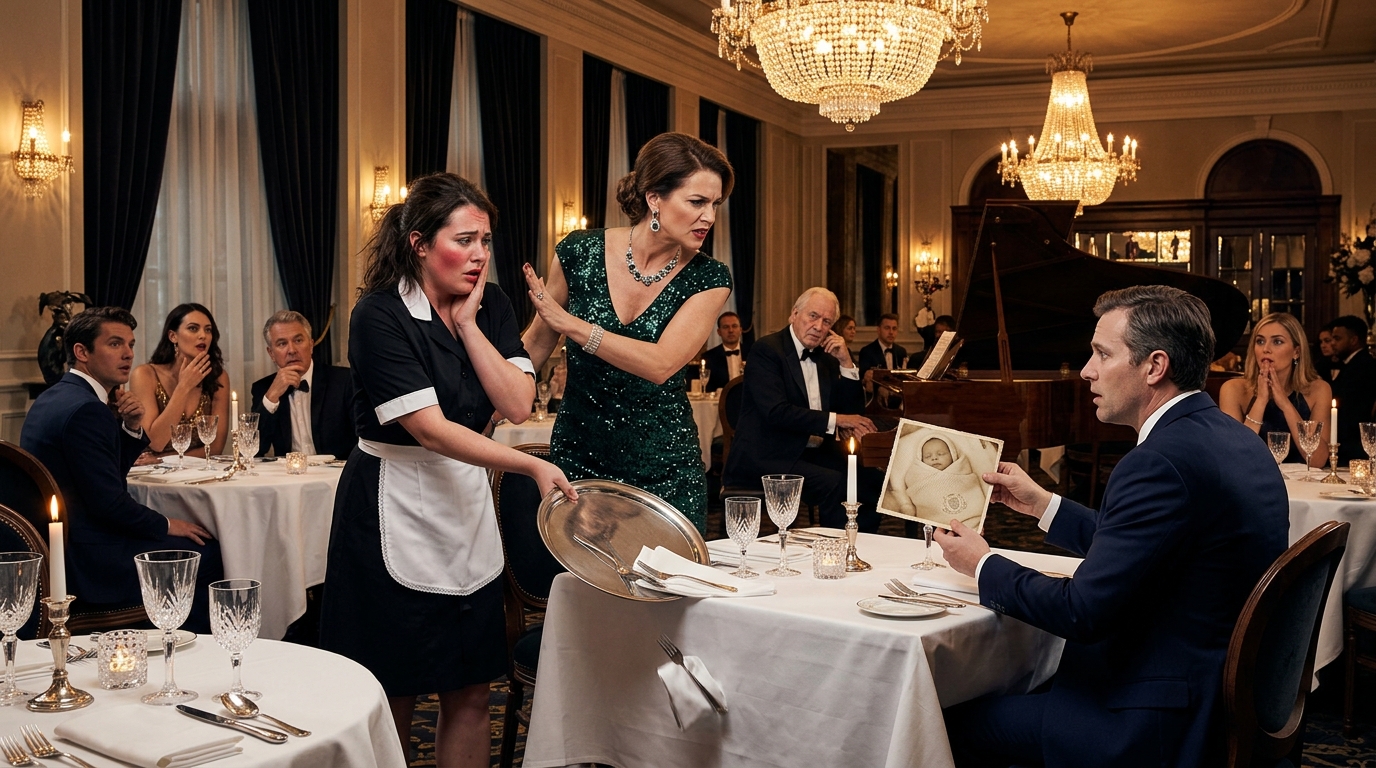
The restaurant was built to make people forget the outside world existed.
Crystal chandeliers shimmered above white tablecloths. Gold-rimmed champagne flutes caught the candlelight. A pianist in a black dinner jacket played softly near the marble fireplace, his fingers moving with the kind of grace that made even silence feel expensive.
Everyone in Le Couronne knew how to behave.
No loud laughter.
No raised voices.
No ugly emotions.
That was the entire point of places like that. Wealth did not erase cruelty. It simply taught cruelty how to lower its voice.
Then my wife stood up and slapped the waitress.
The sound cracked through the dining room so sharply the pianist missed a note.
A silver tray dropped.
Glasses shattered.
Forks froze halfway to mouths.
The young waitress stumbled backward, one hand flying to her cheek. She looked no older than twenty. Maybe twenty-one. Her dark hair had been pinned too tightly at the back of her neck, and her uniform was slightly too large at the shoulders.
My wife, Vivienne, stood over her in a champagne silk dress, her diamonds trembling against her collarbone.
“Keep your distance from my husband,” she hissed.
Every face turned toward us.
My stomach tightened.
“Vivienne,” I said under my breath. “Sit down.”
She ignored me.
Instead, she stepped closer to the girl.
“You thought I wouldn’t notice?” Vivienne said, voice rising now, enjoying the audience despite pretending not to. “The way you kept looking at him?”
The waitress shook her head quickly.
“No. I wasn’t—”
“You weren’t what?” Vivienne snapped. “Circling our table all night? Watching him? Waiting until I looked away?”
The girl’s lips parted, but no defense came.
That was the strange part.
She did not look guilty.
She looked terrified.
Not of Vivienne.
Of me.
Then, with shaking hands, she reached into the pocket of her apron.
Vivienne laughed coldly. “What now? A note? A confession?”
The girl pulled out a worn photograph.
Old.
Creased at the corners.
Softened by years of being folded and unfolded by desperate hands.
“I came for this,” she whispered.
Before I could move, Vivienne snatched it from her.
But I took it from my wife’s hand almost immediately.
The moment I saw the image, the room seemed to tilt.
A baby girl.
Swaddled in a cream blanket.
A tiny family crest stitched into the corner.
Not printed.
Not decorative.
Hand-embroidered in dark blue thread.
My family crest.
The Valcour crest.
A crowned swan inside a ring of thorns.
My fingers went numb.
The pianist stopped playing entirely.
For a moment, there was no music. No silverware. No conversation.
Only my own heartbeat.
The old pianist rose slowly from his bench and leaned forward, squinting at the photograph.
“That child…” he murmured.
His voice shook.
“She was the lost heiress.”
Vivienne took one step back.
The waitress was crying now, but she did not look away from me.
“Your mother paid to erase my name,” she said.
The silence that followed was deeper than shock.
It was recognition.
The kind that spreads before anyone understands what they are recognizing.
I stared at the cream blanket in the photo.
I knew that blanket.
Not because I remembered the baby wearing it.
I had been sixteen when the fire happened.
I remembered standing in the ruins of the east wing while my mother wept into a black veil and told the reporters that my sister Isabella had died trying to save her infant daughter.
I remembered the funeral.
Two coffins.
One large.
One impossibly small.
Closed.
Always closed.
The waitress looked at me through her tears.
“My foster mother said if you let another woman into your family without knowing the truth,” she whispered, “I had to bring you the photo myself.”
My wife grabbed my arm.
“Adrian,” she said, too sharply. “Do not listen to her.”
But I wasn’t looking at Vivienne anymore.
I was looking at the waitress.
At the shape of her eyes.
At the angle of her mouth.
At the small birthmark beneath her left ear that I had seen once before in a portrait that vanished from our family wing after the fire.
The pianist whispered again, as if the words were being dragged out of him by ghosts.
“No…”
His face had gone gray.
“She bears Isabella’s likeness.”
And that was when I understood the night was no longer about jealousy.
It was about a dead sister.
A missing child.
And the lie my family had buried for fifteen years.
The Girl Who Should Have Died in the Fire
Her name was Clara.
At least, that was the name she had been given.
Clara Bell.
A waitress at a restaurant my wife had chosen because she said it was “private enough for family discussions.” The irony of that would not become clear until much later.
When I asked Clara to sit, she refused.
“I can’t stay long,” she said.
Her voice trembled, but there was something stubborn beneath it. Something Isabella had possessed too. A quiet refusal to be rearranged by stronger people.
Vivienne’s face hardened.
“This is theatrical nonsense,” she said. “Some girl finds an old photograph, invents a story, and suddenly we’re supposed to entertain her?”
The old pianist turned toward her.
“I saw that blanket,” he said.
Vivienne’s eyes cut to him.
“You’re a piano player,” she said. “Not a witness.”
He flinched, but did not sit down.
“My name is Marcel Armand,” he said quietly. “I played at Valcour House for twenty-seven years.”
The room shifted.
I stared at him.
I had not recognized him at first. He was older now, thinner, his once-black hair gone silver. But then memory caught up.
Marcel.
My sister’s favorite pianist.
The man who used to play Debussy in the blue salon while Isabella painted by the window.
The man my mother dismissed after the fire without explanation.
“Marcel?” I said.
His eyes softened briefly.
“Master Adrian.”
No one had called me that since I was a boy.
Vivienne’s fingers tightened around the back of her chair.
I could feel her calculating. I knew that expression. She wore it when negotiating, when flattering donors, when deciding which truth could be bent without breaking.
But this truth was already cracking.
I held up the photograph.
“Where did you get this?” I asked Clara.
She swallowed.
“My foster mother kept it hidden in a Bible. She said if anything ever happened to her, I had to find you.”
“Who was she?”
“Agnes Bell.”
Marcel made a small sound.
I turned to him.
“You knew her?”
He nodded slowly.
“She was a nursery maid at Valcour House.”
The restaurant had gone utterly still around us. No one pretended to eat anymore. Even the waitstaff stood frozen near the service doors.
Clara looked from Marcel to me.
“She died three weeks ago,” she said. “Before she passed, she told me I wasn’t her daughter. She said I was carried out of a burning house when I was a baby. She said the woman who gave birth to me didn’t die in the fire.”
My throat closed.
“What?”
Clara’s voice broke.
“She said Isabella was alive when they took me.”
The chandeliers above us seemed suddenly too bright.
Too sharp.
Too clean for the ugliness underneath them.
I heard Vivienne inhale.
Not in surprise.
In alarm.
I turned toward her.
For one second, her mask slipped.
Then she recovered.
“Adrian,” she said softly now, changing tactics. “You’re grieving. This is obviously designed to exploit your family trauma.”
“My family trauma?” I repeated.
She reached for my hand.
I pulled away.
The movement was small.
But everyone saw it.
Vivienne’s mouth tightened.
Clara looked down at the photo.
“Agnes told me your mother said the baby was sick,” she whispered. “That I wouldn’t survive. Then she gave Agnes money and told her to take me far away.”
“My mother said that?”
Clara nodded.
“And if Agnes ever spoke my real name, your mother would have her arrested for kidnapping.”
The name rose inside my mind before I wanted it to.
Mother.
Genevieve Valcour.
The woman who had built our family reputation like a fortress.
The woman who controlled every inheritance, every marriage, every public statement.
The woman who had spent fifteen years making sure Isabella’s name was spoken only in mourning.
I looked at Vivienne.
“Did you know about this?”
She did not answer immediately.
That was the answer.
Then Clara said something that made every drop of blood leave my face.
“Agnes said your mother wasn’t alone that night.”
Her eyes moved to Vivienne.
“She said another family helped her hide me.”
Vivienne went white.
And suddenly I remembered why my mother had been so determined I marry her.
Vivienne was not just my wife.
She was the daughter of the family that bought the burned east wing three months after Isabella’s funeral.
The Portrait That Disappeared From the Family Wing
I left the restaurant with Clara, Marcel, and the photograph.
Vivienne followed us into the rain, furious now.
“You are humiliating me,” she said.
I turned on the pavement outside Le Couronne.
“No,” I said. “You did that when you slapped a waitress in front of a hundred people.”
Her eyes flashed.
“She was staring at you all evening.”
“She was trying to decide if I looked like someone who might believe her.”
The line hit harder than I expected.
Vivienne looked past me at Clara, who stood near the curb with Marcel’s coat around her shoulders.
“You have no idea what you’re inviting into your life,” Vivienne said quietly.
For the first time that night, she sounded less angry than afraid.
That should have warned me.
Instead, I drove to Valcour House.
The estate sat twenty miles outside the city, hidden behind iron gates and old plane trees. At night, the house looked less like a home than a verdict.
The east wing remained sealed.
My mother called it preservation.
I had always known it was avoidance.
Inside, the corridors smelled of beeswax, old stone, and cold roses. The staff had gone home. My mother was away at a charity retreat, though later I would learn that was another lie.
Marcel walked more slowly than the rest of us. Every few steps, he seemed to recognize something and regret it.
Clara stayed close to me without meaning to.
She was trying to be brave.
She was failing in the same way Isabella used to fail—visibly, beautifully, with her chin raised anyway.
I led them to the family portrait gallery.
There were generations of Valcours on the walls.
Men with stern mouths.
Women with pearls.
Children dressed like inheritance.
But one frame had been empty since the fire.
Isabella’s portrait.
My mother claimed the smoke had ruined it.
I had believed her because I was sixteen and grief made adults sound authoritative.
Marcel stopped before the empty frame.
“She removed it the morning after,” he said.
“Who?”
“Your mother.”
I looked at him.
His voice dropped.
“She said no one was to look at Isabella anymore.”
Clara stepped closer to the frame.
Her reflection appeared faintly in the old glass that still covered the empty backing.
Same dark eyes.
Same long lashes.
Same haunted softness around the mouth.
Marcel began to cry silently.
“It is like watching time apologize,” he whispered.
Then we heard footsteps.
Slow.
Measured.
Coming from the far end of the gallery.
My mother appeared beneath the archway in a black coat, her silver hair pinned perfectly at the nape of her neck.
She did not look surprised to see us.
That frightened me more than anything.
Her eyes moved from me to Marcel.
Then to Clara.
She stared at the girl for a long time.
No shock.
No grief.
No joy.
Only irritation.
As if a document she had shredded years ago had somehow reassembled itself and walked back into her house.
“So,” my mother said.
Her voice was calm.
“Agnes finally died.”
Clara took a step back.
I felt something inside me snap.
“You knew.”
My mother looked at me with mild disappointment.
“Of course I knew.”
The simplicity of it was obscene.
“You told us the baby died.”
“I told the world what it needed to hear.”
“What did Isabella need?” I asked.
For the first time, something moved in my mother’s face.
Not guilt.
Pain, maybe.
But pain poisoned by pride.
“Your sister was going to destroy this family,” she said.
“She was twenty-four.”
“She was reckless. Emotional. Easily manipulated.” Her eyes flicked to Clara. “And she had given birth to a child whose existence would have shattered the succession structure your grandfather spent his life protecting.”
Clara’s voice was barely audible.
“Where is my mother?”
Silence.
My mother looked at her fully then.
For one awful second, I thought she might lie.
Instead, she said, “Buried.”
Clara swayed.
Marcel caught her arm.
I stepped toward my mother.
“You told me she died in the fire.”
“She did die that night,” my mother said. “Just not in the way the newspapers described.”
The corridor seemed to narrow.
My mother turned and looked toward the sealed east wing.
“If you insist on digging up ghosts,” she said, “you may as well see where they were buried.”
The Room Beneath the Burned Wing
The east wing had not been repaired.
That was the first lie.
From the outside, the damage looked historical. Charred stone. Sealed windows. A memorial plaque by the garden.
Inside, it had been maintained.
Not restored.
Maintained.
As if someone had been entering regularly for fifteen years.
My mother led us through a service passage I had forgotten existed. Vivienne arrived halfway down the corridor, breathless, rain on her hair, panic in her eyes.
“You called her,” I said to my mother.
“She is your wife.”
“She is part of this.”
My mother did not deny it.
Vivienne looked at me desperately.
“Adrian, I didn’t know everything.”
“Everything?” Clara repeated.
That one word landed like a match.
My mother unlocked a narrow door beneath the burned staircase.
A hidden lower room waited beyond it.
Cold.
Windowless.
Shelves lined the walls. Boxes. Files. Old medical supplies. A child’s wooden rattle sealed in a plastic bag.
And on the far wall—
Isabella’s portrait.
Not burned.
Not ruined.
Hidden.
Clara stopped breathing.
The woman in the painting looked so much like her that the room seemed to split between past and present.
Then Clara saw the table.
On it lay a metal case.
My mother opened it.
Inside were documents.
Birth records.
A death certificate for an infant girl.
Forgery.
Custody transfer papers under false names.
Payments to Agnes Bell.
Payments to the Harrow family.
Vivienne’s family.
I turned toward my wife.
“You knew enough.”
Her lips trembled.
“My father handled the transfer. I was a child.”
“And tonight?”
She looked at Clara.
Then away.
“My mother saw her working at the restaurant last month,” Vivienne said. “She recognized the face. She told your mother.”
Clara’s hands clenched.
“So the slap?”
Vivienne said nothing.
My mother answered for her.
“We needed to discredit the girl before she reached Adrian. A jealous waitress trying to seduce a married man is easy to dismiss.”
My skin crawled.
“You planned that?”
“She improvised poorly,” my mother said, glancing at Vivienne with contempt. “But yes.”
For the first time, Vivienne looked wounded by my mother’s cruelty.
That almost made me laugh.
They had built a machine to erase a girl, and now one gear was offended by another.
I picked up the birth certificate.
Sofia Isabelle Valcour.
Born fifteen years earlier.
Daughter of Isabella Valcour.
Father listed as unknown.
Clara stared at the name.
Sofia.
Her real name.
“Why?” she asked.
Not loudly.
Not dramatically.
Just one small word from a girl who had lost her entire life before she was old enough to remember it.
My mother looked at her.
“Because your mother chose the wrong man.”
Marcel stepped forward.
“No,” he said.
Everyone turned.
He was trembling now, not with fear, but rage.
“Tell the truth, Madame.”
My mother’s expression sharpened.
“Careful.”
“No,” Marcel said, louder this time. “I was careful for fifteen years. I let you buy my silence. I let you send me away. I let you call it loyalty.”
His voice broke.
“But Isabella did not die because she chose the wrong man. She died because she found out who arranged the fire.”
The room went still.
My mother’s face changed.
Just slightly.
But enough.
I looked at Marcel.
“What are you saying?”
He reached into his coat and withdrew a small cassette tape.
Old.
Labeled in faded ink.
Isabella. Night of fire.
“I kept one thing,” he said. “The thing she gave me before she ran upstairs for the baby.”
My mother moved.
Fast for a woman her age.
But Clara moved faster.
She stepped between my mother and Marcel.
“No,” she said.
My mother struck her.
Hard.
The sound was nearly identical to the slap in the restaurant.
But this time, Clara did not stumble away.
This time, she looked my mother straight in the face.
And when she spoke, she did not sound like Clara Bell anymore.
She sounded like every buried woman in that house speaking through her.
“You don’t get to erase me twice.”
The Heiress Who Came Back From the Dead
The tape destroyed my mother.
Not immediately.
Women like Genevieve Valcour do not collapse in a single moment. They fracture slowly, with posture intact.
On the recording, Isabella’s voice was young, breathless, terrified.
Mother found the amended will. She knows Father left controlling shares to my child if anything happens to me. She says no unmarried daughter will drag this family into scandal. I think she means to burn the nursery and blame the wiring. If I do not survive this, Sofia is alive. Agnes has her. Marcel, please—
Then shouting.
A crash.
My mother’s voice in the background.
Cold.
Furious.
Unmistakable.
Give me the child, Isabella.
Then the tape cut out.
The rest came through documents.
Through payments.
Through old staff testimony.
Through the Harrow family records Vivienne eventually surrendered in exchange for reduced charges.
The fire had been staged to destroy documents and create a story.
Isabella had discovered the plan too early.
The confrontation turned violent.
She died before the flames ever reached the nursery.
Agnes Bell escaped with the baby through a laundry passage and was later paid to keep her hidden under threat of prison and violence.
My mother held the funeral anyway.
Two coffins.
One body.
One lie.
Vivienne was charged with conspiracy, fraud, and obstruction. She claimed she had only been protecting the family she married into.
I never spoke to her again.
My mother stood trial six months later.
She wore black every day, as if she were mourning the inconvenience.
But when Clara—Sofia—took the stand, the courtroom changed.
She did not scream.
She did not perform grief.
She simply held up the old photograph of herself as a baby in the cream blanket and said, “This is the first picture I have of the life she stole from me.”
That sentence did what decades of Valcour money could not prevent.
It made the truth human.
My mother was convicted.
The estate passed, by the terms of my grandfather’s amended will, to Sofia Isabelle Valcour—the child my family had declared dead because her existence made her powerful.
The first time she returned to Valcour House after the trial, she did not go to the grand staircase.
She went to the blue salon.
Isabella’s portrait had been restored to the wall.
Sunlight touched the frame that morning.
Softly.
Almost carefully.
Marcel sat at the piano and played the piece Isabella used to love.
Sofia stood beneath her mother’s portrait for a long time.
I did not interrupt her.
Some grief needs witnesses.
Some grief needs silence.
After a while, she reached into her coat and pulled out the old photograph.
The baby in the cream blanket.
The crest in the corner.
The proof Agnes had protected with shaking hands and a dying promise.
“She must have been so scared,” Sofia whispered.
“Your mother?”
She nodded.
I looked at Isabella’s portrait.
Then at Sofia.
“Yes,” I said. “But she was right about one thing.”
Sofia turned to me.
“She knew you would come home.”
Her eyes filled, but she did not cry.
Not then.
Instead, she looked around the room that had once been stripped of her mother’s name and said, “Then we’re not leaving it like this.”
And she didn’t.
The estate became a foundation for children lost in private adoption fraud. The east wing was rebuilt, not as a memorial to our family, but as an archive for women whose stories had been buried under wealth, shame, and signatures.
Le Couronne closed for three months after the scandal.
When it reopened, Marcel played on opening night.
Sofia attended.
Not as a waitress.
Not as a scandal.
Not as a ghost.
As the owner of the Valcour estate.
The table where Vivienne had slapped her was still there, polished and waiting beneath the chandeliers.
Sofia looked at it once.
Then smiled faintly.
“Funny,” she said.
“What is?”
“She thought humiliating me would make me disappear.”
I looked at the crystal lights, the white tablecloths, the champagne glasses, all the beautiful surfaces people trusted too much.
“No,” I said. “It brought you back.”
And that was the truth.
My wife had slapped a waitress because she thought shame was a weapon.
My mother had buried a child because she thought blood could be edited out of history.
My family had spent fifteen years protecting a lie because the lie was cleaner than the girl who survived it.
But the dead do not always stay quiet.
Sometimes they leave behind a photograph.
A blanket.
A witness at a piano.
A foster mother with enough courage to hide the truth until the right moment.
And sometimes, in the middle of a room built for the rich to dine without discomfort, a girl with a stinging cheek reaches into her apron and pulls an entire dynasty out of its grave.