The Coffee On Her Apron
The scream hit the café before the violinist could finish his note.
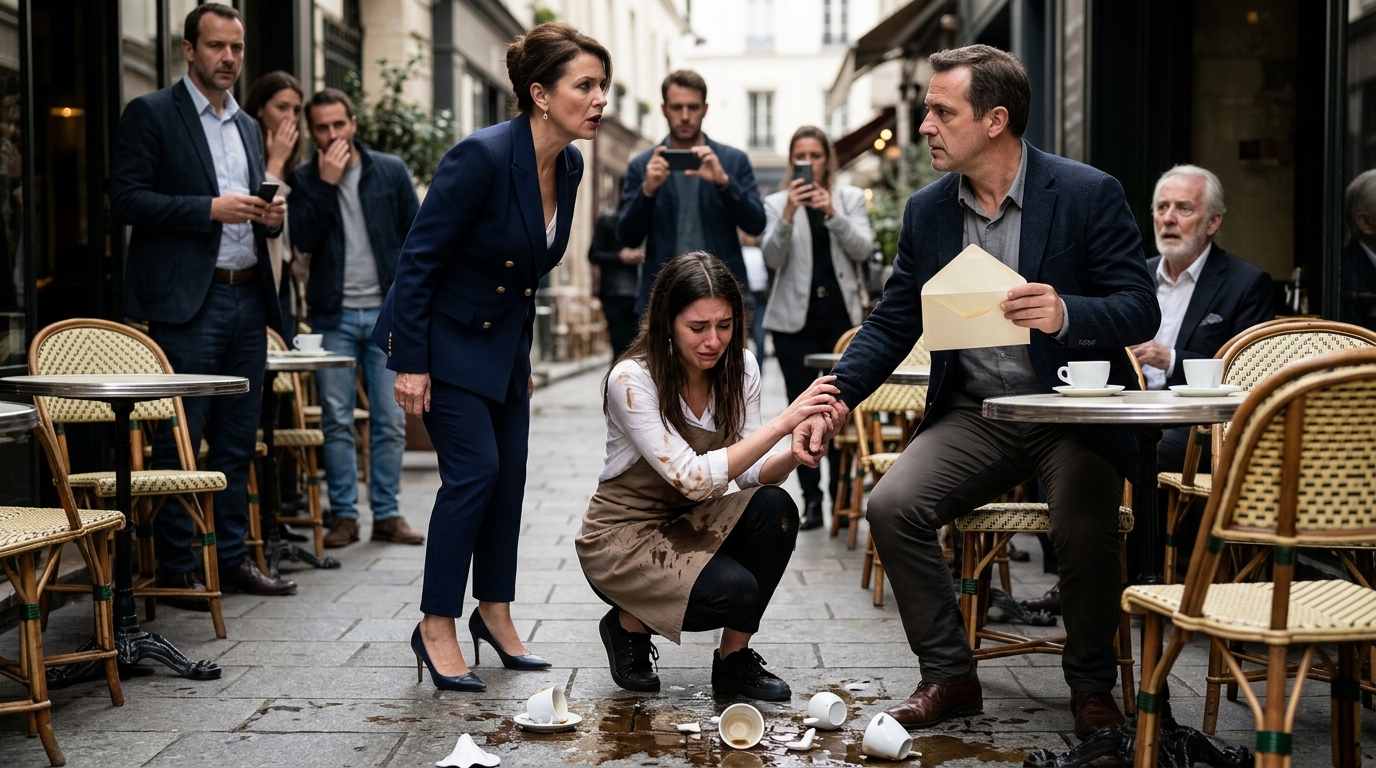
One moment, the terrace looked exactly the way money likes to see itself—white linen, polished silver, fresh flowers in slim glass vases, expensive watches flashing in the late afternoon light. The next, a cup of coffee arced through the air and burst across a waitress’s chest.
She cried out and stumbled backward into a table.
Cups shattered against the pavement.
Guests stood up at once.
Phones appeared faster than napkins.
Hot coffee ran from her hair to her collarbone, down the front of her apron, across the backs of her shaking hands. She looked barely twenty-one. Small. Frightened. The kind of young woman whose face still held traces of childhood when she panicked.
Standing over her in ivory heels and a silver dress was my wife.
Vivienne Beaumont.
Her breathing was hard and fast, but her eyes were perfectly focused.
“That’s what happens when you lie to me!” she shouted.
The entire terrace snapped silent.
Even the violinist stopped.
The waitress’s lips trembled. She didn’t defend herself at first. She only clutched the front of her burned apron as if trying to hold something in place beneath the soaked fabric. That single gesture caught my attention before anything else did.
I had been seated only a few feet behind Vivienne.
Until that second, I had thought this would be another small social eruption—some staff mistake, some entitlement-fueled spectacle, some mess my money would later clean with apologies and envelopes.
Then the girl looked up.
And I felt the air leave my chest.
Her eyes were Elise’s.
My first wife had been dead for nine years.
At least, that was the story everyone had given me.
The story I had repeated so often that it no longer felt like a sentence. It felt like weather.
“She was driving alone.”
“The roads were slick.”
“The ravine burned too hot.”
“The body wasn’t viewable.”
I had memorized their version of my grief.
Now a coffee-soaked waitress with Elise’s eyes stood trembling in my café while my wife humiliated her in front of a room full of strangers.
“I didn’t lie,” the girl whispered.
Vivienne took a step closer.
“Oh, really? Then tell them what you said to me in the ladies’ room.”
The girl shook her head so hard drops flew from her hair.
“I only said I had a letter for him.”
The whole terrace shifted.
Him.
Every face turned toward me.
Vivienne laughed.
Sharp. Cold. Controlled.
“And then,” she said loudly, “she claimed your dead wife wanted you to read it. Do you see what kind of parasites they hire now?”
A few guests exchanged glances.
Someone near the railing actually smiled.
That was the ugliest part.
Not Vivienne.
Not the coffee.
The readiness of elegant people to believe degradation is always more likely than truth when the person being humiliated is poor.
The waitress bent double for a moment, one hand on the table edge, the other still pressed against her apron.
Then the letter slipped out.
A cream envelope.
Sealed in dark red wax.
It hit the stones between us.
A man from the next table leaned down and picked it up before she could.
She panicked instantly.
“No, please…” she whispered, tears filling her eyes. “Please don’t open that.”
Vivienne smiled like a woman who believed the room belonged to her.
“Oh, now you’re scared?”
She turned toward the stranger with a little flourish of her hand.
“Go on. Read it. Let everyone hear her little secret.”
The man broke the seal.
He read only a few lines.
Then his face changed.
He turned, not toward the girl, but toward me.
And in a voice so low it somehow made the whole café lean in, he said:
“This wasn’t written to expose her.”
Vivienne frowned.
“Then what is it?”
He looked down again.
Then back at me.
“It’s a confession.”
The waitress burst into harder sobs.
I stood.
And when the stranger said the next sentence, the whole terrace seemed to tighten around it.
“It was written by your dead wife.”
The Wife They Told Me To Mourn
My name is Adrien Beaumont.
For nine years, I believed I had buried the only woman who ever made me ashamed of how easy my life was.
Elise Laurent had not been born poor, but she moved through wealth as if it were a room she refused to let define her. She never performed gratitude for luxury. Never worshipped it. Never pretended crystal and old paintings made people noble. That was one of the first things I loved about her, and eventually one of the things that made my family treat her like a slow-moving threat.
My mother called her difficult.
My father called her too opinionated for the Beaumont name.
Vivienne—then only my mother’s private assistant—called her unstable in that soft, concerned voice women use when they want to make cruelty sound like diagnosis.
When Elise became pregnant, the atmosphere in the house changed.
I thought it was anxiety.
Legacy pressure.
The usual family tension that comes when an heir is no longer abstract.
What I didn’t understand was that certain people in my family had already decided what kind of mother Elise would be allowed to become.
Or whether she would be allowed to become one at all.
The labor was early.
Complicated.
Violent.
I was kept outside the room far longer than made sense.
When Dr. Varen finally emerged, his face was grave and beautifully rehearsed.
“The baby didn’t survive,” he told me. “Your wife is sedated. We need to monitor her closely.”
I remember leaning against the corridor wall so hard the frame cut into my shoulder. I remember Vivienne taking my arm like I might fall. I remember my mother saying, with the calm of someone already managing the narrative, “Don’t let Elise see how devastated you are. She won’t survive your grief on top of hers.”
Elise woke two days later.
Different.
Not broken.
Worse than broken.
Certain.
“They took her,” she said.
Everyone told me it was trauma.
She kept saying the same thing.
“They took her.”
My mother ordered a second opinion.
Then a third.
Then “rest.”
Then privacy.
Within three weeks, Elise was moved to a private coastal recovery house under the explanation that postpartum delusions required discretion. By then, I was sleeping two hours a night and signing anything put in front of me because I thought paperwork was the tax a man paid when his whole future had died in a hospital bed.
The next year disappeared into managed grief.
I was told Elise improved.
Then declined.
Then could no longer bear to see me.
Then needed longer treatment abroad.
Then, one winter morning, I was told her car had gone off a cliff on a rain-slick road.
There was no body I was permitted to see.
My mother said that mercy sometimes takes the form of distance.
Vivienne said memory was kinder than viewing.
Dr. Varen used words like catastrophic and unrecognizable until I stopped insisting.
I buried a sealed casket.
That is what they gave me.
A sealed casket and a cemetery plot and nine years of silence.
Then I met Vivienne again, this time not as my mother’s assistant, but as the only person who seemed to remember how to speak to me without pity. We married three years later.
The city called it a second chance.
My mother called it healing.
Now, on my own café terrace, with half the district recording and a trembling waitress crying in coffee-stained linen, I realized something I should have understood the second I saw her eyes:
I had never finished mourning Elise.
I had only obeyed the version of her death they found easiest to administer.
The Confession In Elise’s Hand
The man who had opened the letter was Marcel Dupré, a retired magistrate I recognized only after he spoke again. He had known my father for years. He must have recognized the Beaumont household seal pressed into the wax, because his expression held the particular horror of a man who understands both handwriting and consequence.
He handed me the first page.
My fingers shook before I even unfolded it.
It was Elise’s hand.
Not approximate.
Not forged.
Not memory convincing me of what I wanted.
Her actual hand.
The loops too narrow.
The pressure heavier on downward strokes.
The long tail on the capital E that she once said made her name look more certain than she felt.
Adrien,
If this reaches you, then the girl standing before you is our daughter, and I have run out of time to keep the lie contained.
The page blurred.
I sat down because my legs stopped trusting themselves.
Across the terrace, the waitress had both hands over her mouth now, crying without sound. Vivienne was no longer performing outrage. For the first time since I had known her, she looked cornered.
I kept reading.
They told you she died.
They told me you signed her away.
One of those things was a lie.
Maybe both.
I was still bleeding when your mother came into my room with Vivienne at her side. They said the child would be safer “outside the house” until I was stable enough to earn her back. When I refused, Dr. Varen increased the sedatives and wrote the word delusional on the chart before I had finished saying my daughter’s name.
The whole café had gone so quiet I could hear cutlery from inside the building.
My mother.
Vivienne.
Dr. Varen.
All on the first page.
I read on.
They told me the baby was registered under another name while they assessed me.
When I threatened to tell you, they said you already knew.
When I demanded proof, they said grief had made me dangerous.
When I stopped crying, they called it numbness.
When I screamed, they called it instability.
Every feeling became evidence against me.
I looked up.
My mother was not there.
Of course she wasn’t.
But I could feel her in the letter like perfume left in a closed room.
Vivienne tried to speak.
“Adrien, listen to me—”
“Don’t.”
I had never used that tone with her before.
It worked.
Marcel lifted the second page from the envelope.
“There’s more.”
He was right.
Far more.
I took the next sheet.
I escaped Bellmere House only once before they caught me. That was the year Nora turned five. I saw her from across the churchyard with a foster woman who called herself her aunt. I knew my child by the way she stood still when frightened.
Vivienne saw me too.
She told the staff if I ever got close enough to speak, I’d ruin the girl’s future by making her “inherit the madness in public.”
Nora.
The waitress.
My daughter.
The word fit her face instantly, as if the last twenty-one years had been waiting behind one locked door and the letter had finally opened it.
I stood again.
Slowly.
And turned toward the girl who had been meant to leave that café humiliated instead of heard.
“Nora?” I said.
She nodded once.
Then harder.
Then broke all over again.
“Yes.”
That single word finished what the letter had started.
Vivienne’s chair scraped backward.
Someone at table seven whispered, “Oh my God.”
Three more phones rose.
But nobody was looking at the waitress anymore.
Every eye was on me.
And the woman sitting behind my left shoulder, in pearls and cold composure, who had just realized her dead rival had reached the terrace after all.
The House By The Sea
Bellmere House was real.
That was the first thing my lawyer confirmed within twenty minutes of seeing the letter.
Real, private, and owned through a sequence of trusts so layered it would have impressed me once. Now it only made me sick.
The irony was exquisite in the ugliest way possible: I had been funding part of my own wife’s confinement for years through a charitable mental health foundation my mother insisted on running in Elise’s memory.
In Elise’s memory.
The sentence nearly made me choke when my lawyer said it aloud.
I closed the café immediately.
Guests protested.
Investors frowned.
One woman complained about her unfinished dessert.
I didn’t care.
Marcel came with us.
So did Nora, because no one on earth was going to make her disappear again if I had any power left in my name.
Vivienne tried to leave quietly through the side gate.
Security stopped her.
She was no longer screaming by then.
She had shifted into her more dangerous state—controlled, pale, almost tender in tone.
“Adrien,” she said in the car, “you need to understand the context.”
I stared at the road.
“There is no context for stealing a mother’s child.”
“There is if the mother was unwell.”
I turned toward her then.
“Was she?”
She held my gaze for one second too long.
That was answer enough.
Bellmere House stood above the water on a strip of coast I had not visited in years. Pale stone. manicured hedges. Private recovery residence printed discreetly beside the gate. The sort of place wealthy families use when they want illness to remain elegant and invisible.
The director denied everything at first.
Then my lawyer showed the letter.
Then Marcel produced his credentials.
Then I told the woman at the desk exactly what I would do to every board member associated with Bellmere if my daughter’s name or my late wife’s admission files were moved, altered, shredded, or whispered over in the next sixty seconds.
That opened the doors.
We found Elise in the north wing.
Room fourteen.
She was sitting by the window in a gray cardigan with one sleeve buttoned wrong, hands folded too neatly in her lap as if someone had taught her that stillness was safer than hope. Her hair had gone white at one temple. One side of her mouth held the faint pull of an old injury. When the nurse opened the door, Elise looked up not with curiosity, but with the calm fatigue of a person who has had rescue promised too many times to stand for it again.
Then she saw Nora.
Everything in her changed.
Not all at once.
First the eyes.
Then the mouth.
Then the whole body trying to rise faster than time would allow.
“Nora?”
My daughter ran to her.
Not gracefully.
Not cautiously.
She threw herself forward like childhood had finally been given permission to stop surviving and start belonging to someone.
I had to brace a hand against the doorframe.
Because behind them—my daughter sobbing into the neck of the woman I buried nine years earlier—I could see the full shape of what had been done.
Not just grief manufactured.
Not just records altered.
A life split into two rooms and kept that way because powerful people found the arrangement convenient.
Only after Elise held Nora did she look at me.
For a second I thought she might hate me.
I would have understood that.
Instead she said, very quietly, “You still look sad before angry.”
That line was in the letter.
I could not speak.
The Wife Who Thought The Letter Would Die With Her
My mother arrived before midnight.
She came in sable and outrage, as if this were still a problem of tone rather than crime. Vivian stood beside her, quiet now, all elegance stripped down to calculation. Dr. Varen was brought in separately after police retrieved him from his town house.
I watched the three of them take in the room.
Elise on the bed.
Nora holding her hand.
Marcel by the window.
My lawyer with a file already thickening by the hour.
For once, my mother did not begin with denial.
She began with exhaustion.
“Elise,” she said, like she was addressing an inconvenience that had outlived proper timing.
Elise actually smiled.
Weakly.
Cruelly.
Beautifully.
“That’s the warmest you’ve sounded in twenty-one years.”
My mother’s face hardened.
“You were not well.”
Dr. Varen attempted his polished clinical tone.
“Mrs. Beaumont presented with severe postnatal delusion—”
“Then why,” Marcel cut in, “did the child survive under a foster alias funded by the Beaumont memorial trust?”
Silence.
The kind that tells you the room has crossed from explanation into exposure.
I looked at Vivienne.
“She told Nora at church that if Elise spoke, the girl would inherit the madness in public.”
Vivienne did not even flinch.
“She was protecting the family.”
That was what she always called it.
Not theft.
Not cruelty.
Protection.
My mother finally turned to me.
“You were never meant to see any of this.”
I laughed then.
A sound so cold it frightened even me.
“No,” I said. “I was only meant to bury it.”
That was the first time I saw fear enter her.
Real fear.
Not for her reputation.
For her authority.
Because the letter had done what Bellmere, sedatives, sealed caskets, and two decades of narrative management had failed to do.
It had put the truth in my hands before it touched theirs.
Police took statements until dawn.
The foster arrangement was traced.
Financial channels were frozen.
Bellmere’s licensing board was notified.
Dr. Varen lost all visible color when my attorney mentioned fraud, unlawful confinement, and falsified death-adjacent documentation.
Vivienne said almost nothing after that.
She didn’t need to.
The terrace had already heard enough.
A woman who throws coffee to silence a lie can still recover socially.
A woman who throws coffee at her husband’s daughter while wearing a dead wife’s place at the table?
That kind of spectacle survives in whispers longer than diamonds do.
By sunrise, my marriage was finished.
Not dramatically.
Not with screaming.
Finished the way some buildings are—quietly, once you realize the foundation was poured over something unforgivable.
The Daughter Who Walked Out Of My Grief
Three months later, the first hearing opened the records publicly.
My mother was charged.
Dr. Varen lost his license and then his freedom.
Bellmere House was shut pending investigation.
Vivienne vanished into private legal strategy and two interviews with magazines that decided, wisely, not to print her version.
Elise came home slowly.
Not to the main Beaumont house.
Never there.
I sold it.
Brick by brick in my mind before the contracts ever went out.
No child of mine would walk those halls and wonder which room silence had been dosed in. No woman would ever again be told that confinement was care because the wallpaper was expensive and the view of the sea was tasteful.
Nora moved into the apartment above my old bookshop first because she liked the windows and did not trust houses with staff. That, more than anything, told me how much work love had in front of it. We did not become a family in one cinematic sweep. Trust had to be built like recovery—slowly, with setbacks, with silences that no longer meant danger but still felt like it for a while.
Elise kept the letter.
Folded.
Refolded.
Once more placed in its envelope.
I asked her one evening, months later, why she wrote it to confess rather than accuse.
She was sitting by the window with Nora asleep on the sofa, one arm flung over her eyes and one hand still curled around the edge of a blanket the way small children hold things even after they have outgrown the right to be called children.
“Because accusation would have made them defensive,” Elise said. “Confession makes people listen.”
I looked at her.
She smiled faintly.
“I wasn’t confessing to the crime,” she said. “I was confessing to letting you grieve a child who was alive. That was the sin I could still claim as mine.”
I thought of the café terrace.
The coffee.
The phones.
The silence of strangers.
The moment the letter hit the stones and changed direction in the hands of a man who still remembered how to read before choosing a side.
“She was supposed to be humiliated,” I said.
Elise followed my gaze to Nora.
“Yes,” she replied. “That was the whole design.”
Then she looked back at me.
“But humiliation is fragile. Truth only has to survive one dropped envelope.”
I still visit that terrace sometimes in the late afternoon when the violins start and the tables fill and wealthy people perform their neat, expensive versions of emotion. I sit where I was sitting that day and watch the staff move among the glasses and folded napkins.
No one there now remembers the exact sound the coffee made when it hit her apron.
I do.
Because that sound marked the last second of my old life.
People say the letter exposed my wife.
That isn’t quite true.
It exposed my mother.
My doctor.
My marriage.
My cowardice.
The price of believing elegance when it asks for silence.
But most of all, it exposed the lie I had been taught to call grief.
My daughter was never gone.
She was waiting tables in a cheap apron, carrying a confession against her heart, and walking into danger because her mother knew one thing wealthy families always forget:
If you humiliate the wrong person in public, sometimes the whole room ends up hearing the truth instead.