The Towel On The Marble
The hallway smelled of lemon polish, old wood, and humiliation.
That is the first truth I can tell you.
Not the chandeliers.
Not the portraits.
Not the marble gleaming under the afternoon light like a river too cold to touch.
The smell.
Because once you have watched your mother cry on her knees in the house where she raised you, every expensive thing around her becomes an accomplice.
My name is Adrian Halden. I was forty-six years old that afternoon, standing in the front hall of Blackthorne House, and I did the one thing I had spent my whole life convincing myself I would never do.
I let another person make my mother small.
She was seventy-eight.
Her name was Eleanor Halden.
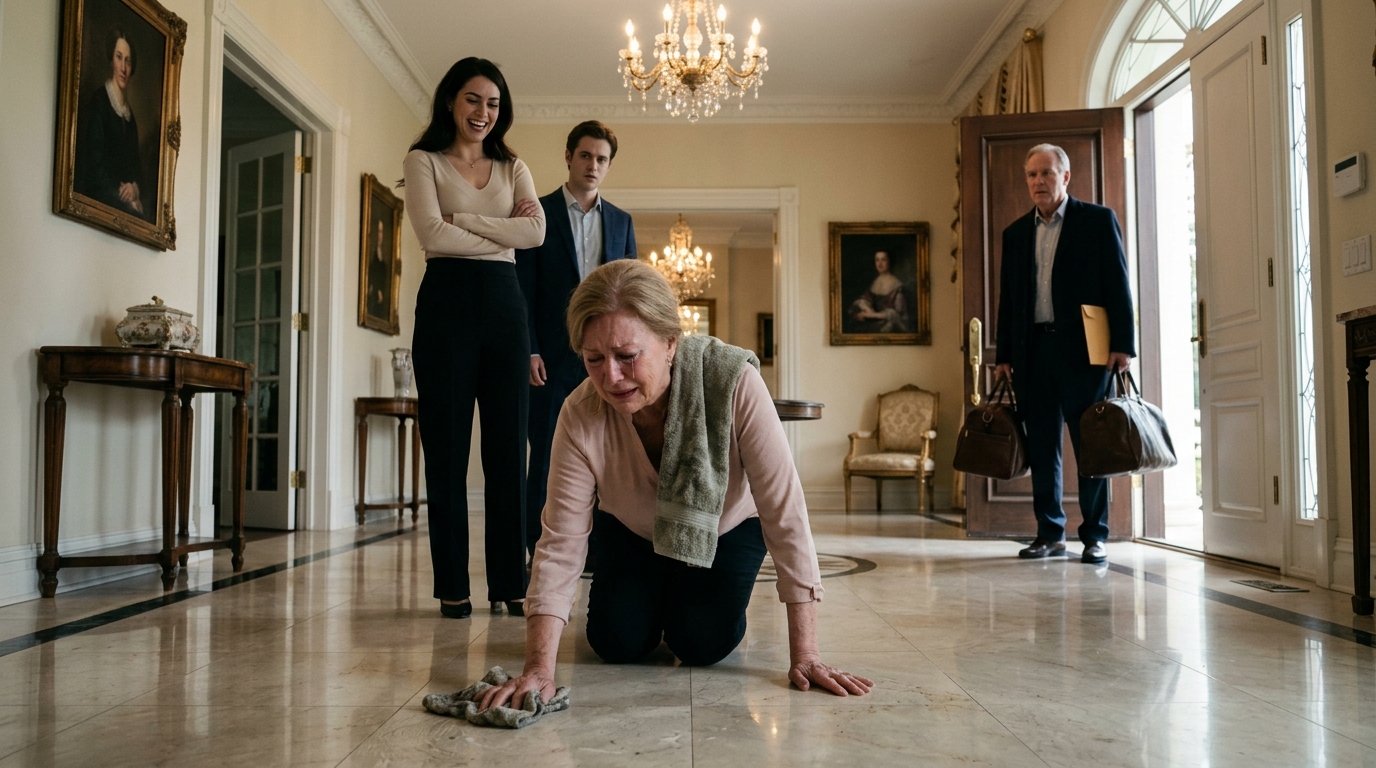
And she was kneeling on imported Italian marble with a gray towel in her shaking hands while my fiancée stood over her like judgment in a silk blouse.
Vanessa Cole had beauty in the most dangerous form it can take.
Precise.
Composed.
Weaponized.
She did not shout often, because people like her understand that cold contempt cuts deeper when delivered quietly. That day, though, even she seemed to enjoy the shape of the moment too much to keep her voice low.
She flung the grimy towel at my mother’s shoulder and said, “On your knees — if you still have tears, you can still clean.”
The towel hit.
My mother recoiled.
I can still see the exact movement. Her shoulders rose on instinct. Her hands trembled harder. The cloth slid down into her lap. She did not even look up when it landed. She just bent her head lower and reached for it again as if dignity, once broken, had to be gathered from the floor in pieces.
“You ought to feel thankful I even allowed you to stay here,” Vanessa said.
My mother’s voice, when it came, was barely more than breath.
“This was my husband’s home…”
Vanessa laughed.
A dry, contemptuous laugh that echoed off the walls beneath portraits of men who had built rail lines, bought judges, and called it legacy.
Standing behind them was me.
Silent.
Torn.
Cowardly enough to let shame masquerade as helplessness.
That is the second truth.
By then, Vanessa had spent nearly a year dismantling my judgment with surgical patience. My investment firm had collapsed after a disastrous merger. I had debts my father didn’t know in full and my mother suspected only in fragments. Vanessa knew every number. She called herself practical. She told me my mother was slipping, sentimental, manipulative. She said old women knew exactly how to weaponize tears. She said if I wanted any future at all, I had to stop letting the house be run like a shrine.
And because I was drowning and she sounded like certainty, I listened.
Then the front door opened.
Not dramatically.
No thunder.
No shouted name.
Just the heavy iron latch turning and the clean, hard sound of a man stepping into a room a second before he understands what he is seeing.
My father stood there with a travel bag in each hand.
Charles Halden.
Seventy-nine.
Tall even now.
Dark coat.
Airport dust on the cuffs.
Face lined by age, money, and the kind of disappointment that only family ever earns fully.
His eyes moved once across the hall.
The floor.
My mother kneeling.
The towel.
Vanessa.
Me.
He froze.
For one impossible second, nobody in the room breathed.
Then he set both bags down with unnatural care, straightened, and said in a calm, almost curious voice:
“Interesting…”
Vanessa’s grin disappeared.
My father looked directly at her.
“…because the woman on that floor is the one whose name I placed on every property document before my departure.”
The blood drained from my face.
Vanessa went white.
My mother remained frozen on her knees, one hand still flattened against the marble as if she no longer trusted the world to remain steady enough for her to stand.
And before any of us could speak, my father slipped a thick envelope from inside his coat and added:
“Or should I reveal whose signature granted her this house before my plane even touched down?”
He looked at me when he said it.
And in that instant, I knew the signature he meant was mine.
The Signature I Didn’t Remember Giving
I wish I could say I didn’t understand.
That shock made everything blurry.
That I had no idea what he was referring to.
But the moment he looked at me, memory came back with teeth.
Three months earlier, Vanessa had stood in my study holding a stack of documents and a glass of bourbon I had not asked for. I was on the edge of default with two private lenders. My hands were shaking so badly I could barely type. She told me my father had finally agreed to “restructure things” before his overseas trip. Temporary asset shields. Emergency family trust repositioning. Legal housekeeping, she called it, tapping the last page with one manicured nail.
“Just sign as witness,” she said. “It’s internal.”
I signed.
Of course I signed.
That is how people lose houses, marriages, and names. Rarely through spectacular evil. Usually through one exhausted signature offered at exactly the right moment by someone who understands your weakness better than you do.
Now my father withdrew the top sheet from the envelope and held it in the light.
There was my name.
My signature.
Notarized.
Witness to the irrevocable transfer of Blackthorne House, the west parcel, and the domestic trust residency rights to Eleanor Louise Halden.
My mother looked up at me.
That hurt more than anything my father could have said.
Not accusation.
Not rage.
Recognition.
As if she had just understood, in one painful flash, that I had once held the power to protect her and didn’t even know I was holding it.
Vanessa found her voice first.
“This is absurd,” she snapped. “Charles, you can’t barge in here with luggage and paper and start making theatrical accusations because your wife had one emotional afternoon.”
My father didn’t even look at her.
“Adrian,” he said quietly, “help your mother up.”
I moved immediately then.
Too late, but finally.
I knelt and slid my hands beneath my mother’s elbows. Her body felt terrifyingly light. She stood on the second try, though her legs wobbled so badly I thought she might fall against me. She didn’t. She caught the edge of the console table instead and turned her face away.
I deserved that.
My father laid the documents on the marble entry table beneath the portrait of my grandfather.
“You signed this on March fourteenth,” he said.
I stared at the page.
“I thought it was a holding instrument.”
“You thought,” he repeated, “because you did not read.”
Vanessa stepped forward. “He was under stress. You manipulated the timing.”
Now my father did look at her.
Coldly.
“Correct,” he said. “I manipulated the timing.”
That landed harder than denial.
He removed a second page.
“This is the instruction letter I left with Mercer & Blythe before boarding my flight. If my wife was ever humiliated, pressured to leave, forced to serve, or coerced into accepting secondary status in this house, the transfer was to be activated immediately and the corresponding inheritance clause triggered.”
My pulse jumped.
Inheritance clause?
My father continued.
“Any heir who knowingly permitted such humiliation would forfeit discretionary control of the family trust until reviewed by the board.”
The room went silent again.
Because there was only one heir in that hallway.
Me.
Vanessa recovered with astonishing speed.
“Charles, please. She was cleaning a spill.”
My father’s gaze dropped to the towel still clutched in my mother’s hand.
Then to the red mark where it had hit her shoulder.
Then back to Vanessa.
“And did the spill also throw the towel?”
Vanessa said nothing.
That was when my father drew one final document from the envelope.
A printed email chain.
Multiple pages.
Highlighted.
Time-stamped.
He set it on the table without a word.
I recognized Vanessa’s address first.
Then the language.
Care facility options.
Cognitive decline positioning.
Graceful residency transition.
Market-prep staging for property evaluation.
My stomach turned.
She had been planning to remove my mother long before this afternoon.
Not in anger.
In sequence.
In writing.
And then my father said the sentence that split the room open even further:
“You may want to read page four, Adrian. It contains the message she sent the broker an hour before I landed.”
I reached for the papers.
And when I saw what Vanessa had written, I realized the hallway scene had not been cruelty spiraling out of control.
It had been rehearsal.
The Papers Hidden In Vanessa’s Handbag
The broker’s name was at the top.
Subject: Window of compliance.
Underneath, in Vanessa’s clipped, immaculate prose:
Mother is finally breaking. If the tears continue, I think we can get a voluntary occupancy release signed tonight. Son is weak but manageable. Father lands after seven; I’d prefer papers executed before then.
I read the sentence twice.
Then a third time.
Because the words were plain, and yet some animal part of my mind still wanted them to become something else before they reached the part of me that knew what they meant.
Voluntary occupancy release.
Signed tonight.
Son is weak.
I looked up.
Vanessa was no longer pretending outrage. She had gone still in a new way—calculating, stripped down, deciding what version of herself might still survive the room.
My father drew a long breath.
“That email was forwarded to me fifteen minutes after she sent it.”
By whom, I didn’t ask.
There are always witnesses in old houses. Drivers. junior associates. secretaries who hate being spoken to like furniture. The rich survive on silence and are destroyed by boredom. Somebody had chosen a side.
My mother lowered herself into the nearest chair without seeming to know she had done it. Her lips moved once before sound came.
“You knew?”
My father’s face changed.
Not enough to soften.
Enough to show grief.
“I suspected,” he said. “I did not know it would be this bad.”
Then, to me: “Bring me her handbag.”
Vanessa laughed once. A sharp, empty little sound.
“You cannot touch my things.”
My father held out his hand instead.
“Then empty them yourself.”
She didn’t move.
That was answer enough.
I crossed the hall, picked up the cream leather bag she had dropped on the ottoman earlier, and carried it back to the entry table. It felt heavier than it should have.
My father tipped it over.
Its contents spilled across the polished surface.
Lipstick.
Compact.
Car keys.
Phone.
A silver pill case.
And a slim folder of documents held together with a gold clip.
My mother made a broken sound when she saw the first page.
Voluntary Release of Residential Rights.
Signature line: Eleanor Louise Halden.
The second page was worse.
Preliminary Cognitive Fitness Concern Memo.
Prepared for private physician review.
The third page was worst of all.
Luxury Assisted Living Intake Packet.
Blackthorne Residence liquidation pathway attached.
My father flipped through the packet once, slowly, then laid it back down as if it had dirtied his fingers.
Vanessa’s voice hardened.
“She cannot manage this house.”
My mother laughed then.
Not loudly.
Not bitterly.
Just once, with the ruined astonishment of someone who finally understands the full insult.
“This house?” she said softly. “I paid the roofers when your father was still proving himself to banks. I chose those floors. I buried a child from this staircase. And you thought I couldn’t manage a hallway.”
That sentence struck me like a blow.
Because it was true.
My younger sister, Caroline, had died at fourteen after a fever that moved too fast for medicine and too slowly for mercy. The house had never fully recovered. None of us had. My mother more than anyone. Vanessa knew that. She had always known exactly where memory left bruises.
My father reached for the silver pill case next.
“What is this?”
Vanessa took one involuntary step forward.
“Nothing.”
He opened it.
Inside were small pale tablets in an unlabeled compartment.
My mother went still.
“The tea,” she whispered.
We all looked at her.
“For weeks I thought I was losing time,” she said. “After supper. In the afternoons. My hands would feel heavy. I’d wake in the sitting room and not remember falling asleep.”
Vanessa’s silence became unbearable.
My father closed the pill case with a snap.
Then he turned to me again.
“What else did she tell you about your mother?”
The shame of answering nearly choked me.
“That she was confusing dates. Forgetting instructions. Getting more unstable.”
My father nodded once, as if checking off the final item on a list he hated having to confirm.
“That’s what I thought.”
He reached back into his coat and withdrew another folded packet.
Medical reports.
Bank transfers.
A private investigator’s summary.
And a notarized affidavit from the housekeeper stating Vanessa had instructed staff to “leave Mrs. Halden to handle the front hall herself” because “humility might help her cooperate.”
Humility.
That word did something terrible to me.
Because for the first time I saw the full design.
This was never about temper.
It was procedure.
My father had not come home early by chance.
He had come home because he had already started investigating the woman I intended to marry.
And what he found was worse than greed.
It was pattern.
What My Father Knew Before He Landed
My father took off his coat.
Folded it once.
Placed it over the back of the chair opposite my mother.
And for the first time since entering the hall, he looked tired enough to seem mortal.
“I met Vanessa’s former father-in-law in Geneva,” he said.
The sentence startled all of us, including Vanessa.
He went on anyway.
“By accident, I thought. Old client dinner. Familiar surname. Then he mentioned his son’s widow, who had attempted to remove his wife from their estate under claims of cognitive decline.”
He let that sit.
Vanessa’s face had gone perfectly still.
“She lost,” my father said. “Not because she lacked paperwork. Because their maid had recorded her rehearsing the scene in advance. Tears, helplessness, a cup broken on purpose, the mother made to clean it while a doctor waited nearby.”
My stomach dropped.
My father looked at the towel on the floor.
“Today was not improvisation,” he said quietly. “It was choreography.”
Vanessa finally snapped.
“That old man was vindictive and senile. His wife was impossible. I was trying to protect my husband’s family from waste and weakness.”
“And now,” my father said, “we have your worldview stated cleanly enough for court.”
Court.
The word hit the marble and stayed there.
My mother closed her eyes.
I looked at Vanessa—not at the face I had defended, desired, trusted, but at the machinery behind it—and realized she was not even frightened yet. She was assessing angles. Lawyers. Damage. Which witnesses could be painted emotional. Which facts could still be made untidy enough to slow consequence.
My father seemed to understand that too.
He lifted the final page from the packet.
“This is the addendum.”
He handed it to me.
The heading read:
Blackthorne Family Preservation Clause — Dignity Trigger.
My own pulse thudded in my ears as I read.
If the widow Eleanor Louise Halden is subject to humiliation, coerced service, pressure to surrender occupancy, chemical impairment, or reputational diminishment inside Blackthorne House by any heir, partner, guest, or advisor acting in anticipation of gain, the following shall occur immediately:
One:
All pending marital settlements involving said heir are voidable.
Two:
The proposed spouse or partner is permanently excluded from residence, trust benefit, or future board affiliation.
Three:
The heir’s control rights are suspended pending demonstrated restitution.
Four:
The widow retains sole life tenancy, governance advisory rights, and documented authority over household security and legal action.
At the bottom were two signatures.
My father’s.
And mine.
I had countersigned it the same day as the transfer.
Not knowing.
Not reading.
Still signing.
I felt physically ill.
My father’s voice softened only once that afternoon, and only then.
“I left you a way to choose correctly, Adrian,” he said. “You just never noticed you were holding it.”
That hurt more than rage would have.
Because he was right.
Vanessa took one quick step toward the table.
“This won’t stand.”
My father looked at her.
“Why?”
“Because he loves me.”
A strange silence followed that. Even now I think it surprised her more than anyone else. She had said it instinctively, as if love were still the most efficient lever in the room.
I turned toward her slowly.
And realized, with sick clarity, that I did not know if I had ever loved her at all.
What I loved was certainty.
Order.
Rescue from my own weakness.
And she had sold me those things while she arranged my mother’s removal in the next room.
My father reached for the hallway phone.
“I called Inspector Wren from the car,” he said. “He should be here any minute.”
Vanessa’s expression changed then.
For the first time all afternoon, real fear got through.
And when it did, the mask came off with it.
“You stupid old man,” she hissed. “Do you know what this house costs to keep standing? Do you know what your wife’s sentiment has bled out of these walls? I was the only one here willing to turn this mausoleum back into an asset.”
Asset.
That was her final mistake.
Because my mother stood up.
Slowly.
Shaking.
Still damp-cheeked and humiliated and exhausted.
But standing.
“This house was never your test,” she said.
The front bell rang.
And Vanessa understood too late that the person who opened the door would no longer be me.
The Clause That Kept My Mother Standing
Inspector Wren entered with two officers and the clipped politeness of a man who had already been briefed enough to know the evening would be expensive for someone.
My father handed him the pill case first.
Then the emails.
Then the unsigned release.
Then the care facility packet.
Then the affidavit.
Not a rant.
Not a scene.
Just evidence.
Vanessa tried performance once more.
She cried.
She shook.
She said she was being framed by a jealous old woman and an emotionally compromised family.
It might even have worked on a less prepared room.
But my father had done something I did not realize until much later: he had replaced drama with sequence. By the time the police arrived, Vanessa’s cruelty was no longer an incident. It was a pattern with attachments.
And patterns are much harder to charm than people.
Wren read in silence for longer than Vanessa could tolerate.
Then he said, “Miss Cole, I’m going to need you to come with us and answer a few questions regarding attempted coercion, unlawful administration of medication, and possible fraud.”
Vanessa turned to me.
“Adrian.”
Just my name.
No argument.
No tears.
No explanation.
A final appeal to the part of me she believed still preferred comfort to truth.
I looked at her.
Then at my mother.
Then at the red mark on her shoulder where the towel had struck.
And for the first time in my adult life, I understood that neutrality is not an absence of cruelty.
It is one of its favorite disguises.
“Go with them,” I said.
The hatred that rose in her face then was almost a relief. Cleaner than charm. More honest than love had ever been between us.
When the officers led her out, she did not fight.
She did not need to.
People like Vanessa always assume there will be another room somewhere, another version of events, another tired man willing to misread his own weakness as devotion.
Perhaps there would be.
Just not in my house.
The door closed behind her.
The hallway fell quiet again.
My father finally sat.
My mother finally allowed herself to lean.
And I stood there feeling as though the architecture of my life had been removed beam by beam while I watched.
“I’m sorry,” I said.
The words sounded pathetic the moment they left me.
Not because they weren’t true.
Because truth had arrived so late.
My mother looked at me for a long time.
Then, to my astonishment, she crossed the hall and touched my face the way she had when I was a feverish boy and too proud to admit pain.
“You were weak,” she said.
I swallowed.
“Yes.”
“But weakness is only final if you kneel to it twice.”
I had to look away.
My father let out a long, tired breath.
“There will be reviews. Lawyers. Board meetings. Questions about your role.”
“I know.”
He nodded.
“Good.”
No forgiveness.
Not yet.
Just consequence.
That was more merciful than I deserved.
Later, after the police cars disappeared through the gates and the staff retreated into the careful silence houses adopt after scandal, I went back to the hallway alone.
The towel was still on the floor.
So was the bucket.
The marble still shone beneath the chandelier light, indifferent as ever.
I picked up the towel.
Then the bucket.
Then, without really thinking, I dropped to my knees and scrubbed the exact stretch of floor where my mother had been made to kneel.
Not because the stone needed cleaning.
Because I did.
My mother found me there.
I didn’t hear her approach.
I only heard her voice when she said, very softly, “That’s enough.”
I looked up.
She stood beneath the portraits with her spine straight again, one hand resting lightly on the banister as if reclaiming the balance of the house by touch alone.
“I don’t deserve easy forgiveness,” I said.
“No,” she replied.
Then she stepped closer and took the towel from my hands.
“But you do still have a chance to become the sort of man this house was supposed to raise.”
She turned then and looked toward the front door where my father’s travel bags still sat unopened on the marble.
One homecoming.
One humiliation interrupted.
One envelope opened at the exact moment the lie had ripened enough to be seen.
I understood something then that I had missed for months.
My father had not only transferred the property before leaving.
He had built a line beneath my mother’s feet and dared the rest of us to reveal who we were when it was crossed.
Vanessa crossed it.
I failed it.
My mother survived it.
And because she did, the house did not belong that night to money, performance, or the people who thought tears made someone easier to move.
It belonged to the woman who had remained standing long enough to be humiliated, and then standing longer still.
The woman whose name was on every document before the plane ever touched down.
The woman who, even on her knees, had never actually left the house at all.