The Woman Who Walked Through The Roses
The wedding had been designed to look untouchable.
White roses lined the aisle in disciplined, expensive rows. A string quartet played something soft and European under the late-afternoon sky. Crystal lanterns hung from the trees like captive stars. Every guest seated in the garden wore the kind of composed happiness people practice when they know they are being photographed.
And at the center of it all stood Adrian Vale.
My fiancé.
Perfect posture.
Perfect smile.
Perfect cuff links my mother said made him look “old family.”
I remember the exact moment I knew my life was about to split in half.
Father Benoit had just finished the blessing. Adrian turned toward me with the ring balanced between two fingers, the gold catching the light. I could hear the faint clink of champagne glasses somewhere beyond the hedges. My veil shifted in the breeze. He smiled at me—warm, steady, practiced—and for one suspended second I thought this was the beginning of something safe.
Then a woman’s voice tore through the garden.
“Don’t let him put that ring on her!”
The quartet stopped mid-phrase.
Heads turned all at once.
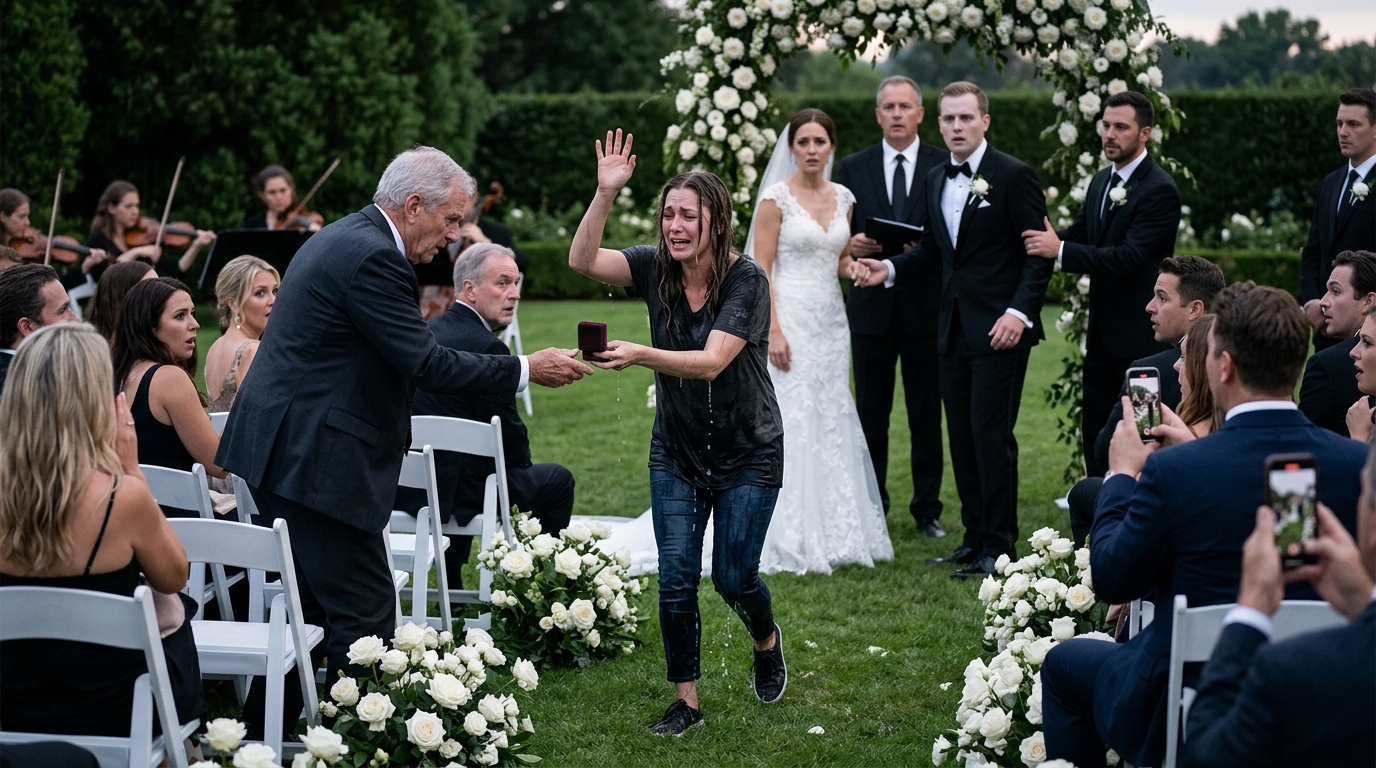
A woman stood at the end of the aisle, soaked through to the skin, water dripping from her hair and the hem of her dress. She looked exhausted in the way only people fueled entirely by panic and purpose ever do. Mud streaked one side of her coat. Her chest rose and fell too fast. And in both hands she clutched an old velvet ring box as if it were the only object in the world keeping her upright.
Adrian went pale.
Not startled.
Not irritated.
Pale.
That was the first thing I noticed.
The second was how quickly his groomsmen moved.
Two of them stepped off the platform immediately, not toward me, not toward the priest, but toward her—as if they already understood exactly how dangerous she was.
“Ma’am,” one of them said sharply, “you need to leave.”
She lifted the ring box higher.
“He already married someone with this ring ten years ago.”
The gasp that moved through the guests sounded almost animal.
Phones rose everywhere.
Not discreetly.
Not politely.
Hungrily.
My throat closed.
I turned to Adrian.
He opened his mouth.
Nothing came out.
That frightened me more than the woman’s arrival.
“What is she talking about?” I asked.
He still didn’t answer.
Then my great-uncle Henri rose from the second row.
Henri Laurent was eighty-one years old, half-blind in one eye, and the only man in my family who could make a room full of wealthy people fall quiet simply by standing up. He stepped into the aisle, took the velvet box from the woman’s hands before the groomsmen could stop him, and opened it.
I watched the color drain from his face.
His mouth actually trembled.
“This date…” he whispered.
He turned the ring toward the light.
“This ring was made for my daughter.”
The garden went still.
Not socially still.
Burial still.
Henri lifted his head and looked directly at Adrian.
“…the week she disappeared.”
I felt my blood turn cold in my veins.
Everyone in Bordeaux knew about Isabelle Laurent.
Henri’s only daughter.
My mother’s cousin.
The woman who vanished ten years earlier after what was supposed to be a brief engagement to a promising man from Paris.
The story had always been the same: she had run. She had broken under pressure. She left no note, no body, no explanation, just a vanished future and a family too ashamed to speak of her for long.
And now a drenched woman stood in the center aisle of my wedding, staring at Adrian as though fear itself had finally learned how to walk upright.
Then she whispered, tears shaking loose down her face:
“Because she didn’t disappear.”
I turned toward the man I was about to marry.
And for the first time since I had known him, I saw something in his expression that had nothing to do with love.
Calculation.
The Ring He Was Never Supposed To Wear Again
My name is Camille Laurent, and until that afternoon I believed I understood what danger looked like.
I thought danger was loud.
Obvious.
Drunk.
Crude.
Poorly dressed.
I had been wrong for thirty-two years.
The most dangerous thing in my life had worn navy cashmere, remembered anniversaries, and brought my mother orchids every time he came to dinner.
Adrian Vale was the sort of man who made women’s friends say things like, “You’re lucky. Men like that are disappearing.” He was measured, educated, generous in public, and just distant enough in private to seem wounded rather than hiding anything. He never shouted. Never overexplained. Never appeared surprised for longer than a second, which at the time I mistook for maturity.
Now, standing under white roses with half the city filming our collapse, he looked at the soaked woman and said the first thing since I had met him that sounded truly spontaneous.
“You shouldn’t have come here.”
Not:
I don’t know you.
Not:
She’s lying.
Not even:
This is insane.
You shouldn’t have come here.
The woman let out a broken, breathless laugh.
“No,” she said. “You just thought I’d be dead before I could.”
Someone behind me dropped a glass.
Henri still held the ring between thumb and forefinger, staring at the engraving inside as if reading a sentence carved into his own past. I stepped down from the platform before anyone could tell me not to.
The priest said my name once.
I ignored him.
I went straight to the woman.
Up close, she looked younger than I expected and older than she should have been. Maybe thirty-five. Maybe forty. Trauma ages people unevenly. One side of her face still held the softness of youth. The other carried a pale scar cutting from the temple down into the cheekbone. Her hands shook, but not with uncertainty. With effort. With the strain of getting to this moment alive.
“Who are you?” I asked.
She looked at me with such exhausted pity that my stomach turned.
“My name is Elodie Marceau,” she said. “And ten years ago, I was the nurse who signed Isabelle Laurent into Saint Agnes Recovery House under another name.”
Henri made a sound I had never heard from a grown man before.
Not grief.
Recognition mixed with regret.
Adrian stepped down then.
Too fast.
Too controlled.
“Camille, listen to me,” he said.
I turned sharply. “No. You listen. Who is Isabelle to you?”
He stared at me.
That infuriating pause again.
The one he always used when deciding which version of himself the room should receive.
Elodie answered for him.
“She was his wife.”
The word wife did not hit like a slap.
It hit like a collapse.
Around us, the guests erupted into whispers so loud they almost became weather. My mother covered her mouth. My father looked as though someone had driven a knife through the center of the afternoon and made him watch. Henri took one step backward and had to steady himself against a chair.
Adrian moved toward me.
“Camille, that is not the full story.”
I laughed.
Actually laughed.
A terrible sound.
“You hid a wife,” I said. “This seems like the kind of story that should have at least made the invitation list.”
“It was never legal in the way you’re imagining.”
Elodie’s head turned slowly toward him.
And she smiled.
Not kindly.
Not angrily.
Like someone hearing a liar return to a favorite instrument.
“You drugged her,” she said. “You locked her in a private clinic. You forged instability assessments and called it care.”
The phones rose higher.
Adrian saw them too.
For one instant, panic flashed across his face. Then the old mask came down again.
“This woman was dismissed for theft,” he said loudly, turning just enough for the guests to hear. “She has been stalking my family for years.”
A few heads shifted, uncertain.
That was his gift.
He didn’t just lie.
He offered people a way to stay comfortable while they believed him.
Then Elodie reached into her coat and pulled out something else.
A folded legal paper, damp at the edges.
She held it up.
“Then tell them why your name appears on the confinement order.”
Adrian stopped moving.
And I realized, with the sick precision of instinct catching up to evidence, that he had not built his life on one buried woman.
He had built it on paperwork.
The House Where They Buried Her Without Soil
We moved the guests into the reception pavilion because nobody knew what else to do.
That may sound absurd, but wealth has a way of continuing its logistics even while scandal bleeds across the linens. The quartet disappeared. The planner cried behind a hedge. Staff removed the champagne tower because apparently even catastrophe must leave room for practical elegance.
I did not change out of my wedding gown.
I did not sit.
I stood at the head of the long glass-topped table with Henri on one side of me, my parents on the other, the priest near the back, and Adrian across from all of us like a defendant auditioning for the role of victim. Elodie sat wrapped in a wool blanket one of the staff found in the bridal suite. Rain still dripped from the ends of her hair onto the white fabric.
Henri laid the ring box in front of him.
I could not stop staring at it.
The ring itself was old-fashioned—heavy gold, hand-cut diamond, the sort of piece commissioned by fathers who believe permanence can be bought and engraved. Inside the band was the date of Isabelle’s engagement dinner and the initials A.V. to I.L.
Adrian Vale to Isabelle Laurent.
There was no room left for ambiguity.
Henri spoke first.
“Tell me my daughter is alive.”
Adrian looked at the table.
He still did not answer directly.
That told us enough.
Elodie did.
“She was alive when I last saw her.”
The air changed again.
Henri closed his eyes.
His fingers curled so tightly around the arm of his chair I thought the skin might split.
“Where?”
Elodie took a breath.
“Saint Agnes Recovery House. Outside Limoges. It operated as a private psychiatric convalescence facility. Off-books patients, wealthy families, quiet women, no reporters.”
My father swore under his breath.
I felt myself go very cold.
“Why were you there?” I asked.
“Because I worked there,” Elodie said. “At twenty-five I thought private care meant discretion and prestige. I thought rich people only paid for privacy, not disappearance.”
She looked at Adrian when she said the last word.
“He brought her in himself,” Elodie continued. “Not the first time. The first time she came sedated from a villa outside Lyon with bruises under her collarbone and a wedding ring she would not let anyone touch. They registered her as unstable, post-traumatic, dangerous to herself. That story bought him time. When she tried to run, they moved her. When she got pregnant, they moved her again.”
I stopped breathing for a second.
Pregnant.
Henri’s head snapped up.
Adrian’s face changed.
Very slightly.
But enough.
Elodie saw it too.
“There,” she said softly. “That still scares you.”
I turned to him.
“She had a child?”
He finally looked at me.
And in that moment I understood something almost worse than the deception itself: Adrian had always believed he could outlast truth if he controlled the temperature of the room. Stay calm. Stay polished. Let everyone else get emotional first. Then they’ll look irrational, and you’ll look like order.
I hated him for how often that had probably worked.
“It’s complicated,” he said.
Henri stood.
The table rattled.
At eighty-one, with one hand trembling and the other braced against polished glass, he still managed to look like judgment wearing an old suit.
“No,” he said. “It is very simple. Where is my daughter?”
Adrian opened his mouth.
Elodie cut across him.
“She was moved six months ago.”
“To where?”
“I don’t know.”
Henri nearly collapsed back into his chair.
Then Elodie reached again into her coat and placed a brass key on the table.
“I only know where they kept her letters.”
The key sat between us all like a piece of old metal and a loaded weapon at once.
Adrian saw it and went white.
That frightened me more than anything yet.
“What does it open?” I asked.
Elodie looked at him.
Then at me.
“The blue cabinet in Adrian’s study.”
My pulse slammed against my throat.
Because three nights earlier, while final seating charts and floral disasters consumed the house, Adrian had told me very calmly that no one was to enter his study under any circumstances.
He said it was because he hated disorder.
I believed him.
Elodie’s voice dropped.
“She wrote letters to her father. To the police. To anyone she thought might still believe her real name. They intercepted them. Copied them. Sometimes burned them. Sometimes kept them, if the words were dangerous enough.”
Henri stared at the key.
Then lifted his eyes to Adrian one last time.
“If there is one letter from her in that cabinet,” he said, voice shaking with something beyond rage now, “I will spend whatever is left of my life making sure you do not die free.”
Nobody spoke after that.
Because we all understood the same thing at once:
the wedding was over.
The only ceremony left was truth.
The Letters In The Blue Cabinet
Adrian’s estate sat twelve minutes from the garden where he was supposed to have married me.
We arrived in a convoy of ruined appearances.
My father driving too fast.
Henri silent in the back seat with the ring clenched in his fist.
Elodie beside me, wrapped in borrowed wool, giving directions with the strained precision of someone dragging memory through fear.
Adrian in another car with two of my father’s security men and a lawyer already called in by someone who knew wealthy men never travel alone into consequence.
The study was exactly as I remembered.
Dark oak shelves.
A French writing desk.
A view over the western lawn.
And against the far wall, beneath a painting of hunting dogs and an autumn field, a narrow blue cabinet I had never seen open.
Elodie’s hand trembled as she fitted the brass key into the lock.
Click.
The sound echoed far louder than it should have.
Inside were files.
Neat.
Labeled.
Ordered.
That was the worst part.
Chaos would have horrified me less.
There were medical transfer forms under three surnames.
Invoices from Saint Agnes and two other institutions.
Copies of psychiatric evaluations written in language so sterile it nearly disguised the violence inside them.
Sedation records.
Transport manifests.
Notarized statements regarding “voluntary withdrawal from public life.”
And then, at the back, bound in gray ribbon, the letters.
Henri reached them first.
The first envelope bore his name.
Papa.
That single word nearly ended him.
He sat down without seeming to realize he had moved and opened it with fingers that no longer obeyed properly.
I looked away as he read.
Not out of politeness.
Because some grief should not be watched head-on.
My father handed me the next stack.
Several were addressed to police precincts.
One to a magistrate in Bordeaux.
Two to “anyone who still remembers Isabelle Laurent before he erased her.”
And one, at the bottom, to a name I did not recognize.
For Celine.
I turned the envelope over.
The wax seal had already been broken.
Inside was a short note written in shaking blue ink.
If you ever receive this, you are old enough to know he did not save you by taking you from me. He stole you by making sure I could not stand up in the room where they gave you another name. If they tell you I abandoned you, remember this: I named you before they renamed you.
Celeste.
My hands went numb.
I read the name again.
Celeste.
Not Celine.
Not Isabelle.
Celeste.
I looked up slowly.
Adrian had one younger sister.
Celeste Vale.
Nineteen years old.
Boarding-school polished.
Always introduced as the miracle his late mother “left behind.”
The age had always seemed strange to me.
Adrian was forty-one.
His father died young.
The family story around Celeste’s birth shifted depending on who told it—late-in-life surprise, complicated surrogacy rumor, a discreet adoption never fully clarified.
I turned to Elodie.
She was already watching me.
“She didn’t die pregnant,” I said.
Elodie shook her head.
Henri looked up from Isabelle’s letter as though pulled from underwater.
“What?”
The room felt suddenly unsteady.
I held out the note to my father first, then to Henri.
Adrian did not move.
He had gone completely still.
Which meant he knew.
Of course he knew.
I heard my own voice as if from somewhere farther away than the study walls.
“Celeste isn’t his sister.”
Nobody spoke.
I looked straight at Adrian.
“She’s Isabelle’s daughter.”
This time even he could not control his face.
There it was.
The crack.
The recognition.
The tiny involuntary collapse behind the eyes.
Henri made a strangled sound.
My father turned on Adrian with such naked disgust it transformed him. “You raised her in the same house,” he said, voice low and lethal. “As your sister.”
Adrian swallowed once.
“It was safer that way.”
The sentence actually seemed to stun the room.
Safer.
As if theft became shelter because he enjoyed the sound of the word.
Henri tried to stand too quickly and nearly fell. My father caught his shoulder. The old man’s face had gone gray, but his voice, when it came, had sharpened into something dreadful.
“You made my granddaughter call you brother.”
Adrian did not deny it.
I felt sickness rise in me so violently I had to grip the desk.
There are lies that shatter trust.
And there are lies that reveal the architecture of a soul.
This was the second kind.
But Elodie was already reaching for another file.
“No,” she whispered. “There’s more.”
Inside the last folder was a transport record dated six days earlier.
Patient transfer approved.
From: Saint Agnes Annex, House B.
To: Sainte-Mere Retreat, coastal unit.
Under escort: C. Vale.
Not Adrian.
C. Vale.
Celeste.
The room went cold.
Because in that instant we all understood something far worse than the old crimes sitting on the shelves.
The daughter Isabelle lost had grown up inside the lie.
And the daughter had helped continue it.
The Bride Who Was Never Meant To Ask Questions
We found Celeste in the winter garden.
She was sitting in a wicker chair beneath the glass roof, wearing a cream cardigan and reading as if the world had not shifted under every surname in the house. Eighteen years of expensive education and perfect grooming had given her a kind of softness that looked almost fragile until you noticed how carefully she watched every entrance.
When we came in, she looked up.
Her eyes moved first to Adrian.
Then to the files in my hands.
Then to Henri.
And something ancient and terrified passed over her face.
“Don’t,” Adrian said quietly.
It was the first time I had ever heard him plead.
Too late.
Henri stepped forward.
He had Isabelle’s letter in one hand and the gold ring in the other.
“Your name,” he said, voice breaking, “was never Vale.”
Celeste rose slowly.
I saw then what I had missed before—the line of her mouth was Henri’s. The shape of the brow, Isabelle’s from the old portraits in the Laurent corridor. It had all been there, softened by styling, obscured by story, hidden in plain sight because rich families can make almost any face belong anywhere if they attach it to the right last name early enough.
“No,” she whispered.
Henri held out the letter.
She did not take it.
“I was told my mother died in childbirth.”
Elodie made a sound like pain turned into breath.
Adrian stepped forward. “Celeste, listen to me.”
She turned on him.
Not slowly.
Violently.
And whatever she saw in his face finished the work the documents had begun.
“You knew.”
It was not a question.
He moved again. “I protected you.”
That was when she slapped him.
Hard.
The sound cracked through the winter garden like a pistol shot.
No one moved.
No one spoke.
Because everyone in that room understood the same thing: for the first time in years, Adrian had lost control of the script before he could hand out pages.
Celeste backed away from him as if realizing the man she called brother had curated not just her past but her entire identity like a locked room.
“All those years,” she said, voice shaking, “she wrote to me?”
Henri nodded once, tears streaming down his face now without dignity or restraint.
“She named you Celeste.”
The girl broke.
Not theatrically.
Not beautifully.
She folded in half as if the spine of her life had simply gone missing all at once. Elodie moved to her first and knelt beside her. I watched the nurse who had risked everything to bring truth to a wedding put one hand on the shoulder of the girl raised inside the lie she failed to stop years before.
There are moments when no one in the room is innocent, but some are still worth saving.
Celeste looked up through tears.
“Is she alive?”
Nobody answered quickly enough.
That was answer enough too.
Then Henri said, “We have a transfer order from six days ago.”
Celeste wiped her face with both hands so fiercely it looked painful.
“She hated the coast,” she whispered.
Every head turned.
She stared at the floor while the next words forced themselves out.
“They moved her three times while I was old enough to notice but too stupid to understand. Every time he called it care. Every time I asked too many questions, I lost privileges, schools, people. The last time I went with her, she said if I ever wanted to know whether she was mad, I should ask why the windows only opened from the outside.”
The room seemed to shrink around that sentence.
I crouched in front of her.
“Where did they take her?”
Celeste looked at me.
Then at Henri.
Then finally at Adrian, who had not moved since the slap.
“To Sainte-Mere Retreat,” she said. “Cliffside unit. Private wing. Under the name Elise Varn.”
Henri closed his eyes.
My father was already reaching for his phone.
Police.
Lawyers.
Orders.
Warrants.
Everything that should have happened ten years earlier began moving in those next sixty seconds.
But before anyone could leave, Celeste said one final thing.
“He’s not the one who signed the last transfer.”
We all turned.
She pointed, not at Adrian—
but at the doorway.
Where my mother stood, white as paper, one hand over her mouth.
And I realized, with a force that nearly buckled my knees, that I was not the first woman Adrian had chosen because she was useful.
I was simply the latest.
The Ring That Never Reached The Altar
My mother had known.
Not everything.
Maybe not at first.
But enough.
Enough to sign the last transfer.
Enough to preserve the wedding.
Enough to let me walk toward a man she had decided was still the better future compared to the scandal of breaking the engagement.
That betrayal will take the rest of my life to name properly.
Later, I learned her explanation.
She thought Isabelle was too damaged to return.
She thought Celeste’s identity would be destroyed.
She thought Adrian had done monstrous things once but could still become respectable if enough time passed and he married cleanly.
This is how families rot.
Not only through the people who commit evil.
Through the ones who call it manageable after enough years go by.
We reached Sainte-Mere after midnight.
Rain still lashed the cliffs below the retreat. The building sat above the sea like a monastery built by people who wanted privacy more than holiness. Lawyers arrived. Police arrived. A magistrate arrived half-dressed and furious that his evening had been disturbed until he saw the names attached to the warrants.
We found Isabelle in Room 14.
Sedated.
Thin.
Alive.
Henri made a sound I hope never to hear again for as long as I live. His daughter opened her eyes slowly under fluorescent light and, for one aching second, looked at all of us as if she had forgotten how many faces the world was allowed to hold.
Then she saw the ring in her father’s hand.
And began to cry.
Not because she was broken.
Because she recognized it.
The gold ring made for a wedding that turned into a disappearance.
The ring Adrian intended to use again under another floral arch, in another garden, on another woman who was supposed to help him outlive the truth.
Henri slipped it into Isabelle’s palm.
She closed her fingers around it.
And that was when I understood something clean and final: the ring had never belonged at my wedding.
It had only ever belonged to a story no one let her finish.
By dawn, Adrian was under arrest.
Not elegantly.
Not quietly.
Not the way men like him expect consequence to arrive.
My mother sat in a police interview room wrapped in a blanket that made her look suddenly much older than I had ever allowed her to become in my mind. Celeste remained at Sainte-Mere with Henri and Isabelle, not as granddaughter returned whole, not yet, but at least no longer disguised as someone else’s miracle.
And I went back once to the garden.
The chairs still stood in straight white lines.
The roses had sagged from the rain.
My bouquet lay where someone had dropped it near the aisle.
The ring I was meant to wear never touched my hand.
People asked later whether I felt humiliated.
No.
Humiliation belongs to people who were exposed.
I was not exposed.
I was interrupted.
Saved, if I’m honest enough to use the word.
The soaked woman who destroyed my wedding did not ruin my life.
She returned it to me before it could be fastened shut by a gold band already engraved with another woman’s disappearance.
And in the weeks that followed, as statements became charges and letters became evidence and a family I thought I understood learned to say Isabelle’s name again without lowering its voice, I kept thinking about the moment under the roses when Elodie first lifted that velvet box.
Everyone thought she had brought scandal.
She hadn’t.
She brought a witness.
A ring.
A date.
And the one sentence no man like Adrian ever expects to survive him:
She didn’t disappear.