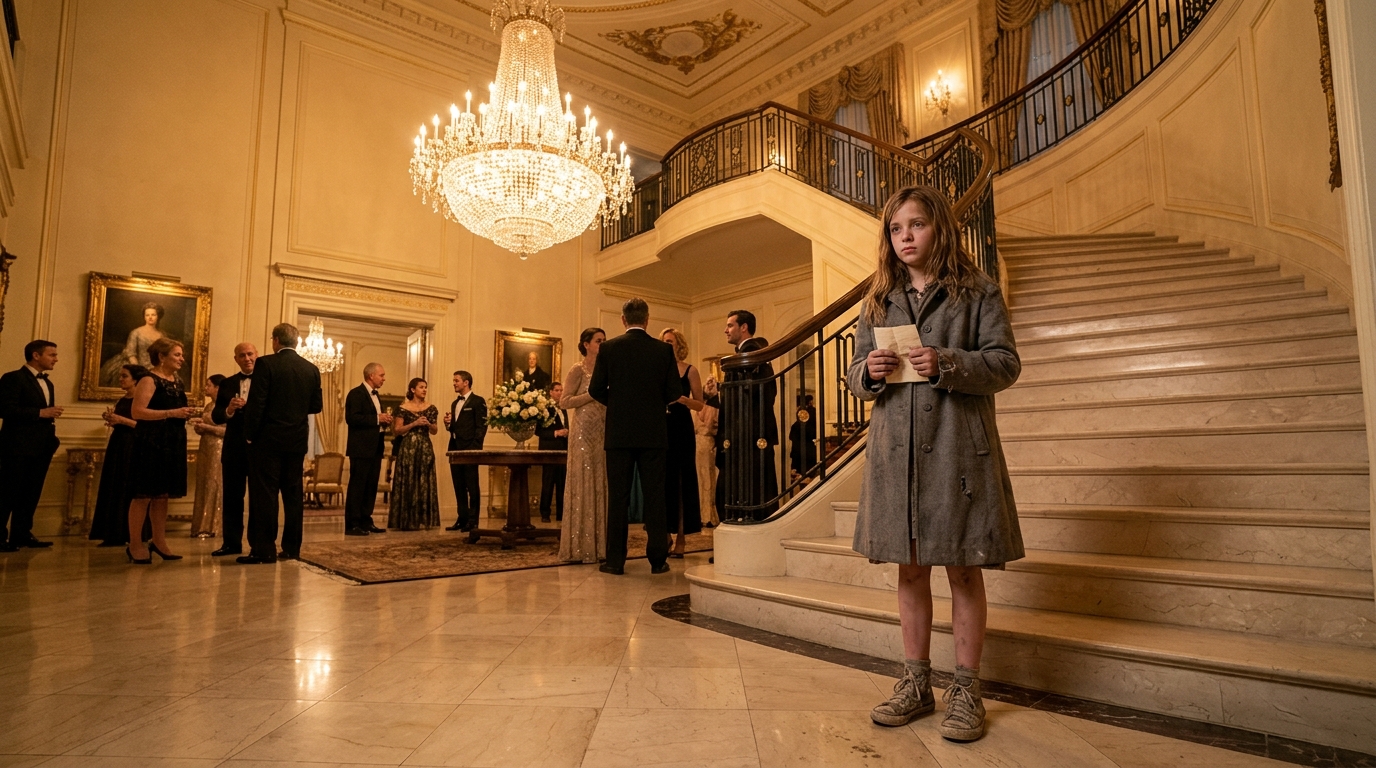
The Girl Beneath the Staircase
The mansion always looked most dishonest under chandeliers.
Blackwood Hall had been designed to make old money feel immortal. Crystal light poured down over marble floors polished to a liquid shine. Gold-framed ancestors watched from the walls with their practiced expressions of permanent entitlement. Footmen moved silently through the room carrying silver trays of champagne as if even gravity obeyed our family name.
It was my grandmother’s winter gathering, the kind of glittering evening where people dressed as though sorrow had never touched their bloodline. Investors laughed too loudly near the fireplace. Wives in emerald silk traded secrets under the balcony. My cousin Arabella was standing at the base of the grand staircase in white satin, seventeen years old and already wearing cruelty like inherited jewelry.
Then the front doors opened.
A little girl stood there.
Not more than nine, maybe ten.
Worn shoes.
Thin coat.
Hair hacked short with the uneven bluntness of a knife or bad scissors.
And in both hands, clutched so tightly the paper shook, an old folded photograph.
At first I thought she had wandered in by mistake.
Then I saw her face.
Not confusion.
Purpose.
The kind only frightened children and dying people ever seem to carry.
The laughter around the room faltered when the nearest guests noticed her. A few turned openly. Someone near the piano lifted a phone and began recording before they had even decided what kind of scandal this might become.
Arabella saw her next.
And smiled.
It was a small smile. Cruel in the way only the very protected can afford to be.
“Amazing,” she said, loud enough for half the hall to hear. “Even abandoned children can smell an inheritance.”
A few guests laughed.
Not because it was funny.
Because wealthy people have a reflex for cruelty when they think it is socially safe.
One of the footmen started toward the girl. I was about to intervene when the child raised the folded photograph higher against her chest, as if that single object were the only thing keeping her upright.
“My mother said,” she whispered, voice so soft I barely caught it, “I had to bring this here if no one came back for me.”
Arabella’s expression sharpened with interest.
“Oh, this should be entertaining.”
She stepped forward before I could stop her, plucked the photograph from the child’s hands, and snapped it open with a mocking little flourish.
Her smile vanished.
I saw the change from where I stood.
It was immediate.
Cold.
Not confusion. Recognition.
The photograph was old, sepia-toned, mounted on heavy card stock the way portraits were twenty or thirty years ago. It showed the front hall of Blackwood under the same staircase, the same carved banister, the same oil portrait of the stag hunt in the background. A whole family posed in formal dress.
But one face had been burned out.
Not torn.
Not faded.
Burned.
Deliberately.
You could still see the blackened edges around the oval where a child had once stood.
Arabella went very still.
I crossed the room in four long steps and took the photograph from her hand.
The date stamped in the lower corner hit me first.
October 12.
Three weeks before the fire.
The fire had been the story our family told for twenty years.
The tragic blaze in the east nursery wing.
The missing child presumed dead.
No remains recovered because the collapse had been too severe.
A family grief too painful to discuss.
And yet here was a portrait taken before that fire with the child already erased from it.
A hand trembled beside me.
My grandmother, Agnes Ashcombe Vale, had risen from her chair by the fireplace. Her face had drained so completely of color that for one terrible second she looked less like an old woman than a ghost discovering its own body had been buried under the wrong name.
She stared at the photograph.
Then at the little girl.
Then back at the burned hole in the portrait.
And in a whisper full of horror, she said, “That missing child was never dead.”
The room went silent.
Her next words were even quieter.
“She was hidden.”
The crystal in the chandeliers didn’t move.
The musicians stopped touching their instruments.
Even the phones lowered.
Because everyone in that room understood, at exactly the same time, that this had just stopped being an awkward interruption.
It had become a family wound opening in public.
And when I turned the photograph over, I found something else on the back that made my blood go cold.
A name.
Written in a shaking hand.
Marianne.
The Face Burned Before the Fire
I took the child into the blue drawing room before anyone could think to send her away.
Arabella tried to follow us.
I shut the door in her face.
The girl flinched at the sound.
Not dramatically. Just enough for me to notice that doors slamming did not strike her as ordinary noise. They meant something to her. Fear had already trained her body.
I knelt so we were level.
“My name is Julian,” I said. “What’s yours?”
She hesitated.
Children who have learned to ration information always pause before names.
“Ivy.”
Her hands were empty now, and without the photograph in them she looked smaller. More breakable. Her coat sleeves were too long. One knee of her tights had been repaired with thread of three different colors. There was dried mud on the hem and a bruise yellowing at her jawline.
“Where is your mother?”
That question changed her face.
“I don’t know.”
Not crying.
Not yet.
Worse than that.
She had said the sentence too many times already.
“She told me to wait by the bakery until dark,” Ivy whispered. “If she didn’t come back, I had to take the picture here. She said if the lady with the white hair saw it, she’d know.”
My grandmother.
I looked down at the photograph again.
The family in it was easy enough to identify despite the age. A younger Agnes in black velvet. Her second husband, Lucien Vale, severe and handsome in the way old predators often are. Their son Victor as a boy. Two servants in the background. And the burned space near Agnes’s knee where a child should have been.
Marianne.
The name struck something dim in memory.
I had heard it only once, years earlier, from a half-drunk gardener who lost his position the following week. He had called the east wing “Marianne’s corridor” and crossed himself afterward as though the words themselves might summon consequences.
I asked Ivy where her mother got the picture.
“She kept it wrapped in cloth,” Ivy said. “Under the mattress where we slept. She said if anybody took everything else, not to let them take this.”
“Did she ever tell you who Marianne is?”
Ivy looked toward the door, then back at me.
“She said it was her name before they buried it.”
The sentence hit me hard enough that I sat back on my heels.
Before they buried it.
A knock sounded at the door.
Three short taps.
My grandmother’s pattern.
I opened it.
Agnes stepped inside with her cane in one hand and the old, trembling dignity of very rich women in the other. Up close, she looked shattered. Her lower lip would not stop quivering. I had not seen my grandmother frightened since my grandfather’s funeral.
She reached toward Ivy slowly, as though approaching a wild animal that might bolt.
“What was your mother called?” Agnes asked.
“Lena,” Ivy said. “Sometimes Mara, when other people were around. But when she was sick, she’d say Marianne.”
My grandmother closed her eyes.
A sound escaped her that I had never heard before.
Not grief.
Recognition with twenty years of delay in it.
“When the fire happened,” she whispered, mostly to herself, “Lucien would not let me see the body. He said there was nothing left to bless.”
I stared at her.
“Grandmother… Marianne was real?”
Agnes turned to me and for the first time in my life I saw naked guilt on her face.
“Marianne was my daughter.”
I felt the room tilt.
Not granddaughter.
Not a cousin I had forgotten.
Her daughter.
Which meant the story we had all been told—that Victor had been her only child, the foundation of the current line—was a lie so old it had calcified into family architecture.
“From your first marriage,” I said.
She gave a tiny nod.
Before Lucien Vale.
Before Blackwood Hall became more his than hers.
Before the Ashcombe fortune was folded into the Vale name and presented to the world as seamless inheritance.
A child from the first marriage would have complicated everything.
No.
Not complicated.
Displaced.
“Lucien told everyone she died,” Agnes whispered. “I believed him because I was ill. They kept me sedated after the fire. By the time I could stand on my own, the nursery had been sealed and her name was gone from the walls.”
I looked down at the photograph again.
The burn mark was clean, deliberate, surgical.
Someone had erased Marianne before the story of her death was even created.
And that meant the fire had never been an accident.
The moment that thought fully formed, I remembered something hidden where no one had touched it in years.
The archive room.
Locked since Lucien died.
And inside it, if I was right, the only papers in the house old enough to remember Marianne before the family decided not to.
When I stood, the photograph slipped slightly in my hand.
Something crackled inside its fold.
A second paper had been hidden in it.
I pulled it free.
It was a receipt.
Recent.
From Briar Hill Private Rest House.
And stamped across the top in dark blue ink was a date from that morning.
The Locked Archive Room
Blackwood Hall keeps its secrets below the library.
Not in cellars.
Cellars are too obvious.
The real secrets live behind walnut paneling, through a narrow iron gate, down a stone passage that smells of dust and wet mortar even in summer. Lucien believed in physical barriers. He liked locks you could feel, rooms that could still pretend modern law had not reached them.
I took the key ring from my grandmother myself.
Her hand shook when she gave it to me.
“Lucien changed the inner code after Marianne disappeared,” she said. “But he never knew I watched him once through the glass.”
The archive room opened with a groan like something waking badly.
Ivy stayed close to my side as we stepped in. Agnes followed more slowly, leaning hard on her cane. Shelves climbed to the ceiling on every wall. Ledgers. title books. estate maps. marriage contracts. trustee minutes. Old families bury bodies in cemeteries and motives in paperwork.
I found Marianne faster than I expected.
Not because her file was intact.
Because someone had removed it badly.
There was an empty gap between MARSH and MERRICK where a bound volume should have stood. Dust marked its outline clearly. Beside it sat a registry ledger from twenty-three years ago with several pages razor-cut out.
But people who erase records always miss their shadows.
In the drawer below the shelving unit, beneath old tax assessments and wine inventories, I found the duplicate index cards Lucien had never believed anyone would check.
Marianne Ashcombe.
Born 14 March.
Primary issue of the first settlement.
Protective succession line.
I stopped reading.
Then read that last line again.
Protective succession line.
I pulled the first marriage settlement next.
The language was brutal in the way old legal documents sometimes are: property, voting rights in the Ashcombe Foundation, and controlling interest in Blackwood Hall were all held in trust for Agnes Ashcombe and then to her firstborn child and lawful descendants. If that line survived, later issue from Agnes’s second marriage had residential privilege and managed distributions—but not true inheritance.
Not ownership.
Not title.
Not legacy.
Privilege.
Which meant Victor never should have inherited control.
Which meant Arabella’s glittering certainty had always rested on borrowed floorboards.
And it got worse.
Tucked inside the settlement was a packet of more recent payment slips.
Monthly transfers.
Private.
Unregistered.
Authorized under household medical maintenance.
Destination: Briar Hill Private Rest House.
Patient alias: Mara Wynn.
Ivy saw the name and grabbed my sleeve so hard her nails bit skin.
“That’s her,” she whispered. “That’s what they called her there.”
There.
Not once.
Repeatedly.
My stomach turned.
For twenty years, someone in this family had been paying a private institution to keep my grandmother’s daughter alive and off the record under another name.
Agnes made a strangled sound behind me.
I turned.
She was staring not at the slips, but at the smaller note paper-clipped to the newest transfer.
Transport approved.
Return to house for signature if necessary.
Use east infirmary.
My blood went cold.
Return to house.
Today.
Ivy’s mother had come here.
Or been brought here.
I flipped to the driver logs.
One entry, written that morning in the house manager’s narrow hand:
Briar Hill collection — Mrs. Celeste Vale authorization — 9:10 a.m.
Celeste.
Arabella’s mother.
Victor’s widow.
The woman who had spent ten years teaching the house to behave as if Arabella were the unquestioned future of Blackwood.
She had not just known.
She was active in it.
And if Marianne had been brought back to the mansion that morning and never returned to Ivy by evening, there was only one reason.
They needed something signed.
A surrender.
A release.
A waiver.
The legal kind of murder old families prefer.
I looked at the east infirmary map pinned beside the utility records.
The room had been closed for years after water damage.
Officially.
Unofficially, it sat at the end of a service corridor no guest ever used and no one inspected unless ordered.
I took the driver sheet, the payment slips, and the settlement papers.
Then I turned to Ivy.
“Your mother is here.”
Her face went blank with shock.
Not relief.
Children who have lived with disappearance know better than to trust hope on the first offering.
Agnes gripped the edge of the table so hard her knuckles flashed white.
“She must never sign anything,” she said. “Julian, if Celeste has her drugged—”
The lights flickered.
Just once.
Then steadied.
Somewhere above us, the orchestra began to play again as if the house itself were trying to cover its own pulse.
I shoved the papers inside my coat.
And for the first time that night, I was no longer afraid of what the truth might cost our family.
I was afraid of being too late.
The Woman In The East Infirmary
The east corridor had been painted over three times and still smelled abandoned.
Most of the mansion glowed with restored wealth—wax, polish, expensive warmth. This wing was different. The wallpaper peeled at the seams. The sconces were dim. A thin medicinal odor rode the colder air, faint but unmistakable.
Someone had been using the infirmary.
Two housemaids were outside the door when we arrived. They both jumped when they saw me, then glanced at one another with the quick shared panic of employees who know exactly when an instruction is about to become evidence.
“No one is to enter,” one of them said.
“Move,” I said.
“Mrs. Vale said—”
I opened the driver log in front of her face.
“Move.”
Behind me, Agnes’s cane struck the floor once.
That did it.
The maids stepped aside.
The infirmary door was locked from the outside.
I still remember that detail more clearly than I want to.
Locked from the outside.
I turned the key and pushed.
The room beyond was small and white and wrong.
Curtains drawn.
Medicine tray.
A narrow bed.
And on the bed, propped against two pillows as if someone had tried to make captivity look clinical, was a woman with my grandmother’s eyes.
She was thinner than I expected.
Older than the photograph but younger than her years should have made her. Trauma freezes some people strangely. It leaves parts of the face untouched and ruins others. Her hair had been cut blunt at the jaw. There was a scar at her temple disappearing into the roots. One wrist was cuff-marked purple. And when she saw Ivy in the doorway, every line of her body tried to rise at once.
“Ivy—”
The word broke on the way out.
Ivy ran to her.
Not carefully.
Not cautiously.
Straight to the bed, into her mother’s arms, with the kind of sound children make only when terror has been holding its hand over their mouths for too long.
Marianne clutched her so fiercely I had to look away for a second.
Agnes did not look away.
She stumbled forward like a woman walking through the wreckage of her own afterlife.
“Marianne.”
Her daughter stared up at her.
And whatever she had prepared herself for, it was not this.
Not age.
Not remorse.
Not the mother who had buried her without meaning to.
For a long moment no one spoke.
Then Marianne said, very quietly, “You believed them.”
Agnes flinched as if struck.
“Yes,” she whispered. “And I have been paying for that ignorance every year since.”
It was not enough.
Nothing would have been enough.
But Marianne closed her eyes once, and when she opened them again the fury in them was old, tired, and no longer surprised.
“Celeste wanted me to sign a waiver,” she said. “She said if I gave up any claim and confirmed I had lived under care voluntarily, Ivy would be placed in a home and fed properly.”
I felt sick.
“She said I owed the family silence because they kept me alive.”
The sentence hung in the room like poison.
“What did Briar Hill do to you?” I asked.
Marianne gave a small, humorless laugh.
“What institutions always do when rich people pay for quiet women. Sedation. Isolation. New names. Friendly lies on the forms.”
Ivy buried her face harder against Marianne’s shoulder.
“She got me out three years ago,” Ivy whispered into the blanket. “We slept in shelters and churches. Then Mama said we had to come back because the old lady had to know.”
Agnes covered her mouth.
I knew then that whatever was left of the evening upstairs was already over.
The only question was whether the lie would die quietly or drag half the house down with it.
Marianne gripped my wrist suddenly.
“There’s more,” she said. “Lucien kept a second will in the green dispatch box. Celeste was looking for it. If she finds it first, she’ll burn it.”
I knew the box she meant.
My grandfather’s writing desk in the ballroom study.
Unlocked during family events because Celeste liked showing guests old things she did not understand.
Above us, the orchestra cut off mid-phrase.
Voices rose.
Then stopped.
Someone had realized the center of the evening had shifted out of the drawing room and into the rot.
I looked at Agnes.
She gave one sharp nod.
No more hiding.
No more corridors.
No more infirmaries.
We were going back upstairs.
And this time, the entire house was going to hear the truth in one room.
The Name That Stopped Belonging To Them
When we entered the great hall again, the guests parted before us.
Not out of kindness.
Out of instinct.
Truth has a smell to it. Even the pampered recognize it when it begins to burn.
Marianne walked slowly, one arm around Ivy, the other braced on my elbow. Agnes came on her other side like something old and regal returning from burial. Behind us trailed the two maids, pale and terrified, and the house physician who had just discovered his private sedation orders were about to become public property.
At the base of the staircase stood Celeste and Arabella.
Mother and daughter.
Both white with a fury they were trying very hard to keep elegant.
For one strange second, the photograph, the child, and the women from the infirmary aligned in the same frame under the chandeliers.
The room could finally see the shape of the lie.
Arabella, with her perfect posture and generations of practiced entitlement, looked suddenly what she had always been.
A girl standing in someone else’s place.
Celeste spoke first.
“Julian,” she said, as though tone alone might still make me manageable, “this has gone far enough.”
I took the green dispatch box from the study table and placed it on the center dining table where everyone could see.
“It has gone exactly far enough,” I said.
The key was still tucked in the lining, just where Marianne said it would be.
Inside lay Lucien’s second will.
Also inside lay three sealed letters and a set of witness affidavits from the solicitor who had resigned the same week Marianne “died.” He had written the truth before disappearing into respectable retirement: that Lucien intended the Ashcombe fortune to remain under his branch’s practical control, and Marianne’s existence made that impossible. The fire was to create legal confusion. The institution was to create absence. Time was to do the rest.
Agnes took the will from my hands.
Her voice shook only once before hardening into something stronger than age.
“I, Lucien Vale,” she read, “acknowledge that the lawful succession of Blackwood Hall and associated Ashcombe interests remains vested in Marianne Ashcombe and her descendants, though public exercise of said rights must be delayed for the preservation of household order.”
A sound moved through the room.
Disgust, perhaps.
Or maybe recognition that the ugliest evil is often phrased as management.
Celeste lunged forward. “That document is not operative.”
“It doesn’t have to be,” I said. “The first settlement is.”
I laid the original marriage trust beside it. Then the Briar Hill payments. Then the driver log. Then the unsigned waiver Celeste had prepared and left in the infirmary cabinet.
All the clean little instruments of quiet theft.
Arabella looked from the papers to Marianne, then to Agnes, then finally to Ivy.
“No,” she whispered.
Not because she loved any of them.
Because she understood math.
If Marianne lived, if Ivy existed, if the Ashcombe line had survived, then everything Arabella had said beneath those chandeliers—about inheritance, about belonging, about abandoned children smelling wealth—had just rebounded on her with perfect cruelty.
Agnes turned to her.
“The house was never yours to promise,” she said.
No one laughed now.
No one recorded.
That was over.
The spectacle had crossed the line into consequence.
Celeste tried one last tactic.
Tears.
They arrived beautifully.
Too late.
“You don’t understand what Victor was told,” she said. “He believed she was unstable. He believed keeping her away protected everyone.”
Marianne looked at her with a stillness far more frightening than rage.
“You forged my signatures for twelve years,” she said.
Celeste stopped crying.
Because there are accusations that do not invite performance.
They end it.
I had already called the police from the east corridor. I heard them before I saw them—boots on stone, clipped voices at the entrance, the old butler finally choosing a side loudly enough to matter.
When the officers entered, the hall did not erupt.
It narrowed.
One officer took the documents. Another stepped toward Celeste. The physician began explaining far too much, which is how guilty professionals often sound when they realize the room has changed owners.
Ivy stayed pressed against Marianne’s side.
Arabella took one step backward and nearly missed the first stair.
For the first time all night, she looked her age.
Seventeen.
Spoiled.
And suddenly terrified that the story she had worn as identity might collapse without leaving anything underneath.
Agnes moved to the center of the room and faced the guests.
“I ask every person here,” she said, “to remember what you saw before dinner. A child in worn shoes was mocked for smelling inheritance. Yet it was my own house that had lived for twenty years on the scent of theft.”
No one answered her.
They didn’t need to.
The silence did the work.
Later, much later, after the police had taken statements, after Celeste had been led out without her diamonds, after the documents had been photographed and sealed, after the guests left in clumps of hushed scandal and professional caution, I stood with Marianne and Ivy in the now-quiet hall beneath the staircase from the photograph.
The same staircase.
The same carved rail.
The same place where a child had once been burned out of the family image before anyone dared call it death.
Ivy looked up at the portrait wall.
“Do I still have to leave?” she asked.
Marianne closed her eyes.
Agnes answered for her.
“No,” she said. “Not unless you choose to.”
Then she reached for Ivy’s hand with the care of someone touching the future after mistaking it for a ghost.
That was the moment I understood what inheritance really is.
Not marble.
Not ledgers.
Not chandeliers pouring gold over liars.
Inheritance is the name that survives the people who tried to erase it.
And that night, in the house that had hidden her mother and mocked her hunger, a homeless little girl walked back under the staircase carrying nothing but a photograph—
and left with the one thing they had spent twenty years trying to steal from her.
Her place.